Supernatural, the show about two brothers beating the crap out of monsters every week, got darker and more interesting through Seasons 3 and 4.
Season 3 dealt with Sam and Dean Winchester trying to simultaneously fight an army of demons that had been unleashed on earth, and figure out a way to evade a particularly nasty deal with the devil. I actually liked Season 3's storyline a lot (especially its character arc for Dean) and thought it would have benefitted from the writers compensating for the season being cut short by the writers' strike by delivering many more character-centred episodes.
As it was, Season 3 contained many what I call 'bookend' episodes - a character issue is presented in a scene at the start of the show, the events of that episode's hunt unfold (with maybe an occasional reference to that character issue), and then in a dramatic scene at the end (usually a conversation between the two brothers in their car) the issue is progressed or resolved. That structure felt very unsatisfying, and only the fact that many Season 3 episodes were FRACKING GREAT (Mystery Spot, Jus in Bello, A Very Supernatural Christmas) compensated for it.
Season 4, however, changed all this. Rather focusing episodes around a monster of the week, the writers started breaking stories by deciding on the issue in the brothers' relationship they wanted to showcase, figuring out the emotional beats of that story, and then designing a monster around that. As a result the show began to feel like it was drawing from the best work of Freaks and Geeks and Everwood, as well as any number of monster of the week series.
Even the bookend episodes are better (as a result of this change). Take something like Episode 4, which deals with Dean's suspicions about Sam's blood, and the question of whether people can choose to not be a monster gets strongly. That issue gets set up at the start, and the writers take quite a long time establishing it, until we really feel it. And then that issue is not only present in the monster, but addressed in actual scenes between the brothers during the episode. Sure, it's pretty on the nose, but it's also satisfying.
The tone of the show has become darker, a bit more sombre. There are still wisecracks, but taking itself more seriously. And it's more satisfying as a result.
The show grows stronger and more interesting throughout the season. By halfway through, I felt it had become a dark, funny, slightly morally complex war story. By the end of the season, I felt it was teaching me how to write TV - treating its characters with respect while being unafraid to damage them, and exploring exactly how much series mythology and continuity the show could stand.
Whereas Seasons 1, 2, and 3 had ... patchy episodes, Season 4 is pretty much strong across the board. In fact, the episode 'The Monster at the End of This Book', manages to combine hilarious entertainment with an such an unbelievable amount of meta (while being vital to the show's mythology) that I'm going to use it as a touchstone for the series I'm currently developing.
Grades so far:
Season 1: B- (except for the finale, which is an A+)
Season 2: B+
Season 3: B (but contains a couple of A+ episodes)
Season 4: A
.gif)
Tuesday, October 27, 2009

Monday, October 19, 2009
Crafty Screenwriting: Summary
Back in August I took a little dip into Alex Epstein's book 'Crafty Screenwriting'. I was looking to see if it had anything to add to the ideas about how to create stories that I'd been reading in 'Presentation Zen' and 'The Elements of Persuasion'.
It was another case of doing three blog posts and not much synthesising of the ideas. So I thought I'd start to rectify that by doing a summary of my summary of 'Crafty Screenwriting'. While there's a lot in the book that I didn't cover, I did write about hooks, pitching, and the elements of a story.
Hooks
A Hook is a brief description of your story that intrigues the audience into wanting to know more.
I keep reading about reducing your story or presentation down to its core idea, to a single catchy phrase. There's a reason for this: we all have multiple demands placed on our attention every day, so how do you cut through the noise and make someone pay attention to you?
You have to make them want to know what happens next.
Hooks make people want to see how things turn out. That means they're simple, intriguing, and a fresh idea.
Pitching
For as long as possible, DON'T write your story down. Instead, actually tell it to people.
That's the best way to find out if your hook or story works. Tell it out loud, over and over again, to whoever will listen. See what people respond to. And because you're not writing it down, you can see what bits of your story are memorable and stick in your head - and at the same time, you can hear when YOU get bored or confused while telling it.
Telling your story to everyone forces you to create a story that's so simple, clear and logical that you can remember it.
Here are three questions to think about while you're telling your story:
And if the idea of telling someone your story completely freaks you out, you can:
Here's the summary of what Crafty Screenwriting says are the elements that make up a compelling story:
A MAIN character
... who has a GOAL that we (the audience) care about.
... The main character is RISKING a lot
... and they have at least one but ideally three basic OBSTACLES in their way:
We need to care about the character's goal, whether it's internal (psychological, emotional) or external (save the world, fall in love). A person may be a jerk, but if we can admire or get behind their goal, then we can root for them as a protagonist.
NB: Characters without goals lead to stories without drama.
The main character is risking something; they have something to lose that is worth caring about.
What makes us care about that possibility of that loss? This is what I've extrapolated from Crafty Screenwriting: The hero (who's someone we care about because we identify with them or want to be with them) is now at risk of being transformed, harmed, or losing something vital to their life. They are in play; the thing that they are risking is (essentially) something that's core to their identify.
The hero is at risk of being changed, fundamentally and for the worse.
It was another case of doing three blog posts and not much synthesising of the ideas. So I thought I'd start to rectify that by doing a summary of my summary of 'Crafty Screenwriting'. While there's a lot in the book that I didn't cover, I did write about hooks, pitching, and the elements of a story.
Hooks
A Hook is a brief description of your story that intrigues the audience into wanting to know more.
I keep reading about reducing your story or presentation down to its core idea, to a single catchy phrase. There's a reason for this: we all have multiple demands placed on our attention every day, so how do you cut through the noise and make someone pay attention to you?
You have to make them want to know what happens next.
Hooks make people want to see how things turn out. That means they're simple, intriguing, and a fresh idea.
Pitching
For as long as possible, DON'T write your story down. Instead, actually tell it to people.
That's the best way to find out if your hook or story works. Tell it out loud, over and over again, to whoever will listen. See what people respond to. And because you're not writing it down, you can see what bits of your story are memorable and stick in your head - and at the same time, you can hear when YOU get bored or confused while telling it.
Telling your story to everyone forces you to create a story that's so simple, clear and logical that you can remember it.
Here are three questions to think about while you're telling your story:
- Is your listener interested in your hook at all? If not, then (a) rephrase it and try again, or (b) come up with a better idea.
- What does it remind them of? Check these other, similar stories out.
- What do they tell you? They may have ideas and criticisms. Listen to them. Even if they're off-base, you'll find out what sort of things they expected to hear or see when you told them your pitch.
And if the idea of telling someone your story completely freaks you out, you can:
- tell it to yourself
- write down the basic beats of the story on cards, mix the cards up, and try to put them back together in the right order
- (... or my favourite) write your story down. Hide those pages. Rewrite it again from memory. Hide those pages. Repeat.
Here's the summary of what Crafty Screenwriting says are the elements that make up a compelling story:
A MAIN character
... who has a GOAL that we (the audience) care about.
... The main character is RISKING a lot
... and they have at least one but ideally three basic OBSTACLES in their way:
- An External Antagonist or Obstacle: We have to care about the antagonists, even if they're an obstacle (like crossing the Antarctic)
- An Intimate Opponent: Someone on the main character's side who is working at cross-purposes to them.
- A Tragic or Comic Flaw (A Psychological Opponent):
- their situation is familiar to us
- we want to walk in their shoes
- we find them fascinating and want to know what they'll do next
- they're caught in a dilemma and we want to know how they'll resolve it (Tony Soprano trying to negotiate between the pressures of his criminal life and his family life - which is also a 'family situation: job vs. family)
We need to care about the character's goal, whether it's internal (psychological, emotional) or external (save the world, fall in love). A person may be a jerk, but if we can admire or get behind their goal, then we can root for them as a protagonist.
NB: Characters without goals lead to stories without drama.
The main character is risking something; they have something to lose that is worth caring about.
What makes us care about that possibility of that loss? This is what I've extrapolated from Crafty Screenwriting: The hero (who's someone we care about because we identify with them or want to be with them) is now at risk of being transformed, harmed, or losing something vital to their life. They are in play; the thing that they are risking is (essentially) something that's core to their identify.
The hero is at risk of being changed, fundamentally and for the worse.
Thursday, October 15, 2009
Movies: August to October
My Neighbour Totoro really deserves the warm fondness that Jenni and Svend use when they talk about it. To me, it felt like an essential film in building up my understanding of Japanese fairytales and its spirit world. There is also a scene at a bus stop which plays out an incredibly audacious intersection between our normal world and the spirit world; the whole movie slowly, plausibly builds up the idea of spirit creatures living in the forest ... but this scene is simply incredible in the way it matter-of-factly brings Totoro in the lives of the main characters.
Bruno is pretty much a masterpiece of script writing. Much like Raiders of the Lost Ark, it features a protagonist who believes he's competent but who fails at every single turn. Bruno has an outer motivation of becoming a celebrity and an inner motivation of finding true love - and the film brings both of those motivations (and Bruno's dominant character trait of outrageous hyper-homosexuality) together for a draw-dropping climax. The only problem for me was that I felt many of the comedic set-pieces featured people who were in on the joke. So, the script = great; the candid camera stuff veered between okay and freaking brilliant. I now want to check out Borat.
Desperation adapts a very large Stephen King novel into a tele-movie. That means a TV budget, so instead of an actor like Terence Stamp or 1980s Peter O'Toole playing Johnny Marinnville, you have Tom Skerrit. Which, I admit, is an interesting choice. The film feels forced, in that typical Mick Garris way, with lots of extreme camera angles and stupid jump scares (a slot machine that pours blood? Really? He didn't get enough of that bullshit when he had the cash register ring up 'No Sale' in the mini-series version of The Shining?). In fact, by about halfway through I felt that Desperation was taking its visual cues from a Resident Evil game, rather than 100 years of cinematography.
On the plus side, Desperation's score has a simple memorable main theme, and it contains a couple of great flashbacks and an amazing establishing shot of the mine at the story's centre. Overall, though, I felt it rushed through the emotions of the book: there were quite a few instances where I didn't feel for the characters, or where the story moved along so fast that it was hard to follow. Also, this is a story that is very much about God ... and unfortunately God's presence in the film felt cosmetic to me, rather than heavy and urgent. All-in-all, I think this one is ready for a smarter version with a slightly bigger budget.
Weird thing about that music - it reminds me a lot of the theme from Moon; there are a lot of interesting parallels that I lack the vocabulary to describe accurately. Here's the first 10 minutes of Desperation (the music is in the first minute thirty):
http://www.youtube.com/watch?v=xXVIwB6Gi_8
(There's no embed for this, unfortunately.) Now, here's the trailer for Moon - and beware! Spoilers. If you haven't seen Moon yet, I wouldn't watch this.
District 9 is great fun. Mostly an excellent film, with frequent moments of awesome and occasional bursts of greatness. Warning: Contains action, aliens, robots, racists and an extremely funny pig. My favourite thing about the film was the inexorable escalation of violence between the different factions as the movie pushed its way towards the end - there was a great moment where I realised, "But if they do that, then the Nigerians would have to do this, and that would mean the MNU would have to respond like this ... oh shit!" Cue an extremely satisfying finale to an impressive film.
Coraline was remarkably more subdued than I expected. For most of the movie I didn't quite feel a sense of excitement about the magical other world that Coraline was exploring - possibly because, for me, her real world seemed just as interesting, and possibly because the script didn't build up the sense of wonder and awe for me. However, once the battle of wills really started between Coraline and her Other Mother, I was seriously into it - the talking cat, the small world, vampire dogs ... it all worked for me. But the end result was a smaller, more intimate film than I was expecting. And the 3D was definitely not essential to the experience.
After three viewings, The Godfather finally worked for me. Perhaps I needed a break of a decade, and to watch The Sopranos and The Wire, but now I can see exactly how influential it is and more importantly how simple and clear the story is: after two introductory sequences (meeting the family at the wedding, seeing how the Corleones operate in Hollywood) the story deals with the implications of a single decision to say no to a man with powerful backers. I cannot wait to watch Part II.
Jenni and Lee arranged a screening of Hopeless. I had a blast watching it for the first time in about three years - I'm now pretty confident about the audience response to the film - the slow build, the scattershot laughs and then the second half of the film jelling more and more. It's funny looking back on it; Hopeless is about young, insecure characters who don't really know how to talk to each other or be in relationships. The film is similarly a little insecure - dashing around the place and aiming to amuse. Which it does ... but watching it, I can't help feeling that we should have gone for the dramatic throat a bit more: that it's not Richard who Phil makes his confession about but rather the guy standing next to him; that Ben actually declares that he loves Maryann (rather than that he loves her as a friend). And it's only in retrospect that I can see the movie seriously pulses with suggestions of bisexuality and polyamorous relationships - that would've been some seriously awesome stuff to explore.
I watched the last hour of Southland Tales, and then the next day watched the whole thing. I'd actually kind of recommend this - knowing where the movie's going eased me into putting up with how it gets there. It kind of feels like Strange Days as directed by Terry Gilliam and written by someone from the 1980s influenced by Repo Man and Buckaroo Banzai Across the 8th Dimension. The film sprawls and the script doesn't really make it easy to let the audience in on what's going on, instead preferring to consistently make an odder choice than you'd expect. But the use of the screenplay inside the film to represent fate, and the ultimate destinies of the characters ... well, I found they moved me on my one and half-th viewing.
Stardust is like a darker, more epic version of the Princess Bride. Slightly less witty, more episodic and possessing more protagonists to keep track of. I recommend it though - it was a good reminder for me of how powerful fantasy can be in delivering an emotional kick.
Bruno is pretty much a masterpiece of script writing. Much like Raiders of the Lost Ark, it features a protagonist who believes he's competent but who fails at every single turn. Bruno has an outer motivation of becoming a celebrity and an inner motivation of finding true love - and the film brings both of those motivations (and Bruno's dominant character trait of outrageous hyper-homosexuality) together for a draw-dropping climax. The only problem for me was that I felt many of the comedic set-pieces featured people who were in on the joke. So, the script = great; the candid camera stuff veered between okay and freaking brilliant. I now want to check out Borat.
Desperation adapts a very large Stephen King novel into a tele-movie. That means a TV budget, so instead of an actor like Terence Stamp or 1980s Peter O'Toole playing Johnny Marinnville, you have Tom Skerrit. Which, I admit, is an interesting choice. The film feels forced, in that typical Mick Garris way, with lots of extreme camera angles and stupid jump scares (a slot machine that pours blood? Really? He didn't get enough of that bullshit when he had the cash register ring up 'No Sale' in the mini-series version of The Shining?). In fact, by about halfway through I felt that Desperation was taking its visual cues from a Resident Evil game, rather than 100 years of cinematography.
On the plus side, Desperation's score has a simple memorable main theme, and it contains a couple of great flashbacks and an amazing establishing shot of the mine at the story's centre. Overall, though, I felt it rushed through the emotions of the book: there were quite a few instances where I didn't feel for the characters, or where the story moved along so fast that it was hard to follow. Also, this is a story that is very much about God ... and unfortunately God's presence in the film felt cosmetic to me, rather than heavy and urgent. All-in-all, I think this one is ready for a smarter version with a slightly bigger budget.
Weird thing about that music - it reminds me a lot of the theme from Moon; there are a lot of interesting parallels that I lack the vocabulary to describe accurately. Here's the first 10 minutes of Desperation (the music is in the first minute thirty):
http://www.youtube.com/watch?v=xXVIwB6Gi_8
(There's no embed for this, unfortunately.) Now, here's the trailer for Moon - and beware! Spoilers. If you haven't seen Moon yet, I wouldn't watch this.
District 9 is great fun. Mostly an excellent film, with frequent moments of awesome and occasional bursts of greatness. Warning: Contains action, aliens, robots, racists and an extremely funny pig. My favourite thing about the film was the inexorable escalation of violence between the different factions as the movie pushed its way towards the end - there was a great moment where I realised, "But if they do that, then the Nigerians would have to do this, and that would mean the MNU would have to respond like this ... oh shit!" Cue an extremely satisfying finale to an impressive film.
Coraline was remarkably more subdued than I expected. For most of the movie I didn't quite feel a sense of excitement about the magical other world that Coraline was exploring - possibly because, for me, her real world seemed just as interesting, and possibly because the script didn't build up the sense of wonder and awe for me. However, once the battle of wills really started between Coraline and her Other Mother, I was seriously into it - the talking cat, the small world, vampire dogs ... it all worked for me. But the end result was a smaller, more intimate film than I was expecting. And the 3D was definitely not essential to the experience.
After three viewings, The Godfather finally worked for me. Perhaps I needed a break of a decade, and to watch The Sopranos and The Wire, but now I can see exactly how influential it is and more importantly how simple and clear the story is: after two introductory sequences (meeting the family at the wedding, seeing how the Corleones operate in Hollywood) the story deals with the implications of a single decision to say no to a man with powerful backers. I cannot wait to watch Part II.
Jenni and Lee arranged a screening of Hopeless. I had a blast watching it for the first time in about three years - I'm now pretty confident about the audience response to the film - the slow build, the scattershot laughs and then the second half of the film jelling more and more. It's funny looking back on it; Hopeless is about young, insecure characters who don't really know how to talk to each other or be in relationships. The film is similarly a little insecure - dashing around the place and aiming to amuse. Which it does ... but watching it, I can't help feeling that we should have gone for the dramatic throat a bit more: that it's not Richard who Phil makes his confession about but rather the guy standing next to him; that Ben actually declares that he loves Maryann (rather than that he loves her as a friend). And it's only in retrospect that I can see the movie seriously pulses with suggestions of bisexuality and polyamorous relationships - that would've been some seriously awesome stuff to explore.
I watched the last hour of Southland Tales, and then the next day watched the whole thing. I'd actually kind of recommend this - knowing where the movie's going eased me into putting up with how it gets there. It kind of feels like Strange Days as directed by Terry Gilliam and written by someone from the 1980s influenced by Repo Man and Buckaroo Banzai Across the 8th Dimension. The film sprawls and the script doesn't really make it easy to let the audience in on what's going on, instead preferring to consistently make an odder choice than you'd expect. But the use of the screenplay inside the film to represent fate, and the ultimate destinies of the characters ... well, I found they moved me on my one and half-th viewing.
Stardust is like a darker, more epic version of the Princess Bride. Slightly less witty, more episodic and possessing more protagonists to keep track of. I recommend it though - it was a good reminder for me of how powerful fantasy can be in delivering an emotional kick.
Sunday, October 11, 2009
Goal-setting: 12 Things in 2 Years
I've been setting goals for a long time now, and I've used lots of techniques to articulate and arrange them - stuff like a list of 50 things to do before you die, and making them S.M.A.R.T (Specific, Measurable, Achievable, Realistic, and Timebound).
It's all good, and I made some scattershot progress on them over the decade and a half I've been doing it. But nothing to blog about.
A couple of years ago, I ran across the idea of creating a list of 101 things to do in 1001 days. Immediately I got excited by that and started putting all of the goals I was most interested in onto this list, grouping them by category, figuring out the stuff I was most interested in. Being the sort of person I am, I also put "Finish my list of 101 things in 1001 days" onto my list to get the satisfaction of ticking it off.
For a long time (between six months and a year) I used this list during my weekly sit-down where I review what's going on in my life. I'd tick things off, figure out what to do next. But I was vaguely dissatisfied with it, and I had no idea why.
Clicking around aimlessly on the internet as I often do, I found a site called 43things.com, which is a goal-setting community where you make a list of 43 things you want to achieve. "Eureka," cried the organisation part of my brain. "That's what's wrong. 101 things is too intimidating for me. It feels unachievable, demotivating and hard to select my next goal from. What I need to do is create a list of 43 thi --"
Wait.
That was another part of my brain speaking up. It realised that if I could cut the list down to 43 items, then I could make it any number I wanted. I could choose a number of items and a timeframe that was right for me. I wanted it to have a bit of alliteration, so 12 things in 2 years became the immediate front-runner.
12 things is an amount I can keep track of. Two years is a decent period of time to do it.
Now the trickier thing was what 12 items to choose.
I'd recently finished doing a life review (which maybe I'll talk about later, but it's basically a series of questions designed to help you see what's going well and what you need to work on). A couple of the items from that review stood out as things as things I needed to fix or work on urgently. So they went on the list.
Next I had a look at the things I needed to get done and was already in the process of doing: getting my full license, setting up a retirement plan, pay off my student loan. Easy (but freaking meaningful) achievements; they went on the list.
Finally I looked at my list of 101 Things and the two folders I have that are filled with other goals. What I was looking for were goals that would make me feel like I was getting closer to being the person I want to be. Stuff like 'Learn to dance', and 'Learn 500 words of Te Reo and 100 basic phrases'.
Now I had my list of 12 items, and a deadline of 18 April 2011 to do them in. Next I had to decide how to deal with the fact that my life will change over the next two years and that some things might become redundant or other more urgent goals might emerge.
I decide to use the concept of the 'Will Do' list:
I figured that there would be urgent or crisis goals that I'll need to deal with over the next two years, but that I would treat this list as a touchstone to keep returning to, to keep me on the right path.
So far I've completed two goals, and have made significant progress on five more. As I complete each one, it gives me more time and energy to focus on the remaining ones.
That's it. That's my goal-setting system as at 2009. What about you? What's yours? (And if you've got any questions, just ask.)
It's all good, and I made some scattershot progress on them over the decade and a half I've been doing it. But nothing to blog about.
A couple of years ago, I ran across the idea of creating a list of 101 things to do in 1001 days. Immediately I got excited by that and started putting all of the goals I was most interested in onto this list, grouping them by category, figuring out the stuff I was most interested in. Being the sort of person I am, I also put "Finish my list of 101 things in 1001 days" onto my list to get the satisfaction of ticking it off.
For a long time (between six months and a year) I used this list during my weekly sit-down where I review what's going on in my life. I'd tick things off, figure out what to do next. But I was vaguely dissatisfied with it, and I had no idea why.
Clicking around aimlessly on the internet as I often do, I found a site called 43things.com, which is a goal-setting community where you make a list of 43 things you want to achieve. "Eureka," cried the organisation part of my brain. "That's what's wrong. 101 things is too intimidating for me. It feels unachievable, demotivating and hard to select my next goal from. What I need to do is create a list of 43 thi --"
Wait.
That was another part of my brain speaking up. It realised that if I could cut the list down to 43 items, then I could make it any number I wanted. I could choose a number of items and a timeframe that was right for me. I wanted it to have a bit of alliteration, so 12 things in 2 years became the immediate front-runner.
12 things is an amount I can keep track of. Two years is a decent period of time to do it.
Now the trickier thing was what 12 items to choose.
I'd recently finished doing a life review (which maybe I'll talk about later, but it's basically a series of questions designed to help you see what's going well and what you need to work on). A couple of the items from that review stood out as things as things I needed to fix or work on urgently. So they went on the list.
Next I had a look at the things I needed to get done and was already in the process of doing: getting my full license, setting up a retirement plan, pay off my student loan. Easy (but freaking meaningful) achievements; they went on the list.
Finally I looked at my list of 101 Things and the two folders I have that are filled with other goals. What I was looking for were goals that would make me feel like I was getting closer to being the person I want to be. Stuff like 'Learn to dance', and 'Learn 500 words of Te Reo and 100 basic phrases'.
Now I had my list of 12 items, and a deadline of 18 April 2011 to do them in. Next I had to decide how to deal with the fact that my life will change over the next two years and that some things might become redundant or other more urgent goals might emerge.
I decide to use the concept of the 'Will Do' list:
- All 12 items are things that I'm committed to doing.
- To avoid feeling overloaded, I can't add new items to the list; in fact, I drew a big black line under the list to emphasise that.
- If I decide to drop something, I highlight it but I do NOT add a new item in its place. That way the list gradually keeps going down; I want to make this easy on myself.
I figured that there would be urgent or crisis goals that I'll need to deal with over the next two years, but that I would treat this list as a touchstone to keep returning to, to keep me on the right path.
So far I've completed two goals, and have made significant progress on five more. As I complete each one, it gives me more time and energy to focus on the remaining ones.
That's it. That's my goal-setting system as at 2009. What about you? What's yours? (And if you've got any questions, just ask.)
Wednesday, October 07, 2009
500 Days of Summer (2009)
scr. by Scott Neustadter and Michael H. Weber
There's a lot to enjoy about this relationship comedy, much of it centring around its playful structure.
Pay attention to the difference between how Tom and Summer are presented. Tom is definitely the main character of the film: the story is presented mostly through his eyes, and it's sympathetic towards him. We have way less psychological access to Summer and what's going on with her; as a result, to Tom she appears to flip between being his dream girl and a complete bitch. And there's at least one point in the movie where Summer does something that makes no apparent sense whatsoever.
But ...
Here's the thing when you watch it: accept that Summer is not the main character but play a little mental game and pretend that she is the protagonist of the film. The one who has to make choices and change.
Go further and pretend that Tom is her antagonist. From the Elements of Persuasion:
Keep that in mind and you might find the script's structure is not only playful but extremely balanced.
I highly recommend this film - so far it's in my top 5 for the year.
There's a lot to enjoy about this relationship comedy, much of it centring around its playful structure.
Pay attention to the difference between how Tom and Summer are presented. Tom is definitely the main character of the film: the story is presented mostly through his eyes, and it's sympathetic towards him. We have way less psychological access to Summer and what's going on with her; as a result, to Tom she appears to flip between being his dream girl and a complete bitch. And there's at least one point in the movie where Summer does something that makes no apparent sense whatsoever.
But ...
Here's the thing when you watch it: accept that Summer is not the main character but play a little mental game and pretend that she is the protagonist of the film. The one who has to make choices and change.
Go further and pretend that Tom is her antagonist. From the Elements of Persuasion:
Antagonists keep the Hero from achieving their goal.
Antagonists don't create conflict; they "clarify what the conflict is about"....
[Stories] aren't about 'defeating' the Antagonist, they're about us discovering
what we need to change in order to defeat them.
Keep that in mind and you might find the script's structure is not only playful but extremely balanced.
I highly recommend this film - so far it's in my top 5 for the year.
Saturday, October 03, 2009
Synopsis: Made to Stick (Introduction)
This will be the last of my 'How do you make story' reviews for a while, but before I dig into what Made to Stick is about I wanted to mention how impressed I am by its design.
I was feeling pretty overloaded yesterday - stretched at work between deadlines and training someone, having to run a game afterwards, and dealing wiht a few relationship issues. So when I finally hopped into bed and picked up 'Made to Stick' I was torn between wanting to read a bit of this book that I'd finally been able to pick up from the library, and finally going to sleep.
So, I pick it up (just to check it out) and the first thing I notice is its cover:
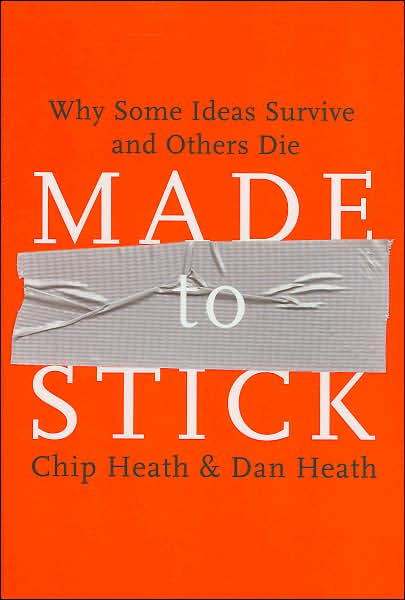
Immediately, I try to peel away that 'To' label ... but the library has carefully plastic-wrapped the cover. So I turn to the inside jacket, to read a bit of a description, and see that part of the book is going to be about discussing urban legends and conspiracy theories and why they spread so effortlessly. Reading through the rest of the jacket's copy, I can see that this is going to be my sort of book.
And it reminds me of this post by Seth Godin: The Purpose of a Book Cover
Simplicity: How do you strip an idea to its core without turning it into a silly sound bite? See how Army commanders force siplicity into their battle plans - page 25
Credibility: How do you get people to believe your idea? See how NBA coaches engineered an experience that made the dangers of AIDS more palpable to their players - page 162
(That AIDS example is genius, btw. If you're just interested in flicking through the book at the library, I'd recommend it.)
So I check out the examples - which are well written, entertaining and illustrative. Then I check out the table of contents which says there's an 'Easy Reference Guide' at the back of the book. That guide is a 5 page summary of the ideas in the book - which is exactly what I want most books to have, because it saves me the work of doing it myself.
By this point, I'm intrigued and entertained enough that I read the whole introduction (which you can check out here, if you're interested).
Basically, this is exactly how I'd like a non-fiction book to be designed. Easing you into the subject matter, giving you a summary of what it says right up front (rather than hiding it in the last chapter), and providing entertaining, concrete examples. I'm looking forward to reading this.
I was feeling pretty overloaded yesterday - stretched at work between deadlines and training someone, having to run a game afterwards, and dealing wiht a few relationship issues. So when I finally hopped into bed and picked up 'Made to Stick' I was torn between wanting to read a bit of this book that I'd finally been able to pick up from the library, and finally going to sleep.
So, I pick it up (just to check it out) and the first thing I notice is its cover:
Immediately, I try to peel away that 'To' label ... but the library has carefully plastic-wrapped the cover. So I turn to the inside jacket, to read a bit of a description, and see that part of the book is going to be about discussing urban legends and conspiracy theories and why they spread so effortlessly. Reading through the rest of the jacket's copy, I can see that this is going to be my sort of book.
And it reminds me of this post by Seth Godin: The Purpose of a Book Cover
So I turn to the back cover, again not intending to read the book, just checking it out, and this is what I see: A list of the six qualities of 'stickiness' that the book is going to discuss together with page numbers illustrating the points. Like so:Is the purpose of the cover to sell books, to accurately describe what's in the book, or to tee up the reader so the book has maximum impact?
The third.
... Tactically, the cover sells the back cover, the back cover sells the flap and by then you've sold the book.
Simplicity: How do you strip an idea to its core without turning it into a silly sound bite? See how Army commanders force siplicity into their battle plans - page 25
Credibility: How do you get people to believe your idea? See how NBA coaches engineered an experience that made the dangers of AIDS more palpable to their players - page 162
(That AIDS example is genius, btw. If you're just interested in flicking through the book at the library, I'd recommend it.)
So I check out the examples - which are well written, entertaining and illustrative. Then I check out the table of contents which says there's an 'Easy Reference Guide' at the back of the book. That guide is a 5 page summary of the ideas in the book - which is exactly what I want most books to have, because it saves me the work of doing it myself.
By this point, I'm intrigued and entertained enough that I read the whole introduction (which you can check out here, if you're interested).
Basically, this is exactly how I'd like a non-fiction book to be designed. Easing you into the subject matter, giving you a summary of what it says right up front (rather than hiding it in the last chapter), and providing entertaining, concrete examples. I'm looking forward to reading this.
Tuesday, September 29, 2009
Bad Family: Starting to develop a pitch
I need to figure out how to pitch and market Bad Family.
Andy Kitkowski developed a set of 19 questions to figure out how to market a game.
I'm going to fill in those questions as I get the inspiration and time. If you know anything about the game, I encourage you to help me in the comments.
The idea is to take the finished stuff to nzrag and gametime for further development, and then off to Story Games (the big leagues).
Here we go ...
Andy's Narcissist Self-Interview 20
4) This is my target audience.
+ People who want to play a comedy game.
+ People who want a complete game in an hour.
+ Board gamers, maybe.
+ People who haven't played an RPG before (I want Bad Family to be accessible and non-geeky).
+ Groups of friends who like to take the piss together.
This is a really important question and I need to put more thought into answering it.
5) These are other games, media, etc am I blatantly stealing from (or, what I am inspired by)
The Simpsons, Malcolm in the Middle, and Angel. In fact, Angel was the original inspiration because I noticed that in the show was never about how skilled a character was - they either succeeded or they failed when they tried to do something. I wanted a game that would be that simple.
Primetime Adventures is an inadvertent influence - the game has turned out like a stripped-down version of PTA.
6) Here is one single sentence which describes 1-2 things about my game idea that other games don't currently offer (to my knowledge).
I totally don't know how to answer this. I don't think there are any other games that aim to create animated sitcoms. Cartoons, yes (Toon, Cartoon Action Hour); sit-coms, no.
7) Here, in no more than three sentences, is what the game is about in general.
Cartoons.
Dysfunctional family.
Worst-case scenarios.
Selfishness.
Obviously that's more than 3 sentences but I'm happy to brainstorm on this one and then winnow it down.
8) Here are one to two vignettes about the game's setting.
On the realistic end of things, one player wanted her character to be a teenage boy who was struggling with whether or not he was gay. He ended up at a party, with the girl he was interested trying to lead him upstairs to a bedroom - while at the same time his best (male) friend from school gatecrashed and declared that he loved him in front of everyone. It was an extremely awkward moment in the story that made all of us cringe in sympathy.
Towards the more surreal, I've seen a grandmother character stoned on peyote, stripping off all of her clothes under a hot sunny day while cycling to her weekly bridge game. And one young kid accidentally invented a time machine when he tried to soup up his bicycle with some spare parts stolen from a local army base.
Andy Kitkowski developed a set of 19 questions to figure out how to market a game.
I'm going to fill in those questions as I get the inspiration and time. If you know anything about the game, I encourage you to help me in the comments.
The idea is to take the finished stuff to nzrag and gametime for further development, and then off to Story Games (the big leagues).
Here we go ...
Andy's Narcissist Self-Interview 20
PART I
1) Here is the name of the game, and how I came up with the name.
Bad Family.
I started with names based on the central mechanic of the game. So, it was stuff like 'Good or Bad', 'The Hand You're Dealt'.
Then I decided to focus on the family that is at the heart of the game, and at the same time introduce the idea that things will either go really well or really badly for them. So I had names like 'The Fortunes of the Joneses' and 'Lucky Jones'. That didn't sit well with me, and I began a search that may have lasted six months or a year for a name that worked better - and by better I mean I felt good about saying it out loud to other people.
Eventually I settled on 'Bad Family' - it's a riff on Bad Santa, it feels a bit current and catchphrase-y, and it clearly emphasises that it's about a family and that they may well do bad things to each other.
2) How would the "back cover blurb" for the game go? Imagine it being read by the "Movie Commercial Guy" ("In a World...")
Imagine your family - loving, complex, weird, and a little screwed up. Now imagine each of them having the worst day of their lives at the same time ... today. Imagine your family - you love them, hate them, and they're a little screwed up. Now imagine everyone in your family is having the worst day of their life.
Bad Family is the game about that day.
Bad Family: answering the question of whether you love the selfish jerks who are trying to stop you from getting what you want.
Alternatively, I have this:
Do you like animated sit-coms like The Simpsons or Family Guy?
3) This is a brief example of what play might look like, involving three players and no more than 10 "lines" of text.
SIVA:
Okay, we're back to your turn Elise. Now, if I remember right, your character's Want is to 'Prove he's not gay'. Where did we leave him, and what are you going to do next?
ELISE:
The party had just gotten started at my parents house, and all of my friends from school had arrived. So I think the music's loud, we're all dancing, and everyone starting to get drunk. And that's when Katie shows up.
TOBIAS:
I'll play her. "Lee, great party! I've never been to your place before - it's not as weird as they say at school."
ELISE:
"Thanks ... uh, do you want to have a look around?"
TOBIAS:
"I'd love to see your bedroom. I mean get a look at where you sleep. I mean -"
SIVA:
I'llthere. So the best case scenario is that you go up to the bedroom, and - who knows - you might get up to all sorts of horrible embarrassing hijinks in the course of proving you're not gay. My worst case scenario, on the other hand, is that Brian arrives. And he chooses just that moment to get down on his knees in front of you, and Katie, and everyone at the party, and declare his love for you.
ELISE
Oh shit. Okay, I'll draw a card ... Failure. Crap! ... Well I'm not going to let that stand. I'll spend a Bonus and redraw.... Failure. okay, okay ... I need to save my Bonuses for later so, crap, I guess Brian arrives and does his thing.
EVERYONE:
(in sympathetic embarrassment)
AARRGGGGGGGGGGGGGGGGGRAGGGGOOOOH!!!
TOBIAS:
Do you want to spend a Bonus to continue the scene?
ELISE:
No. Guess I'll pass the turn to you.... Crap.
[Hmmm ... I'm not sure - does this come across as homophobic? It's based on a real moment in a playtest, and when we were playing it was awkward, sympathetic and felt true. I'm not sure how it reads, though.
1) Here is the name of the game, and how I came up with the name.
Bad Family.
I started with names based on the central mechanic of the game. So, it was stuff like 'Good or Bad', 'The Hand You're Dealt'.
Then I decided to focus on the family that is at the heart of the game, and at the same time introduce the idea that things will either go really well or really badly for them. So I had names like 'The Fortunes of the Joneses' and 'Lucky Jones'. That didn't sit well with me, and I began a search that may have lasted six months or a year for a name that worked better - and by better I mean I felt good about saying it out loud to other people.
Eventually I settled on 'Bad Family' - it's a riff on Bad Santa, it feels a bit current and catchphrase-y, and it clearly emphasises that it's about a family and that they may well do bad things to each other.
2) How would the "back cover blurb" for the game go? Imagine it being read by the "Movie Commercial Guy" ("In a World...")
Bad Family is the game about that day.
Bad Family: answering the question of whether you love the selfish jerks who are trying to stop you from getting what you want.
Alternatively, I have this:
Do you like animated sit-coms like The Simpsons or Family Guy?
Do you like stories about dysfunctional families, like The Royal Tennebaums, or Malcolm in the Middle, or Married with Children, or American Beauty or pretty much any TV show ever?
That's basically what Bad Family is about: together we'll create an episode of an animated sit-com about a dysfunctional family.
You'll play one of the Family Members, and as part of the game you'll set up a goal your Family Member wants to achieve by the time the episode ends. You win the game by getting what you want before everyone else does. You can increase your chances of winning by creating horrible situations for the other members of your family. Horrible situations like you'd see in any episode of a sit-com.
3) This is a brief example of what play might look like, involving three players and no more than 10 "lines" of text.
SIVA:
Okay, we're back to your turn Elise. Now, if I remember right, your character's Want is to 'Prove he's not gay'. Where did we leave him, and what are you going to do next?
ELISE:
The party had just gotten started at my parents house, and all of my friends from school had arrived. So I think the music's loud, we're all dancing, and everyone starting to get drunk. And that's when Katie shows up.
TOBIAS:
I'll play her. "Lee, great party! I've never been to your place before - it's not as weird as they say at school."
ELISE:
"Thanks ... uh, do you want to have a look around?"
TOBIAS:
"I'd love to see your bedroom. I mean get a look at where you sleep. I mean -"
SIVA:
I'll
ELISE
Oh shit. Okay, I'll draw a card ... Failure. Crap! ... Well I'm not going to let that stand. I'll spend a Bonus and redraw.... Failure. okay, okay ... I need to save my Bonuses for later so, crap, I guess Brian arrives and does his thing.
EVERYONE:
(in sympathetic embarrassment)
AARRGGGGGGGGGGGGGGGGGRAGGGGOOOOH!!!
TOBIAS:
Do you want to spend a Bonus to continue the scene?
ELISE:
No. Guess I'll pass the turn to you.... Crap.
[Hmmm ... I'm not sure - does this come across as homophobic? It's based on a real moment in a playtest, and when we were playing it was awkward, sympathetic and felt true. I'm not sure how it reads, though.
4) This is my target audience.
+ People who want to play a comedy game.
+ People who want a complete game in an hour.
+ Board gamers, maybe.
+ People who haven't played an RPG before (I want Bad Family to be accessible and non-geeky).
+ Groups of friends who like to take the piss together.
This is a really important question and I need to put more thought into answering it.
5) These are other games, media, etc am I blatantly stealing from (or, what I am inspired by)
The Simpsons, Malcolm in the Middle, and Angel. In fact, Angel was the original inspiration because I noticed that in the show was never about how skilled a character was - they either succeeded or they failed when they tried to do something. I wanted a game that would be that simple.
Primetime Adventures is an inadvertent influence - the game has turned out like a stripped-down version of PTA.
6) Here is one single sentence which describes 1-2 things about my game idea that other games don't currently offer (to my knowledge).
I totally don't know how to answer this. I don't think there are any other games that aim to create animated sitcoms. Cartoons, yes (Toon, Cartoon Action Hour); sit-coms, no.
7) Here, in no more than three sentences, is what the game is about in general.
Cartoons.
Dysfunctional family.
Worst-case scenarios.
Selfishness.
Obviously that's more than 3 sentences but I'm happy to brainstorm on this one and then winnow it down.
8) Here are one to two vignettes about the game's setting.
Depending on the group, the setting can veer all over the place from realistic to totally surreal. Occasionally I've had playtesters who think this is a problem - but over time I've grown to see this as a feature; each group sets up a particular tone for their game.
On the realistic end of things, one player wanted her character to be a teenage boy who was struggling with whether or not he was gay. He ended up at a party, with the girl he was interested trying to lead him upstairs to a bedroom - while at the same time his best (male) friend from school gatecrashed and declared that he loved him in front of everyone. It was an extremely awkward moment in the story that made all of us cringe in sympathy.
Towards the more surreal, I've seen a grandmother character stoned on peyote, stripping off all of her clothes under a hot sunny day while cycling to her weekly bridge game. And one young kid accidentally invented a time machine when he tried to soup up his bicycle with some spare parts stolen from a local army base.
Friday, September 25, 2009
The Elements of Persuasion: Summary
Recently, I did a bunch of posts summarising a book called The Elements of Persuasion, which is about how to construct stories that people will pay attention to and agree with. I felt that those posts got a bit caught up in the details, so I wanted to create a summary of that summary. Which is what you're about to read.
According to the book, there are five elements of persuasion: Passion, the Hero, the Antagonist, a moment of Awareness, and the Transformation into taking action. Here's a bit more about each of those five elements:
Passion
How do you get other people to care about the idea or cause that you care about?
To begin with, you need to be personally committed; it needs to be your passion. So before you tell your story, you need to ask:
Your Passion is the key to making anyone else care about your story. If people aren't connecting with your story at an emotional level, if they aren't feeling your Passion, then you're telling the wrong story.
What are the advantages of Passion?
Passion cuts through all the competing demands for an audience's attention and makes them listen to you. Check out this presentation by a 13 year old girl to the United Nations:
Passion is communicable. If your story connects with people emotionally, they will spread it for you because it's fun to tell.(*) At the start of this talk, Seth Godin shares an example of a story that spread - a story about a man who worked for the SPCA in San Francisco.
Speaking with Passion has a few more benefits:
The Hero
The Hero personifies the story and shows us how change our lives.
Heroes are changed by living through the story, and they take different actions because they've been changed. That means heroes show us how to change our own lives, and live according to the values in the story.
To use this idea when you're writing your story, start by reducing your story down to its central concept. Then transform that concept into actions. Finally, choose a hero who demonstrates how to take those actions.
It's vital to find the right hero for your story, and if you want to change people's minds and lives then it's best if your hero is real rather than fictional.
One final advantage of having a hero is that it allows the storyteller to unify the audience. By 'unify', I mean that the audience all see and interpret the events of the story through the same point-of-view.
The Antagonist
Antagonists keep the Hero from achieving their goal.
Antagonists don't create conflict; they "clarify what the conflict is about". (I wish I'd taken more notes on this point, because it seems profound!) At the moment I interpret it to mean that stories aren't about 'defeating' the Antagonist, they're about us discovering what we need to change in order to defeat it.
If you're going to persuade people, then they must remember what you've said. Memory and recall are improved when you experience strong emotions. Think about how much you love to hate the villains in Die Hard or Star Wars or [insert a more topical movie reference of your choice here]. Using an Antagonist lets you easily generate strong negative emotions, but at the same time audiences will associate those the negative emotions with the Antagonist - which keeps your Hero sympathetic. And the audience's dislike of the antagonist will get them on the Hero's side.
Choose the 'right' antagonist. One that can be overcome, but not one that's a straw villain (either imaginary, or whose threat is overinflated). And don't demonise the Antagonist - instead, give the hero and the audience a change to learn from them.
Awareness
You want to create a moment of Awareness in the audience where they see the problem for what it is and the actions they need to take to fix it.
Hopefully by this point you'll have also created the Passion to change things and given them a role model of how to change (the Hero). Awareness applies both to the Hero and to the audience; ideally, the audience should share the Hero's realisation that something needs to change.
Transformation
Taking action and changing things transforms you and the world around you.
EDITED TO ADD:
Here are the links to the rest of my posts on the Elements of Persuasion.
Introduction.
The First Element: Passion.
The Second Element: The Hero.
The final three Elements.
According to the book, there are five elements of persuasion: Passion, the Hero, the Antagonist, a moment of Awareness, and the Transformation into taking action. Here's a bit more about each of those five elements:
Passion
How do you get other people to care about the idea or cause that you care about?
To begin with, you need to be personally committed; it needs to be your passion. So before you tell your story, you need to ask:
- Do I really care about what I'm about to say? Do I need to tell this story?
- It is true?
Your Passion is the key to making anyone else care about your story. If people aren't connecting with your story at an emotional level, if they aren't feeling your Passion, then you're telling the wrong story.
What are the advantages of Passion?
Passion cuts through all the competing demands for an audience's attention and makes them listen to you. Check out this presentation by a 13 year old girl to the United Nations:
Passion is communicable. If your story connects with people emotionally, they will spread it for you because it's fun to tell.(*) At the start of this talk, Seth Godin shares an example of a story that spread - a story about a man who worked for the SPCA in San Francisco.
Speaking with Passion has a few more benefits:
- Passion gets your audience ready to want to listen to you; it warms them up
- Passion makes your story seems more vivid and more real
- The more passionate and personal your story is, the easier it is to overcome stage fright; Passion helps you tell your story in a way that makes you appear natural and relaxed
The Hero
The Hero personifies the story and shows us how change our lives.
Heroes are changed by living through the story, and they take different actions because they've been changed. That means heroes show us how to change our own lives, and live according to the values in the story.
To use this idea when you're writing your story, start by reducing your story down to its central concept. Then transform that concept into actions. Finally, choose a hero who demonstrates how to take those actions.
It's vital to find the right hero for your story, and if you want to change people's minds and lives then it's best if your hero is real rather than fictional.
One final advantage of having a hero is that it allows the storyteller to unify the audience. By 'unify', I mean that the audience all see and interpret the events of the story through the same point-of-view.
The Antagonist
Antagonists keep the Hero from achieving their goal.
Antagonists don't create conflict; they "clarify what the conflict is about". (I wish I'd taken more notes on this point, because it seems profound!) At the moment I interpret it to mean that stories aren't about 'defeating' the Antagonist, they're about us discovering what we need to change in order to defeat it.
If you're going to persuade people, then they must remember what you've said. Memory and recall are improved when you experience strong emotions. Think about how much you love to hate the villains in Die Hard or Star Wars or [insert a more topical movie reference of your choice here]. Using an Antagonist lets you easily generate strong negative emotions, but at the same time audiences will associate those the negative emotions with the Antagonist - which keeps your Hero sympathetic. And the audience's dislike of the antagonist will get them on the Hero's side.
Choose the 'right' antagonist. One that can be overcome, but not one that's a straw villain (either imaginary, or whose threat is overinflated). And don't demonise the Antagonist - instead, give the hero and the audience a change to learn from them.
Awareness
You want to create a moment of Awareness in the audience where they see the problem for what it is and the actions they need to take to fix it.
Hopefully by this point you'll have also created the Passion to change things and given them a role model of how to change (the Hero). Awareness applies both to the Hero and to the audience; ideally, the audience should share the Hero's realisation that something needs to change.
Transformation
Taking action and changing things transforms you and the world around you.
EDITED TO ADD:
Here are the links to the rest of my posts on the Elements of Persuasion.
Introduction.
The First Element: Passion.
The Second Element: The Hero.
The final three Elements.
Monday, September 21, 2009
Lost: Second Impressions II
I'm rewatching episodes of Lost, Season 1. Just gotten through eps 6 to 12.
The pacing of the show starts to seem a bit off from about episode 6 (the Sun flashback). All of a sudden the show stops watching these characters, and starts forcing them to make decisions, such as 'Stay on the beach or go live in the caves'. It's a huge plot point that gets rushed through - whereas, staying true to the tone that the show's set up, it should take at least an episode to work through.
That's followed by Charlie's episode (saving Jack from the cave in), which feels very traditional in a 'Here's the plot, and here's the metaphor' kind of way.
Basically the pacing of episodes and character motivations in the stories have become faster, more traditional / conventional. Sort of treating the characters and plots like playing pieces in a game to be shifted around into more interesting positions.
For a while I found it less satisfying, but then I started getting into the accelerating pace -
as if the first 9 episodes were an overture. Now we've been hit by the plot - three seemingly separate events that are in reality closely related:
The pacing of the show starts to seem a bit off from about episode 6 (the Sun flashback). All of a sudden the show stops watching these characters, and starts forcing them to make decisions, such as 'Stay on the beach or go live in the caves'. It's a huge plot point that gets rushed through - whereas, staying true to the tone that the show's set up, it should take at least an episode to work through.
That's followed by Charlie's episode (saving Jack from the cave in), which feels very traditional in a 'Here's the plot, and here's the metaphor' kind of way.
Basically the pacing of episodes and character motivations in the stories have become faster, more traditional / conventional. Sort of treating the characters and plots like playing pieces in a game to be shifted around into more interesting positions.
For a while I found it less satisfying, but then I started getting into the accelerating pace -
as if the first 9 episodes were an overture. Now we've been hit by the plot - three seemingly separate events that are in reality closely related:
- Clare is kidnapped by someone who was already on the Island
- Locke and Boone discover the Hatch
- Sayid finds Rousseau and learns that there are Others, whispering in the jungle.
- Her psychic has a baffling change of heart, expanded on in this post
- An amazing dream sequence that features Locke with white and black eyes (significant given Season 5).
- The statement that Aaron is a significant figure in the destiny of the Island.
Thursday, September 17, 2009
Lost: Second Impressions I
The rewatching of Lost has begun. An opportunity to compare my early reviews with my memories of the first season's episodes, and filter all of that through my understanding of what's going on up to the end of Season 5.
Surprisingly, the first three episodes actually aren't as 'reality' based as I remembered. They've set up the basic structure of the show: that there are big questions to be answered and weirdness to be understood - the monster and the polar bear are chief among them. Rousseau's distress message that's been playing for 16 years is another.
Lost is also quite sophisticated in the way it reveals some of these things: 'The Island can heal' has huge ramifications, immediately establishing that the show is 'not quite real', but it's totally implied - never stated explicitly - in Locke's episode: Walkabout
There's an emphasis on Jack and Kate in these early episodes that seems ... disproportionate to where the show ends up going. Two things that come out of that though are that Kate is great in these early episodes - proactive, gung-ho, involved with everyone. I really want to know when she lost her energy as a character.(*) Also the first meeting between Jack and Kate, when she sews up his wound, is played in such a delightfully off-beat way that it actually set up the possibility of a time loop, that she's travelled back in time to re-experience this moment ... which was the first of several exciting 'Did the writers know what they were doing right from the start' moments in these first 10 episodes.
(*) It's an energy that the writers seemed to want to restore to her, halfway through Season 5 when we learned why she actually went back to the Island.
For instance, there's an enormously interesting moment between Locke and Walt, where Locke explains backgammon to Walt. That there are 2 players - one light and one dark. The significance of this is huge, given what we learned in the last two episodes of Season 5.
Here's what I said originally about the third episode
There's also a joy in reconstructing the history of the characters and the objective timeline of the show. For instance, Locke's insistence that he has a destiny, that he HAS to go on the walkabout actually comes from an episode (in Season 4?) when Mr Abaddon visits Locke in the hospital.
My major concern so far is that there's no subtext no story happening below the surface (the stuff that I enjoyed so much when I rewatched Buffy Season 3 recently.) There is a grand game happening below the surface of the episodes, in the background, and in the past ... but I'm not sure that's enough to keep me rewatching. My fear is that, basically, Lost will turn out to be a story about interconnections and conspiracies and grand philosophical ideas ... and maybe not so much about people ...
Previous Lost reviews
Surprisingly, the first three episodes actually aren't as 'reality' based as I remembered. They've set up the basic structure of the show: that there are big questions to be answered and weirdness to be understood - the monster and the polar bear are chief among them. Rousseau's distress message that's been playing for 16 years is another.
Lost is also quite sophisticated in the way it reveals some of these things: 'The Island can heal' has huge ramifications, immediately establishing that the show is 'not quite real', but it's totally implied - never stated explicitly - in Locke's episode: Walkabout
There's an emphasis on Jack and Kate in these early episodes that seems ... disproportionate to where the show ends up going. Two things that come out of that though are that Kate is great in these early episodes - proactive, gung-ho, involved with everyone. I really want to know when she lost her energy as a character.(*) Also the first meeting between Jack and Kate, when she sews up his wound, is played in such a delightfully off-beat way that it actually set up the possibility of a time loop, that she's travelled back in time to re-experience this moment ... which was the first of several exciting 'Did the writers know what they were doing right from the start' moments in these first 10 episodes.
(*) It's an energy that the writers seemed to want to restore to her, halfway through Season 5 when we learned why she actually went back to the Island.
For instance, there's an enormously interesting moment between Locke and Walt, where Locke explains backgammon to Walt. That there are 2 players - one light and one dark. The significance of this is huge, given what we learned in the last two episodes of Season 5.
Here's what I said originally about the third episode
Later eps of Lost feel like a TV show. This feels like just watching interesting stuff happening. It's not doling out too many plots twists or starting to over-dramatise more than a few characters by involving them in soap-opera issues. The show's just letting people be people.There a joy in seeing these characters are going to evolve. Michael (who in about 10 episodes time will reveal himself to have a satisfyingly consistent attitude towards Walt). Rose's faith that other people have survived the crash. It's also odd to see so many characters established who disappear in later episodes: Charlie, for instance, and Boone and Shannon (who are both playing much better for me now)
There's also a joy in reconstructing the history of the characters and the objective timeline of the show. For instance, Locke's insistence that he has a destiny, that he HAS to go on the walkabout actually comes from an episode (in Season 4?) when Mr Abaddon visits Locke in the hospital.
My major concern so far is that there's no subtext no story happening below the surface (the stuff that I enjoyed so much when I rewatched Buffy Season 3 recently.) There is a grand game happening below the surface of the episodes, in the background, and in the past ... but I'm not sure that's enough to keep me rewatching. My fear is that, basically, Lost will turn out to be a story about interconnections and conspiracies and grand philosophical ideas ... and maybe not so much about people ...
Previous Lost reviews
Tuesday, September 15, 2009
Play: Tim Brown on 'Serious Play'
Another TED talk, this time at the Serious Play conference in 2008.
In this, Tim Brown talks about how fearing the judgment of our peers represses our creativity and prevents us coming up with wild ideas.
He explains that when adults experience a new situation, they want to CATEGORISE it very quickly. They don't want to play with it or explore, they want to fit it into the world and uses they already know.
On the other hand kids ask: What is it? What can I do with it?
Brown discusses how to create environments where you can play. Play isn't anarchy; it has rules about how to play and when to play. Brainstorming environments, for instance, need rules in order to help us break the rules effectively - the most obvious example of that is the brainstorming principle of defering judgment on ideas until you've finished.
He observes something I'd never thought of before - that sometimes our desire to be original can be a form of editing. We stop ourselves from getting into a groove (or a rut) with something we're enjoying; even though that groove might be fun or playful, we judge it harshly simply because it's not 'original'.
You need trust, says Brown. Create a place where you have the security to take risks and play. At his company, IDEO, all the employees are hired because they are best friends. Friends are a shortcut to trust and playfulness.
The other principles he suggests are:
1. Build something. Create something tangible to comment on, and once you have that prototype, keep refining and challenging it.
2. If you're creating an environment or a situation, role play it - act it out to create empathy with the users, and to see how it'll work.
Be playful and create real stuff.
Sunday, September 13, 2009
Tip: Play
the thing is, if there's a problem in my life it's up to me to fix it. And I'm talking about writing here: if I'm not happy with what I'm writing, or with the amount of writing I'm getting done, I'll have to change my life in order to get happy.
I realised this somewhere around Day 2000 of writing The Limit. I was 5 and a 1/2 years into writing my script (it turns out that criticism of my previous film + perfectionism + no job = a pathological number of rewrites), when I had to acknowledge to myself that I was stuck, I was bored, and my brain wasn't fresh.
That's important: my brain wasn't fresh. While my writing was varying in its usual way (*), my mind had been focused on writing the same intense dark thriller material for way too long.
(*) My writing schedule varies between procrastination, not flowing, insights, and enjoyment, and then back to procrastination again once I feel I've done enough to rest on my laurels, or that I've hit a benchmark where I can tell myself I'll stop writing for a while so I can come back and look at the script with 'fresh eyes'.
So, that was the problem: non-fresh brain. It was up to me to find a solution and fix it.
Thinking about it, I realised that all my writing was being done under pressure. Pressure I was putting on myself. I certainly wasn't being playful. I wasn't writing just for the sake of it. I wasn't taking a look at any of the many, many ideas that were building up in my filing cabinet as I struggled to finish The Limit.
So, I created something I call "PLAY".(*) I decided that every two months, after working on a single project, I would take two weeks off. During those two weeks, I could PLAY with any project I wanted. Anything that inspired me or that took my fancy. I'd pull out my folders of TV ideas, skills I wanted to learn, blog posts I wanted to write. ... And then I'd just do it.
(*) Yes, for some reason the all-caps are important to me.
I'm in the middle of PLAY right now, and I'm working on "a game to change the world", and a pitch for a TV show (that I'm also going to use to learn a layout programme with). I've also varied when I PLAY a little: it turns out that 2 months was just a little bit too long. I'm now on a six-weeks of focused writing followed by 2 weeks of PLAY, which seems to be a better ratio for me.
PLAY has changed my approach to writing. It's a reward for hard, focused work. It's an opportunity to get inspired about stuff I might do next. It takes the pressure off me to create 'good' stuff, and instead lets me explore.
So there you go. Identify a problem in your life. Try a solution. Don't be afraid to make radical changes. This why I admire Matt trying out different schedules; and Jenni for taking Wednesdays off to write. It's the sort of stuff we need to do; as writers, we need to create a life that works for us (and the people around us).
(This was previously posted on Jenni's blog.)
I realised this somewhere around Day 2000 of writing The Limit. I was 5 and a 1/2 years into writing my script (it turns out that criticism of my previous film + perfectionism + no job = a pathological number of rewrites), when I had to acknowledge to myself that I was stuck, I was bored, and my brain wasn't fresh.
That's important: my brain wasn't fresh. While my writing was varying in its usual way (*), my mind had been focused on writing the same intense dark thriller material for way too long.
(*) My writing schedule varies between procrastination, not flowing, insights, and enjoyment, and then back to procrastination again once I feel I've done enough to rest on my laurels, or that I've hit a benchmark where I can tell myself I'll stop writing for a while so I can come back and look at the script with 'fresh eyes'.
So, that was the problem: non-fresh brain. It was up to me to find a solution and fix it.
Thinking about it, I realised that all my writing was being done under pressure. Pressure I was putting on myself. I certainly wasn't being playful. I wasn't writing just for the sake of it. I wasn't taking a look at any of the many, many ideas that were building up in my filing cabinet as I struggled to finish The Limit.
So, I created something I call "PLAY".(*) I decided that every two months, after working on a single project, I would take two weeks off. During those two weeks, I could PLAY with any project I wanted. Anything that inspired me or that took my fancy. I'd pull out my folders of TV ideas, skills I wanted to learn, blog posts I wanted to write. ... And then I'd just do it.
(*) Yes, for some reason the all-caps are important to me.
I'm in the middle of PLAY right now, and I'm working on "a game to change the world", and a pitch for a TV show (that I'm also going to use to learn a layout programme with). I've also varied when I PLAY a little: it turns out that 2 months was just a little bit too long. I'm now on a six-weeks of focused writing followed by 2 weeks of PLAY, which seems to be a better ratio for me.
PLAY has changed my approach to writing. It's a reward for hard, focused work. It's an opportunity to get inspired about stuff I might do next. It takes the pressure off me to create 'good' stuff, and instead lets me explore.
So there you go. Identify a problem in your life. Try a solution. Don't be afraid to make radical changes. This why I admire Matt trying out different schedules; and Jenni for taking Wednesdays off to write. It's the sort of stuff we need to do; as writers, we need to create a life that works for us (and the people around us).
(This was previously posted on Jenni's blog.)
Wednesday, September 09, 2009
Movies: Film Festival mini-reviews
Soul Power covers the 1974 concert in Zaire that took place at the same-ish time as the Ali-Foreman fight. Lots of great performers including James Brown, favourite-bluesman-ever BB King, and new favourite singer Bill Withers. For me it's a movie that really illustrated the joy of playing music, and the satisfaction of playing music yourself rather than receiving it from some 'star'. Great stuff.
Moon is impossible for me to discuss without talking spoilers. So, I'm talk about it at the bottom of this post.
2009 was a middling year in terms of the number of movies I missed that were on my must-see list: In The Loop (scheduling conflict with Moon), Rachel (got the start time wrong), This Way of Life (couldn't be bothered, on the day). Far more impressive were the number of movies I missed that I only really really wanted to see: Mother, Afghan Star, Rough Aunties, Visual Acoustics, Thirst, and The First Day of the Rest of Your Life.
It Might Get Loud was the last film of the festival for me, and definitely my favourite. I am the target audience for a movie about how Jimmy Page, The Edge and Jack White became guitarists.
OK, back to Moon. I guess all I really wanted to say is that I have a brain that can't help but try and guess the twist in a movie. As much as I try to shut it off, it keeps ticking along - adding new information into my working theories about what's really happening. It's ruined the full effect of a few movies for me (Sixth Sense and The Usual Suspects, in particular).
Moon doesn't really have a twist. As a story, it plays pretty fair - and actually reveals what's happening very early on. My problem, though, was that the reveal implicitly establishes a few things that need to happen. Two characters have to come into conflict. There has to be an investigation. Certain people have to respond to events that occur early in the movie. That sense of inevitability bugged me.
On the other hand, I was anti-bugged by Sam Rockwell's performance, the look and feel of the film, and the Clint Mansell soundtrack. These things were extraordinary.
Moon is impossible for me to discuss without talking spoilers. So, I'm talk about it at the bottom of this post.
2009 was a middling year in terms of the number of movies I missed that were on my must-see list: In The Loop (scheduling conflict with Moon), Rachel (got the start time wrong), This Way of Life (couldn't be bothered, on the day). Far more impressive were the number of movies I missed that I only really really wanted to see: Mother, Afghan Star, Rough Aunties, Visual Acoustics, Thirst, and The First Day of the Rest of Your Life.
It Might Get Loud was the last film of the festival for me, and definitely my favourite. I am the target audience for a movie about how Jimmy Page, The Edge and Jack White became guitarists.
OK, back to Moon. I guess all I really wanted to say is that I have a brain that can't help but try and guess the twist in a movie. As much as I try to shut it off, it keeps ticking along - adding new information into my working theories about what's really happening. It's ruined the full effect of a few movies for me (Sixth Sense and The Usual Suspects, in particular).
Moon doesn't really have a twist. As a story, it plays pretty fair - and actually reveals what's happening very early on. My problem, though, was that the reveal implicitly establishes a few things that need to happen. Two characters have to come into conflict. There has to be an investigation. Certain people have to respond to events that occur early in the movie. That sense of inevitability bugged me.
On the other hand, I was anti-bugged by Sam Rockwell's performance, the look and feel of the film, and the Clint Mansell soundtrack. These things were extraordinary.
Saturday, September 05, 2009
New Thing: The Long Range Game
I've started a new game project based on the thinking I've been doing about planning and visualising the future. I get a little frustrated with myself - I care about the world; there are problems that I want to solve. But I don't know where to start.
So I'm writing a game about figuring out where to start, what could happen next, and what to do about it. This is a game to help me visualise the future. This is a game that will hopefully make planning fun.
I've given myself three restrictions:
So I'm writing a game about figuring out where to start, what could happen next, and what to do about it. This is a game to help me visualise the future. This is a game that will hopefully make planning fun.
I've given myself three restrictions:
- Must be under 3000 words
- Must not use randomisers like dice or cards
- Must be playable online.
Tuesday, September 01, 2009
The Dip: The Big Picture
You'll remember this series on the Dip started out with Jenni's story. She engaged in a long battle with her Inner Critic over whether her latest book was worth writing or not. Eventually she decided to quit writing the book that she had so many concerns about, and started work on a new one that she enjoyed more (and finished quickly). She did this despite being concerned that she might develop a bad habit of quitting things that seemed too difficult.
Said another way, Jenni was faced with the eternal question that faces writers (and everyone else): should you abandon this project (or person or product) and start working on another one?
In The Dip, Seth Godin says that if you're considering quitting, you're probably trying to influence someone or some thing (like a book you're writing, or a song you're trying to finish, or a work role you're trying to master). Whatever (or whoever) it is, if you're considering quitting, then you're probably failing to influence it.
So Godin looks at what you're trying to influence in two ways:
1.
The little picture is the project you're working on right now, trying to make progress on.
2.
The big picture is the market you're trying to influence with this project. To illustrate this little picture/big picture (project/market) relationship:
And this is the answer to Jenni's dilemma, which (unlike me) she figured out without having to read through an 80-page book:
If you quit your market simply because you're in a Dip, then you've wasted all of your time. I don't want you to waste your time. I want you to succeed!
The value of not quitting, the value of persistence, comes from being firmly committed to the market that you're trying to influence. If you're 'market-committed', then you can change tactics, try different projects, quit a book or a band ... as long as you're confident you're making progress in the big picture.
So figure out what you're committed to, and work your way through the Dip!
--- --- ---
As always, The Dip is available at Wellington Library.
Is there anything you want to quit? And if you quit, will it give you more time and energy to get through the Dip on something more important?
If you're in a Cul-de-Sac, do you think it's possible to change it into a Dip? How would you do that?
Said another way, Jenni was faced with the eternal question that faces writers (and everyone else): should you abandon this project (or person or product) and start working on another one?
In The Dip, Seth Godin says that if you're considering quitting, you're probably trying to influence someone or some thing (like a book you're writing, or a song you're trying to finish, or a work role you're trying to master). Whatever (or whoever) it is, if you're considering quitting, then you're probably failing to influence it.
So Godin looks at what you're trying to influence in two ways:
1.
The little picture is the project you're working on right now, trying to make progress on.
2.
The big picture is the market you're trying to influence with this project. To illustrate this little picture/big picture (project/market) relationship:
- you can write a book, but you're trying to create an audience for your books
- you can write a song, but you're trying to become a better songwriter
- you can work at a particular job, but you're trying to earn a satisfying living.
And this is the answer to Jenni's dilemma, which (unlike me) she figured out without having to read through an 80-page book:
- If your new book turns out to be crap and you quit it and start a new one, you're still trying to be a writer
- If you don't like this song, you're still going to keep figuring out what sort of songs you like to write
- If you hate your job, you can quit it but that doesn't mean "quitting your quest to make a living or a difference or an impact."
If you quit your market simply because you're in a Dip, then you've wasted all of your time. I don't want you to waste your time. I want you to succeed!
The value of not quitting, the value of persistence, comes from being firmly committed to the market that you're trying to influence. If you're 'market-committed', then you can change tactics, try different projects, quit a book or a band ... as long as you're confident you're making progress in the big picture.
So figure out what you're committed to, and work your way through the Dip!
--- --- ---
As always, The Dip is available at Wellington Library.
Seth's blog dedicated to the Dip is here.
... and that's it. Hope you've enjoyed this series. It's been tough to write, but it feels useful to me. Here are a few questions to finish off:Is there anything you want to quit? And if you quit, will it give you more time and energy to get through the Dip on something more important?
If you're in a Cul-de-Sac, do you think it's possible to change it into a Dip? How would you do that?
Saturday, August 29, 2009
The Dip: When you should quit
When you're experiencing a Dip, you should do whatever it takes to get through it.
The worst thing you can do is quit in the middle of a Dip, during the period when you're experience the most pain and the least reward, quitting when you have the least perspective on the situation. And remember: if you quit in the middle of a Dip, then you're:
So let's review. You should quit if you're:
Quitting before you start
Before you start a new project (or try entering a new career or work on a new goal) ask yourself, "When will I quit? Under what circumstance will I stop doing this thing?"
Be specific:
An example Seth uses in the book is of a marathon runner working out exactly what would make them quit in the middle of an event. Blisters or cramps may feel bad, but they're not enough to justify pulling out of a race with two kilometres to go.
... But this is all pretty idealistic. Despite all this, we're all still going to face the Dip with the things we're doing and we're probably not going to have these pretty , well-organised "Quitting Criteria" to refer to. So Seth provides two questions to ask before deciding to quit while we're in the Dip:
1. Am I panicking?
If you're in the middle of something, and the pressure has really come on you, and you're at your lowest ebb ... then that is (very probably) a bad time to quit. Your panic is going to make you quit right in the middle of a Dip.
Panic should be a signal to stick with something. Don't quit.
2. What sort of progress am I making?
You're either moving forward, falling behind or standing still.
If you're going to succeed, then you've got to be making some sort of forward progress, no matter how small.
If you're not making forward progress, and you're not quitting (in order focus on something where you CAN make progress) then you're wasting your time, your energy, and your life.
The progress you're making doesn't have to be huge; in fact it can be quite subtle - and it's up to you to define what 'progress' means to you.(*) But if you're not making progress, then it's time to start assessing whether you're in a Dip or a Cul-de-Sac.
(*) It could be something more pleasurable, or that you're getting better results from, or earning more from. It's up to you to define the y-axis of this graph.
But quitting does not equal failing. To quit is to say "I value this thing over the thing I'm doing now." Failure, on the other hand, happens when you exhaust all your options to try and succeed, or you run out of time to succeed, or you give up.
One more post to come - and we're going to loop all the way back to Jenni's story [LINK], to talk about the difference between quitting writing a book and quitting being a writer.
In the meantime, have you ever stuck with something and not quit even though you know you should have?
--- --- ---
As always, The Dip is available at Wellington Library.
The worst thing you can do is quit in the middle of a Dip, during the period when you're experience the most pain and the least reward, quitting when you have the least perspective on the situation. And remember: if you quit in the middle of a Dip, then you're:
- wasting all the time and effort you put into getting this far
- giving up on becoming one of the few, valuable people who ever master a skill.
So let's review. You should quit if you're:
- working on a Dip that doesn't have a good enough reward at the end of it
- on a dead end path (one where the rewards aren't worth or aren't getting any better)
- engaged in a self-destructive activity (which Seth calls a 'Cliff')
Quitting before you start
Before you start a new project (or try entering a new career or work on a new goal) ask yourself, "When will I quit? Under what circumstance will I stop doing this thing?"
Be specific:
- What will make you quit?
- What would have to happen in your world?
- How would you have to feel?
- How long would you have to stick it out without making any progress?
An example Seth uses in the book is of a marathon runner working out exactly what would make them quit in the middle of an event. Blisters or cramps may feel bad, but they're not enough to justify pulling out of a race with two kilometres to go.
... But this is all pretty idealistic. Despite all this, we're all still going to face the Dip with the things we're doing and we're probably not going to have these pretty , well-organised "Quitting Criteria" to refer to. So Seth provides two questions to ask before deciding to quit while we're in the Dip:
1. Am I panicking?
If you're in the middle of something, and the pressure has really come on you, and you're at your lowest ebb ... then that is (very probably) a bad time to quit. Your panic is going to make you quit right in the middle of a Dip.
Panic should be a signal to stick with something. Don't quit.
2. What sort of progress am I making?
You're either moving forward, falling behind or standing still.
If you're going to succeed, then you've got to be making some sort of forward progress, no matter how small.
If you're not making forward progress, and you're not quitting (in order focus on something where you CAN make progress) then you're wasting your time, your energy, and your life.
The progress you're making doesn't have to be huge; in fact it can be quite subtle - and it's up to you to define what 'progress' means to you.(*) But if you're not making progress, then it's time to start assessing whether you're in a Dip or a Cul-de-Sac.
(*) It could be something more pleasurable, or that you're getting better results from, or earning more from. It's up to you to define the y-axis of this graph.

But quitting does not equal failing. To quit is to say "I value this thing over the thing I'm doing now." Failure, on the other hand, happens when you exhaust all your options to try and succeed, or you run out of time to succeed, or you give up.
One more post to come - and we're going to loop all the way back to Jenni's story [LINK], to talk about the difference between quitting writing a book and quitting being a writer.
In the meantime, have you ever stuck with something and not quit even though you know you should have?
--- --- ---
As always, The Dip is available at Wellington Library.
Seth's blog dedicated to the Dip is here.
Wednesday, August 26, 2009
The Dip: Why it's good to quit
This is how I became a writer:
Originally I wasn't even in JP's band. He was being lead singer of The Wake (the band he'd set up during our first year at university), and I was struggling through my uni studies, trying to figure out how to write short stories and doodling around on my guitar.
The two of us started hanging out at my flat, showing each other the songs we'd been writing, and trying to figure out how to make them better. Eventually we had enough material to make a set list, and we realised that this was more than just jamming: we actually wanted to start a side-project from JP's band.
And thus Trash Dallas was born. JP and I decided to audition for a drummer and a bass-player, to take our show on the road. The auditions for our side-project were ridiculously hard, and eventually JP invited me to just start jamming with The Wake.(*) After a while, I became part of the band, and a whole bunch of plot twists ensued ...
(*) And thus Trash Dallas was dissolved, after about three months of auditions and no gigs.
About two years later, JP left - frustrated (I think) for various reasons. In the meantime I'd become increasingly integral to the band.(*) Another friend - Margo - joined as lead singer, and we recorded an album and did a few more gigs. Then Margo left, and we started working on a second album, scrabbling for gigs, and trying to audition a lead singer.
(*) Writing it down like that, I hope the two things weren't related!
All through this soap opera with the band, I was studying for my Honours degree, holding down a part-time job, being in a deteriorating relationship, and still working on my writing (I had a bunch of short stories at this point and a decidedly crappy novel). The pressure on me - the pressure of living my life in four different directions - felt enormous. And there was a single moment when it all reached a crisis point.
Greg the drummer came up to me in the quad at university, asked me if I had enough time to come to a rehearsal in a couple of days.
I remember looking up, staring at the roof of the quad, thinking about my Honours exams, about all the extra-curriculars I'd tried to cram into this year. But most importantly I thought about writing - about how I didn't seem to have any time for it, about how writing was something I could control, how it was something I enjoyed and wanted to get better at.
In that moment, it was clear to me that I had to choose; effectively, I had to choose between two possible lives: music or writing.
I looked up at the roof of the quad, and when I looked down I quit the band.
I chose writing. I'd written lots of stuff before this, but it was that moment that focused me. And a lot of great and painful things have come out of that.
I thought of this moment while reading The Dip. Seth Godin believes it's a good idea to quit stuff that you find unrewarding. When you quit unrewarding stuff, what you gain is time. You can use that extra time (and mental capacity) to focus on getting through the Dip on stuff that matters, the stuff that you can be great at.
Let's break that down a bit more:
What's so special about this book is that it's remorseless. Quit any project that doesn't have a Dip, it says. Don't stick something out if you're not going to get the benefits of being the best in the world. Quit stuff that you don't want to be exceptional at; quit stuff that you're not really enjoying. If you don't, you'll end up below-average or miserable.
Thinking about it, this answers one of the questions my Inner Critic has been yelling at me while writing these articles. If you quit stuff all the time how can you ever get good at anything? How can you ever do anything worthwhile?
The answer: quit stuff that's not worthwhile. That gives you more time and energy to focus on the things that are.
What Seth Godin is saying here reminds me of something I read about 5 years ago and really took to heart - that quitting can become a habit, a bad habit. The essay I read went on to say that instead of quitting, you should only start things you intend to get all the way through.
Now, this is slightly opposed to what Godin is talking about ('Quit stuff that isn't adding to your life' vs. 'Only start stuff you intend to finish'). And I guess that's been the source of my confusion.
I think the way to reconcile the two is that sometimes you have to start something in order to figure out whether it's worthwhile or not. I'll talk about more about that in a couple of days, but Godin's basic approach is to decide - before you start something - when exactly you will quit it.
What about you: have you ever quit something and been happy you did?
--- --- ---
As always, The Dip is available at Wellington Library.
Seth's blog dedicated to the Dip is here.
Originally I wasn't even in JP's band. He was being lead singer of The Wake (the band he'd set up during our first year at university), and I was struggling through my uni studies, trying to figure out how to write short stories and doodling around on my guitar.
The two of us started hanging out at my flat, showing each other the songs we'd been writing, and trying to figure out how to make them better. Eventually we had enough material to make a set list, and we realised that this was more than just jamming: we actually wanted to start a side-project from JP's band.
And thus Trash Dallas was born. JP and I decided to audition for a drummer and a bass-player, to take our show on the road. The auditions for our side-project were ridiculously hard, and eventually JP invited me to just start jamming with The Wake.(*) After a while, I became part of the band, and a whole bunch of plot twists ensued ...
(*) And thus Trash Dallas was dissolved, after about three months of auditions and no gigs.
About two years later, JP left - frustrated (I think) for various reasons. In the meantime I'd become increasingly integral to the band.(*) Another friend - Margo - joined as lead singer, and we recorded an album and did a few more gigs. Then Margo left, and we started working on a second album, scrabbling for gigs, and trying to audition a lead singer.
(*) Writing it down like that, I hope the two things weren't related!
All through this soap opera with the band, I was studying for my Honours degree, holding down a part-time job, being in a deteriorating relationship, and still working on my writing (I had a bunch of short stories at this point and a decidedly crappy novel). The pressure on me - the pressure of living my life in four different directions - felt enormous. And there was a single moment when it all reached a crisis point.
Greg the drummer came up to me in the quad at university, asked me if I had enough time to come to a rehearsal in a couple of days.
I remember looking up, staring at the roof of the quad, thinking about my Honours exams, about all the extra-curriculars I'd tried to cram into this year. But most importantly I thought about writing - about how I didn't seem to have any time for it, about how writing was something I could control, how it was something I enjoyed and wanted to get better at.
In that moment, it was clear to me that I had to choose; effectively, I had to choose between two possible lives: music or writing.
I looked up at the roof of the quad, and when I looked down I quit the band.
I chose writing. I'd written lots of stuff before this, but it was that moment that focused me. And a lot of great and painful things have come out of that.
I thought of this moment while reading The Dip. Seth Godin believes it's a good idea to quit stuff that you find unrewarding. When you quit unrewarding stuff, what you gain is time. You can use that extra time (and mental capacity) to focus on getting through the Dip on stuff that matters, the stuff that you can be great at.
Let's break that down a bit more:
- Quitting stuff that ISN'T worth it = good for you
- Quitting stuff that IS worth it = self-destructive for you.
What's so special about this book is that it's remorseless. Quit any project that doesn't have a Dip, it says. Don't stick something out if you're not going to get the benefits of being the best in the world. Quit stuff that you don't want to be exceptional at; quit stuff that you're not really enjoying. If you don't, you'll end up below-average or miserable.
Thinking about it, this answers one of the questions my Inner Critic has been yelling at me while writing these articles. If you quit stuff all the time how can you ever get good at anything? How can you ever do anything worthwhile?
The answer: quit stuff that's not worthwhile. That gives you more time and energy to focus on the things that are.
What Seth Godin is saying here reminds me of something I read about 5 years ago and really took to heart - that quitting can become a habit, a bad habit. The essay I read went on to say that instead of quitting, you should only start things you intend to get all the way through.
Now, this is slightly opposed to what Godin is talking about ('Quit stuff that isn't adding to your life' vs. 'Only start stuff you intend to finish'). And I guess that's been the source of my confusion.
I think the way to reconcile the two is that sometimes you have to start something in order to figure out whether it's worthwhile or not. I'll talk about more about that in a couple of days, but Godin's basic approach is to decide - before you start something - when exactly you will quit it.
What about you: have you ever quit something and been happy you did?
--- --- ---
As always, The Dip is available at Wellington Library.
Seth's blog dedicated to the Dip is here.
Monday, August 24, 2009
The Dip: The difference between good stuff and bad stuff
I've been summarising Seth Godin's book, 'The Dip', which talks about how to deal with the powerful desire to give up on doing worthwhile things when they start getting hard or unrewarding.
Let me call on the power of enormous charts to illustrate what a Dip looks like:
See how this activity was worthwhile and rewarding when you started it. The halfway point on this chart represents feeling bogged down, like you're not making any progress or enjoying yourself. That's the Dip. If you push through, things become even more rewarding, and the curve rises up towards more results, enjoyment, and mastery. However, it's easy to imagine what the chart would look like if you quit in the middle of the Dip; instead of rising back up, the curve would crash down to zero.
In the last post, I talked about the idea of quitting bad stuff so that you can focus your energies on pushing through the Dip, and mastering or finishing your good, worthwhile projects.
Which raises the question: what is 'bad stuff'?
Seth describes these as 'Cul-de-sacs' - these are activities that you're not going to get any better at or that you're not going to enjoy any more than you already are. There are also cul-de-sacs where you not feeling that rewarded right from the start and it doesn't seem to be improving the longer you stick with it.
Cul-de-sacs suck away your time, when you could be doing better stuff.
Ultimately, these activities lead to either failure or giving up on them after sinking way too much time into them. They can also lead to perfectly enjoyable hobbies that you do for fun, without the intention of getting any better at. However, cul-de-sacs can also be stuff you don't really enjoy but you still keep doing it because you just don't think about it that much - you're on autopilot but ignoring the changing weather conditions.
The common element with cul-de-sacs is that you won't get any more enjoyment from it no matter how much you keep practicing or doing it. They look like this:

Or maybe like this:
 Seth believes you can tell when you're in a Dip or a cul-de-sac. He says we have an innate sense about it (once the concepts have been pointed out to us). But while he's a big believer in relying on your intuition, later in the book he asks you to predefine the circumstances under which you'll quit. I'll talk about that in a couple of posts.
Next up, why it's good to quit. In the meantime, do you recognise any cul-de-sacs in your own life?
Seth's blog dedicated to the Dip is here.
Let me call on the power of enormous charts to illustrate what a Dip looks like:
See how this activity was worthwhile and rewarding when you started it. The halfway point on this chart represents feeling bogged down, like you're not making any progress or enjoying yourself. That's the Dip. If you push through, things become even more rewarding, and the curve rises up towards more results, enjoyment, and mastery. However, it's easy to imagine what the chart would look like if you quit in the middle of the Dip; instead of rising back up, the curve would crash down to zero.
In the last post, I talked about the idea of quitting bad stuff so that you can focus your energies on pushing through the Dip, and mastering or finishing your good, worthwhile projects.
Which raises the question: what is 'bad stuff'?
Seth describes these as 'Cul-de-sacs' - these are activities that you're not going to get any better at or that you're not going to enjoy any more than you already are. There are also cul-de-sacs where you not feeling that rewarded right from the start and it doesn't seem to be improving the longer you stick with it.
Cul-de-sacs suck away your time, when you could be doing better stuff.
Ultimately, these activities lead to either failure or giving up on them after sinking way too much time into them. They can also lead to perfectly enjoyable hobbies that you do for fun, without the intention of getting any better at. However, cul-de-sacs can also be stuff you don't really enjoy but you still keep doing it because you just don't think about it that much - you're on autopilot but ignoring the changing weather conditions.
The common element with cul-de-sacs is that you won't get any more enjoyment from it no matter how much you keep practicing or doing it. They look like this:
Or maybe like this:
Seth believes you can tell when you're in a Dip or a cul-de-sac. He says we have an innate sense about it (once the concepts have been pointed out to us). But while he's a big believer in relying on your intuition, later in the book he asks you to predefine the circumstances under which you'll quit. I'll talk about that in a couple of posts.Next up, why it's good to quit. In the meantime, do you recognise any cul-de-sacs in your own life?
--- ---- ---
Seth's blog dedicated to the Dip is here.
Sunday, August 23, 2009
The Dip: An overview of how to succeed
Last time, I was describing Jenni's battle with her Inner Critic over whether her latest book was worth writing or not. I described that as a 'Dip': the increasingly powerful desire to give up on something because it's getting too hard.
Seth Godin talks about this in detail in 'The Dip: a little book that teaches you when to quit (and when to stick). What follows is my summary of some of his main concepts ...
Imagine you're learning something or creating something. It seemed like a great idea when you first started it, but at some point you start getting discouraged by the lack of results, or it starts hurting too much to go on (if, say, you're trying to do a measley 10 bicycle crunches a day in order to make a token effort to try getting a flatter stomach and yes that is personal experience talking). Perhaps it's simply a case that you don't know what to do next, or it's not fun, or you've found it impossible to make progress on.
Can you think of a situation you've been in like that?
When most people are faced with these sorts of obstacles, they quit. That's human nature. When faced with the unknown, when faced with embarrassment, or the prospect of failing, we quit.
Seth Godin recommends that we proactively quit. Essentially the advice in his book boils down to this:
To get through a Dip, quit the stuff that's bad for you, and stick with the stuff that's good for you.
Focus all your efforts on pushing through the dips of things that you really enjoy and that you could be great at. To gain that focus, you need to quit stuff that's distracting you, to quit the activities that are unrewarding (or only moderately rewarding) dead ends. "Quitting the stuff you don't care about or the stuff you're mediocre at or (better yet) quitting the [dead ends] frees up your resources to obsess about the Dips that matter," Seth says.
Quitting bad stuff gives you more time to focus on good stuff. And the thing is: anything worth doing probably involves you going through a Dip. So you need stick with the good stuff long enough to make it through discouragement and failure, so that you can start getting the benefits from it.
All of which raises the question of how can you tell good stuff from bad stuff? I'll summarise that tomorrow, and in the post after that I'll talk more about why quitting things is good.
Meanwhile, how does all this sound? Does this ring true to you?
Seth's blog dedicated to the Dip is here.
Seth Godin talks about this in detail in 'The Dip: a little book that teaches you when to quit (and when to stick). What follows is my summary of some of his main concepts ...
Imagine you're learning something or creating something. It seemed like a great idea when you first started it, but at some point you start getting discouraged by the lack of results, or it starts hurting too much to go on (if, say, you're trying to do a measley 10 bicycle crunches a day in order to make a token effort to try getting a flatter stomach and yes that is personal experience talking). Perhaps it's simply a case that you don't know what to do next, or it's not fun, or you've found it impossible to make progress on.
Can you think of a situation you've been in like that?
When most people are faced with these sorts of obstacles, they quit. That's human nature. When faced with the unknown, when faced with embarrassment, or the prospect of failing, we quit.
Seth Godin recommends that we proactively quit. Essentially the advice in his book boils down to this:
To get through a Dip, quit the stuff that's bad for you, and stick with the stuff that's good for you.
Focus all your efforts on pushing through the dips of things that you really enjoy and that you could be great at. To gain that focus, you need to quit stuff that's distracting you, to quit the activities that are unrewarding (or only moderately rewarding) dead ends. "Quitting the stuff you don't care about or the stuff you're mediocre at or (better yet) quitting the [dead ends] frees up your resources to obsess about the Dips that matter," Seth says.
He's talking about being pro-active. You shouldn't just suffer through a Dip, waiting for it to end. Instead, actively work at getting through a dip quicker.
Quitting bad stuff gives you more time to focus on good stuff. And the thing is: anything worth doing probably involves you going through a Dip. So you need stick with the good stuff long enough to make it through discouragement and failure, so that you can start getting the benefits from it.
All of which raises the question of how can you tell good stuff from bad stuff? I'll summarise that tomorrow, and in the post after that I'll talk more about why quitting things is good.
Meanwhile, how does all this sound? Does this ring true to you?
--- ---- ---
Seth's blog dedicated to the Dip is here.
Saturday, August 22, 2009
Open Thread
Talk, talk, talk. But also: share with me your top 3 interesting websites to visit. I would diversify my experience of the internet.
Subscribe to:
Posts (Atom)