Monday, June 14, 2010

Left Coast: A day in the life of a writer

Here's a little something I wrote up for Left Coast, my game about drug-addled science fiction writers struggling to write their books.


6 am. Can't sleep.
6.07 am. Baby wakes up screaming.
6.30 am. Wash baby poo off hands.
7.34 am. Score.


8.40am. Sit down to write.
8.43am. Breakfast.
9.04am. Sit down to write.
9.11am. Tidy room.
9.15 am. Blink.


Sometime. Sit down to write.
Afternoon. Blank.


2.14pm. Realise I’ve been staring at a wall for a long time.
2.15pm. Wash unidentified brown substance off own hands.
2.something. Blank.


4pm. Driving north.


4.23pm. Coffee with the gang.


5.05pm. Steal TV back from Eddie.


6.10pm. Pick up more nappies. For baby.
6.11pm. Score.
6.13pm. Phone dealer.
6.15pm. Phone dealer.
6.16pm. Phone dealer.


7.48pm. Party with dealer & the gang.

8.09pm. Replace smashed painting with vase of flowers picked from front lawn.


1am. Where am I?
1.02am. Call wife.
2am. Walk 5 miles back to home.
2.50am. Scribble short story idea on borrowed napkin from diner.

4am. Write on front porch while drinking beer and ignoring screams of baby.


Friday, June 11, 2010

New Thing: Left Coast

Five years ago I wrote a role-playing game called Left Coast, in which you play science fiction authors living in a dreamy, drug-addled version of 1960s and 1970s California. The game is about trying to help these authors balance their family obligations with writing a novel, and hopefully doing that before they go insane.


Not only was Left Coast a lot of fun to work on, it also won an award and still has people who like it today. As far as I'm concerned, that's success ... but it's a form of success that brings up two questions for me:

First, is something worth writing if its audience will probably be intensely passionate but small?

Because the thing is: there's an audience for Left Coast. Like I said, there are people who still bring it up in conversation five years later. There are people who've volunteered to playtest it. Let me restate: five years after I wrote it, people are volunteering to play my game, and encouraging me to finish it. That is amazing.

And shouldn't I capitalise on that?

I feel churlish making the following calculation (like I'm scanning a free iPad for spyware), but I find myself balancing that audience enthusiasm against the numbers of people likely to like, play, and buy the finished game and against the effort involved in finishing it.

In fact, this is the first project I've mentioned here where I think Seth Godin's 'viral idea' post really applies. Let's say I execute Left Coast perfectly - I create a game that's fun to play and lives up to its potential, and I publish it in either (a) an attractive format, or (b) for free. Let's say the game reaches a bunch of people through the enthusiasm and evangelism of the people who already like it, and through whatever marketing efforts I make to reach more people who are into the sorts of things that Left Coast is about.

How many people will that second generation of people tell? Will the number of people who know about the game expand exponentially or will it flatten off? I'm fascinated by and uncertain about this. I know Malc's told Joe, who's into it. Jesse talked about it at Story Games a little bit (with no prompting from me).

My gut says that a game about sci-fi authors trying to write novels while they deal with weird shit that's either the result of them going insane or might be an alien invasion from an alternate dimension is an idea that (by its very nature) will have a small but intensely enthusiastic group of supporters: it's not people who play games, ... it's people who play role-playing games, and who are interested in the lives of drug-addled science fiction authors.

But ...

... that logic apply to every single RPG ever written on every single subject ...

... my gut instinct could be completely wrong.

So, really, let's rephrase my first question and ask: Does this game sound interesting to you?

Second question is: Am I into it?

Let's say that I shouldn't be concerned with how wide-spread the appeal of Left Coast is. As a creator, surely the only thing that matters is whether I'm excited by it?

That question, that phrasing, is the whole point of the New Thing. Am I excited by it?

Well, I like Left Coast. Even though I'm wondering if it's the best use of my time, I do want to make it better because it's a game I want to play.

So let's figure out what 'make it better' entails.

I think Left Coast's got the potential to be a pretty weird and awesome game. At the moment, it has a good process for setting up a bunch of eccentric characters who are involved in difficult relationships with the authors and for creating some conspiracies for the authors to become involved with. But while the set-up's fine, the process of playing the game, of generating conflicts and stories, is not so much sorted out.

Talking with Joe Murphy (who's keen to playtest Left Coast) about this, he gave me an insight into what needs to happen next:
I don't know if it'd help, but don't worry about producing a finished game. Literally, don't concern yourself with that. Just produce something that works enough that we can poke at it at the table and see where the system doesn't work.

This is similar to the Pixar philosophy of sharing your unfinished work as soon as possible. Rather than be terrified that something doesn't work, playtest as soon as possible. Joe continues by saying:
Try to create something that allows you to at least paper over the cracks in the system with fun roleplaying. Left Coast [has] such a strong premise that I've no doubt charitable groups would give it a shot and paper over the cracks.
So, for Left Coast to take a step forward in the next three to six months, I'd need to create a version of the rules that other people could playtest. That'd involve:
  • revising the game based on the notes I took and the feedback I received from the previous playtest
  • running a one-off playtest specifically to test and break the new scene framing mechanisms (and to brainstorm new ones)
  • starting a discussion about scene framing (perhaps on The Forge, or Google Wave)
  • running a second playtest (either a one-off or a 'fresh start' using setting and characters from playtest one
  • producing a draft of an unfinished game that "works enough" so that Joe, Malc, et al, can poke at it at the table and see where the system doesn't work.
Beyond that, success for Left Coast would involve publishing it in a format that evokes its subject matter, and it being a game that's not only fun but it also clearly explains how to play it. I'd also find out how to tell the audience for this game that it exists. ... And 'Wild Success' would be for Left Coast to be popular, to reach a dedicated audience, and for it to have decent word of mouth

I'm interested in your thoughts. What does this sound like to you: Interesting? Worthwhile? What's your assessment of the effort vs. the reward?

Monday, June 07, 2010

Games: March to June

Here's some game-related stuff that I've been into over the last couple of months:

ImmorTall is a lovely little Flash game with an simple interface (move left or right) that forces you into some tragic choices.

Air Pressure is a gentle, ever-so-slightly depressing Flash game about a break-up.

Mike gave me a copy of Sorceror and Sword, a supplement for Sorceror which focuses on the pulp fantasy Conan, Fafhrd and the Gray Mouser, Elric (among others). It's an inspiring book - in the sense that it inspires me to want to run games using it, and it provides a methodology for creating stories in a fantasy setting without getting bogged down in pre-planning an epic story for a seven-year campaign.

Continuity is my favourite Flash game in a long time - a combination of platformer and sliding puzzle. Have a go. The first level should only take you a few seconds to work through.

Shade was a nice little Twilight Zone styled piece of interactive fiction. When in doubt, consult your to-do list!

I gave a little bit of feedback on Love in the Time of Seid by Jason Morningstar and Matthjis Holter and Blowback by Elizabeth Shoemaker. Providing feedback on games I'm excited about is one of my favourite things about my game design hobby.

Love in the Time of Seid is a game set in a royal court that creates a situation filled will the potential for betrayal and love (of both the doomed and true varities). It relies on a few simple rules (and no dice) to draw out the players' creativity in creating scenes, and to make them challenge each other to go deeper into the scenes (in order to create a story that matters).

Blowback is a spy game to create stories much like you'd see in Burn Notice (highly competent spies trapped in suburbia). The basic ideas of mission planning and how to handle the big conspiracy are excellent, and I'm looking forward to reading the next draft.

Rock Band and Singstar continue to be the greatest games ever created. Pure fun encoded onto a disc. Singstar, in particular, constantly surprises me with its ability to keep me playing until midnight.

I've enjoyed this Minesweeper variant, which crosses Mindsweeper with a D&D-esque reward system of 'levelling up' in order to tackle tougher squares. I also enjoyed Warp Shot - it's like golf, with gravity wells and Portal-esque wormholes.

I also attended two sessions at Day of Games, a day-long convention where people rock up, choose a game they're interested in, and play for a couple of hours. I ran Poison'd, Vincent Baker's game about pirates for Malc, Donna and Karen (with Mark, who showed up about 15 minutes after we'd created characters). This is the second time I've run it with really fun results. The game is slightly internet-notorious for encouraging the players to make nasty, pervese, and sexually reprehensible dramatic choices. What I realised during this play of it is that players engage with (or veer away from) that sexual and violent content as they're comfortable with. In particular, the game has a few questions in its character creation section that I consider to be like the safety on a handgun. If you ask questions about whether the characters have committed particular sins, then you're taking the safety off, which in terms of this game means that you can expect those sexually violent behaviours to be part of the story of the game. But you can equally leave those particular sins off your list of questions, which - I think - creates a safer environment (useful, if you're not sure about the comfort levels of the group you're playing with).

Day of Games also gave me the opportunity to playtest two fantasy games by Simon Carryer. On Mighty Thews is pulp fantasy with a (as we played it) ironic, light-hearted attitude (think Fritz Lieber's Fafhrd and Gray Mouser stories, ... with dashes of Elric and Conan thrown in there too). Simon's other game (which I shall not name here because I don't want the google hits) is fantastic - he describes it as D&D ... if it had been invented by David Cronenberg. Still very much in development and in need of rules that distinguish it from old-school D&D dungeon crawls, it's a great mix of a grim mood, character classes that examine gender roles in a primitive society, and biological horror (of which I want to see much much more). I expect this to be an unsettling hit once it's completed.

I've also played and finished a seven session game of Bliss Stage, which I think will have to be a separate post. Great fun, though. Creatively challenging, and also socially challenging as I got to know and respect the playstyles of some people I haven't played much with. I thoroughly recommend Bliss Stage, and I think I'll be taking some design lessons from it and applying them to my own games.

Saturday, June 05, 2010

New Thing: The Orphans

So, when I was a kid I loved watching scary shows on TV ... and I had a nice give-and-take relationship with Mum and Dad about it:

Doctor Who: no problems; I could watch as much as I want
Sapphire and Steel: they let me stay up late, and then were pretty kind and low-key with the 'I told you so' after it had finished and I was in bed freaking out about plagues and men hiding in photographs
The Andromeda Strain: had to sneak into the living room at my grandparents' house and hide behind the couch watching it without anybody noticing.

For the last two years, I've been working on a ghost story for kids. A horror movie for kids, really. That's my goal: to create something that just slightly too scary for my target audience to handle, and thus begin the cycle again.

The Orphans is a little bit Sapphire and Steel and a little bit Silent Hill. A bunch of pre-teenagers live in with their parents in an old building that's been renovated into a bunch of apartments. One day the kids wake up and their parents are gone. As in missing, with no trace of them.

When the children try to leave the building they find that the doors won't open, the windows won't break and the walls can't be cut through. No-one outside can hear them or seems to notice them at all. The children are trapped.

And that's when the ghosts start showing up.

The Orphans mixes in a whole bunch of different influences: Lord of the Flies, my nightmares about Victorian orphanages, bodysnatchers, and a bit of survival horror.

For me the cool thing about it is that I have no idea how it's going to turn out. I've been outlining it, for fun, for about a year - coming back to it whenever I get some free time, and discovering what happens in the next bit of the story. At the moment, I'm trying to decide exactly how unhappily it's going to end; it's definitely not a safe movie.

As a feature film, I have a feeling that it'll look slightly animated - like Waking Life, or this trailer for Mars:


MARS - The Movie [HD Trailer] from Geoff Marslett on Vimeo.


The next step (in the next three to six months) would be to finish the outline and see if this is a story I want to take any further.

A reasonable success would be to write a draft of the script.

The wild and outrageous success would be to get enough funding to make the movie (and make it live up to its potential), so that it scares one 9-12 year old child hiding behind the couch and gets them in to horror movies.

Handwriting recognition

I've decided to try out some handwriting recognition software. In fact, this post has been constructed using it. I have borrowed a tablet, and downloaded a free trial of a package called 'ritepen'.

For the most part, it is good. It recognises nearly every word I enter. Correcting words is slower but not too painful. The biggest problem's adjusting toT. the interface: it is not entirely like like writing words on paper - it's, slower and ghtchiev(asthePc pauses to register what's happening. ) The fact that I'm concentrating on how to use the interface means the way I express myself i s ...stunted, and this simple post has taken 20 minutes to compose.


It's getting easier to use, but more practice is required.  The verdict so far: It's cool, but not fun.

Sunday, May 30, 2010

New Thing: Artificial

Why hasn't anyone written a 'good' AI movie before? We've seen lots of films where creepy artificial intelligences stalk and kill people via food processors (and a few reasonably famous films about AIs using humans as batteries). But not so much with exploring the idea that humans creating another form of sentient life might be a good thing. It's all Frankenstein and dystopias and the dark future. Well, how about having a bright future?

So I want to write that story and I think I've got a way to do it.

Artificial is a low-budget science fiction film - and, in an attempt to not lose a quarter of my readers with that statement, it's got a modern-day, real-world setting and a strong focus on characters.


In fact it's a love story. I didn't realise this when I first came up with for Artificial; I thought it was going to be about the changes that happen to society once AIs are released into the wild, and about the philosophical clash between two computer programmers - one who's optimistic about the future vs. one who's pessimistic, suspicious, and vigilant about what will happen when their team creates an artificial intelligence. Both these women have strong relationships with the AI (one respectful; the other, darkly glowering and paranoid).

If I were a cleverer writer, I'd make the love story be between the AI and the paranoid pessimist. But I'm after something much simpler I'm afraid - and between the story of an optimistic programmer and her impossible yet deepening love for the million lines of code contained inside a metal box, the clash of the whole human race's hopes and fears playing out in microcosm between the optimistic and the pessimistic programmers, *and* a story (that feels mythic) about the creation of a race of artificial intelligences ... well, with all of that I'm feeling like this will be a fun script to write.

How does this sound to you? Is it something you've seen before? (I'm fairly sure there are novels about it, but not movies - as far as I'm aware). Express your thoughts!

(And if you're interested in more, I have heavily inspired by this article by David Brin.)

Saturday, May 29, 2010

Workplace Bully: Wrapping Up

I think it's time to wrap up this first New Thing; tomorrow I'll post the pitch for the second New Thing. It's a love story.

Thank you for all your help and insights during this. I hope you've enjoyed it as much as I have. Thank you, in particular, for sharing your insights about when this has actually happened to you.

I've been doing more reading on bullying recently (John Clarke's 'Working with Monsters', an excellent book with a strong focus on the psychology of the bully). It's been a good source of inspiration for things that could happen in this story of the conflict between the bully and their target. It's also helped me start to take the 'step forward' that this project needs in order to convince me that it's worth doing - there's a sub-text running through it that I've identified, a sub-text that (for me) represents the true horror in this particular story of bullying:

The Bully is destroying the Target's reputation. The Bully is manipulating the situation so that the Target looks incompentent and angry. The Bully is creating an identity for the Target with is unfair, but which unfortunately is backed up by facts that the Bully has engineered ... and by changes in the Target's personality (which are totally the result of the Bully's behaviour).
I love this idea that the Bully is warping the reality of the workplace, creating an environment in which the Target is perceived as the bad guy. That will really inform my outlining work as I keep exploring this project.

All right! Time to do a little more wrap-up research on this. I'll post the next New Thing tomorrow morning.

Wednesday, May 26, 2010

Workplace Bully: Answering questions

I've finally had a chance to answer the outstanding questions from the previous post. Stephanie asked what kind of tone I want for this story; Sean asked a related question:


How do you want viewers to feel while watching this? Do you want them to really feel the experience of being bullied? If so, what does that feel like to you?

My feeling is that this whole project is going to be an exercise in tone. It’s got something going on that has no obvious reference points because I can’t think of anything that’s done it before. Here are a couple of things I’ve been thinking about while the Tone thread has been going on, though:


  • To me, bullying feels like it happens incrementally. It starts as small-scale, isolated incidents. The Bully is testing whether they can get away with their bullshit on this particular person. Those isolated incidents slowly begin to make you feel stressed and terrible about yourself; they gradually form a pattern of dysfunctional behaviour where you’re accepting being bullied because it’s just normal and the way things are.
     
  • You could think of Workplace Bully as a disaster movie – a social disaster movie, where the Bully is the iceberg and the Target is the Titanic, and we the audience can see the two of them moving slowly towards a collision.

The great thing about these thoughts on tone (slow, incremental) is that they feed into the way I want to present the story (bite-sized, episodic).

Related to this is Emma’s question about whether this will be hard to write, because I’ll inevitably be pushing something very personal out into the world. I’ve thought for a long time about how to answer this, and in the end my answer’s very simple: You’re totally right. I’m expecting there to be a lot of elements in this story that are highly personal to me. But I have no idea what they are, yet. Part of the fun of this is going to be discovering those truths while I’m in the process of writing it.

+++

Joe, thanks for your comment and questions. You said:


Storytelling is about simplification. There's also a tendency for people to define themselves in simple terms - a gamer, a nerd, a victim of abuse. How are you going to ensure that the victim isn't just a victim?

A couple of short answers to this. First, the character traits that make someone a good target for bullying will help flesh her out. Secondly, I really think that the second half of the story (where she fights back) will has the potential to demonstrate enormous character growth and put her under some really interesting new types of stress (which gives me the opportunity to demonstrate new facets of her character).

I guess I’m saying that I will have to write this in order to demonstrate to myself that she’s not just a caricature, but I feel the potential for a well-rounded character is there.

You also asked how are people around her affected by the tension or stress she's under. Excellent, excellent question. I’m very excited by this. I think there’s a lot of scope to show the pressures that the bullying puts on her partner and her workmates, and look at how her behaviour changes. I think I’ll leave it there, but I will say this: people who are bullied run the real risk of becoming bullies themselves.

There are a couple more questions to answer, but I’ll leave it there. I’m going to spend a bit of today researching and outlining. If you’ve got more questions or comments, feel free.

FYI: I’ve been stoked by the feedback you’ve been giving me. I suspect there will only be a few more days of Workplace Bully as the New Thing, but we’ll see how it goes. I’m playing this by ear, and figure I’ll present the next New Thing when it feels right (rather than on some arbitrary schedule).

Monday, May 24, 2010

Workplace Bully: Should the characters be male or female?

When over 25% of the people who are commenting on Workplace Bully bring up the same point, it's time to pay attention. In my pitch, I said that the Bully is male and the Target of his bullying is female. A lot of you have expressed surprise, curiousity or even concern about that, so this post is for you to share your thoughts and perhaps even discuss it among yourselves.

First off, here are my thoughts about why I pitched it the way I did:

1. I have some actors in mind for the roles.
2. My instincts are telling me that the second half of the story, where the Target fights back against the Bully, just plays better if the Target's a woman.
3. I know how to write this if it's a male Bully and a female Target. Not so sure about the other way round; I don't have an instinctive feel for what that female Bully would be like yet (more research required).

Against that, there's a couple of points that have come through strongly:

1. A couple of people have mentioned that they've been bullied by women (I certainly have), and there's an impression from that that middle-aged women bullies are quite common in the business world.
2. Making the Bully a woman removes the undertones of sexual predatoriness (?) and physical intimidation that a man would bring to the role.

So there's a starting point if you'd like to discuss it. If necessary, I'll moderate this - but I figure it should be really interesting to hear each other's ideas. Now! Off to answer some of the questions raised in previous comments, and do some research on this story.

Saturday, May 22, 2010

Workplace Bully: What's the tone?

Here's a question for you while I'm busy working on answers from the comments thread and resting my hands: when you first heard the pitch for Workplace Bully, what did you imagine it would be like?

When you hear that it's a webseries of short one to two minute episodes about a bully victimising someone at work, what do you expect to see?

Tuesday, May 18, 2010

New Thing: Workplace Bully

In the last ten years, both at work and in my flats, I've had the misfortune of running into four enormous arseholes. One of them very nearly broke me.

Confronting and defeating bullies isn't something that comes naturally to me. Or to a lot of people, I suspect. But it's totally necessary for our survival. Bullying is high-stakes. It can drive a person to a nervous breakdown or to suicide. And a lot of people share this experienceaccording to this Stuff article, one in five New Zealanders may experience bullying.

In the process of learning a little bit of verbal self-defence, I realised there's a great story in here. I'm interested in watching a story about someone who's driven right down to the breaking point, and who fights their way back up.

Workplace Bully is a web-series.

There are two main characters - the bully and the woman he's bullying (a new arrival to the office).

There are two halves to the story - her slowly realising she's being bullied as her self-esteem gets driven down to breaking point, and then her learning how to fight back against the bully, which will require her to push herself, her workmates, the bully and her workplace as far as she possibly can.


I have a very clear vision for this show. It's funny (in the sense that watching a witty bully is entertaining), but the first half is mostly about tension and slowly-mounting disaster. There's no physical violence in it; the only violence in this story is verbal and bureaucratic.

In the second half, as she learns how to fight back, I'd hope that the story starts to feel archetypal - a hero's (sic)journey about a woman nearly destroyed by a monster. And then fighting back against him.

As a show, I think it's going for something very real. Plausible. Realistic. And, I think, really dramatically satisfying. But not a drama; it's almost like a constructed documentary

Episodes are very short - one or two minutes. In fact, each episode is basically a scene focusing on a single situation - a morning tea, a power-point presentation, a single moment of insight into the woman or the bully's personal life. And the episodes don't follow on directly from each other: this isn't a cliffhanger-type show; it's more a gentle observing of incidents from two peoples' lives that add up to a bigger story.


I have two actors in mind, and I'm keen to try and shoot it Lone Gun style. So far it's been an easy show to outline and come up with episodes for (and it has the added bonus that doing the research benefits me). I suspect that rather than scripts, Workplace Bully would semi-improvised from an outline.

What I'd like to do in the next three to six months is:

1. Outline and research a bunch of episodes, to make sure that there's enough material there.
2. Shoot a Season Zero: three to six easy to achieve episodes over one or two days, Lone Gun style.

The Big, Wild Success for this project would be that I film the whole arc and that there's an audience for it. It'd also be great if it helped people (but maybe that's just a little too sincere).

So, if you're interested in this project or you have some thoughts on it, let's have a conversation about it. Because I'd like to try and get the most out of this, I've implemented a few rules:
  • Interview me (and each other). Ask questions, rather than posting monologues about what you think.
  • Be nice. Make people feel safe to post, and try and critique constructively. Although, if you absolutely must tell me why this idea is not damn good, go for it ... but - you know - 'constructively', and we'll sort out how that works.
  • I will try and engage heavily with this conversation, here, on Twitter and on Facebook. Let's see how that works.

Monday, May 17, 2010

The New Thing Part 2 is coming in 1 day

Tomorrow, I'm going to start posting the first of four pitches for projects that I'm thinking about working on, and I'm going to invite you to help me play a game with me to figure out which one of them I'll tackle next.

I'm doing this because I spent seven years developing The Limit in secrecy; at most 5 or 6 people knew about that script's details. That was tough: the amount of feedback I could get was extremely limited, and I couldn't tell if people would be interested in it when I finally got around to putting it on the market. This time I want to create a bit more openly, and I want to figure out which ideas might have an audience - which simply means figuring out if you're interested in a particular idea, and whether you'd want to tell other people about it.

So, over the next two weeks I'm going to publish these pitches and I'd like to talk with you about them. Now: I think it'd be boring for everyone and pretty much useless if this conversation turns into some serious, high-stakes thing where everybody (including myself) expresses their opinions, invests a lot of status in 'being right', and the whole thing ends up in a cluster-fck where we're judging each other's creative ability.

I think we can agree that that would suck. And therefore I would like to do the opposite.


Let's pretend to be interviewers

Inspired by Tim Brown's TED talk, I want to play a game. I would like you to pretend to be interviewers, interviewing me about each of these ideas (or, at least, the ones that interest you). Rather than opinions, let's have a conversation where I listen and answer your questions, and think about your points and engage with them.

Questions, not monologues. That's my goal. (I have reasons for this, which I can go into in Comments if you're curious.)

Inviting you to discuss stuff with me like this implies a few things:
  • You're a guest here. Since I've invited you in, it's up to me to make sure people are playing nice and positive, and that these interviews are good. In fact, I'll adopt the Lurkers Rule from Mo Ryan's TV blog: the environment here should be so accepting, so calm and so non-screechy that most timid lurker should feel safe about commenting. Upshot: I'll be moderating these conversations, as well as participating in them.
  • What does 'nice' mean? Simply that I'm expecting people to be courteous and empowering. I'm fine with disagreement - it's valuable! - but I'd like that disagreement to encourage creativity, rather than be a blunt 'No' that blocks all further conversation and discourages me (or anyone else from working on it).
  • You can share what you'd do with the idea, but - you know - phrase it like an interviewer would.
  • I'm looking forward to discussing this with you! And I'm interested in your opinion ... but I guess I'll have to decide on a case-by-case basis whether I care about it. In other words: I'm not asking for your permission to create something.

Hopefully, if this is successful, three things will have happened:
  1. I will have learned something
  2. I will be more likely to create something
  3. I will have a guideline about which ideas have the potential to create an audience (As a rough guide, I'm going to base that on how vigourous the conversation is)

What would I like you to do?

My goals for this are pretty simple. I want to gauge if people are interested in any of these ideas - and if they are, then what are they interested in?


That means if you like one of these upcoming ideas, or if you feel you've got something to say about them, or even if you don't like them - I'd love you to comment. And if you don't like one, or aren't interested and don't comment, then that silence is helpful too.

(And if you've never commented before, please feel free to.)

So, comment. Ask questions. Be yourself, but pretend to interview me. Let's try to create something that's fun and positive. Will this work? I have no idea, but let's play the game and find out.

For the first time, I'm going to really use twitter and facebook to continue the conversation. I'm going to post and reply on these more than I normally would. If you're not on twitter, you can check the sidebar on my blog's main page to follow along.

So here we go. First up - tomorrow - an idea for a web-series about a nasty little situation that many of us will have seen in our everyday work and flatting lives ...

Let's get ready to start the conversation!

Sunday, May 16, 2010

The New Thing Part 2 is coming in 2 days

Let's summarise where I'm at:

While working through my issues with writing last year, I realised that I wanted writing to fit into my life, rather than dominate it. And that led to me discovering something about the New Thing: By choosing to write less, I'm writing more.

The most obvious thing I've done is limit myself to working on two things at any one time.(*). That means I'm getting more done partially because I'm stopping myself from spreading my attention too thinly. If my life gets busy, then I drop down to one thing. And if my life gets super-stressful then I'm fine about simply spending between zero to 20 minutes a day just playing around with ideas.
* 'Thing' can mean a writing project, but it can also mean 
some big project to do with another aspect of my life.
 
Changing how I feel about writing has also been a big part of writing more. I've gone from freaking out to seeing writing as an opportunity to work on things that excite me. This means, for instance, I'll be doing something like cleaning the toilet or washing the shower curtains, and I'll suddenly (perhaps 'reasonably') get enthusiastic to write - right now.

Basically, the way I procrastinate has flipped polarities, and I like it.

Saturday, May 15, 2010

The New Thing Part 2 is coming in 3 days

An essential part of the New Openness is letting people judge your work. I'm a little cautious about this, mostly because I'm acutely susceptible to negative feedback - it's not that I don't like it, it's that I've often found negative feedback demolishes my desire to create something.

There's been a recent bubble of articles about letting people judge your work, and asking who should judge your work. Seth Godin has been talking a lot about shipping (finishing a project and sending it out into the world); he says:
[S]ome people learn to ship, they learn to do work that matters and most of all, they learn to ignore the critics they can never possibly please. The ability to choose who judges your work--the people who will make it better, use it and reward you--is the key building block in becoming an artist in whatever you do.

Trent at the Simple Dollar also did a post of being careful about who judges you.

A lot of the people who judge you will never be pleased with you, no matter what you do. It will never, ever be enough. There will always be something with which they can bring you down and reassert their sense of superiority.
Guess what? Their opinions do not matter. Not one little bit. If you waste even one second of your life trying to please such people, that’s a second you’ll never get value from and never get back.

<snip>

In the end, the only opinions that really matter are your own opinions and the opinions of a very small and select group of people who know the full situation and whose opinions you’ve actually decided to care about. Everyone else? Not so much
After thinking about this, I've decided to take a different approach with Part 2 of the New Thing. I'm going to be interested in everyone's opinions and ideas, but I'm going to reserve the right to not care about them. I have no idea how that balancing act will work in practice, but I'm fascinated to find out.

Friday, May 14, 2010

The New Thing Part 2 is coming in 4 days

As a counter-point to the New Openness, Derek Sivers has a great post all about the dangers of sharing what you're planning to do.

Research shows that talking about your ideas makes you less likely to accomplish them (because announcing something gives your mind just enough of a sense of achievement that you don't actually need to do the thing).

I'm actually aware of this principle - and I've fallen victim to it many times. I'm hoping that clearly defining the next actions I'm wanting to take with each project will help minimise the threat from this effect a little.

Thursday, May 13, 2010

The New Thing Part 2 is coming in 5 days

There is lots of anecdotal evidence that having a career as a writer in New Zealand is f--ing difficult. Like, there are somewhere around 20 screenwriters working in New Zealand who make a living from writing full-time. Like, our most successful novelists with an extensive back-catalogue are earning around $30,000 p.a. from their work.

Here's an excerpt from a Salient interview with Witi Ihimaera that illustrates this point:
Every time I look at Maurice Gee’s work, or Patricia Grace’s work, I’m always stunned at what they’ve achieved. If they were working overseas they would not be working, I would not be working. They would be supported, I would be supported. Let me fire you an example:

Sky Dancer has know sold out 4,000 copies at $34.95, of which I get 10 percent in royalties – $3.45 for every book. From 4,000 copies I will realise $14,000.

It’s not a lot of money, so we do it for love, we do it because we have this commitment. I remember Maurice Gee saying once on the radio, he won an award for about $12,000 and the interviewer was saying ‘what are you going to do with this money?’ And he said ‘oh well, there’s a thing called the mortgage, and this will help to pay it off.’
About six years ago, I was script-editing at Gibson Group (which, in my experience, involves trying to find the funny while infected with the flu and working till 2am). I hung out with the other editors, who'd been writing professionally for years. When I asked them about their careers, they kept emphasising that they had other jobs - part-time, sure, but steady incomes - and they wrote and created in multiple areas, just to make sure the money kept coming in.

I begin to suspect that my experience working on lovebites has ill-prepared for the realities of writing in a number of ways.

So, my starting position is this: I need to be writing and creating stuff because I love it ... and worry about the potential (or 'hypothetical' or 'tiny') monetary rewards later. So rather than money, I want to be mentally engaged and excited by building stuff, and I want to feel that it's adding to my life.

Monday, May 10, 2010

The New Thing (Part Four): The New Openness

OK. I know that I have enough space in my life that I can work on writing (at most) two things: one 'Big' project and one less important project (which I drop if life gets busy).

But what do I write? That's always been my problem ... and a leading contributor to me freaking out about writing: I stress about what's the right thing to dedicate myself to right now. Unpacking what feeds into that stress, I found a whole bunch of stuff:
  • focusing on the opportunity cost (If I write this, I won't be able to work on all my other projects. And will this one even work out? Should I actually be working on something else?)
  • fear of how long I'll be working on it (I ended up working on The Limit for seven years - I am prepared to commit to this for that long?)
  • a tendency to judge the worthiness of a project before I start exploring its potential. 
 ... The result? Paralysis.


View Larger Map


So what should I do with this discovery that I feel good about writing but I'm still afraid to commit to writing something?

On the 652 kilometre drive back from the Pixies' Auckland gig, Sean and Helen and I had a wide-ranging conversation that - at one point - touched on the idea of writer's paranoia: the fear that if you actually talk about your awesome story idea, someone will steal it and write it before you get a chance to.

I've been this guy. I've suffered from this fear, this paranoia, this community-destroying suspicion of other writers. I've thought things like: I can't trust you because you might plagiarise me. I can't trust you because you might get inspired to write something similar - and you might do it first. Or you might get all the credit. Or getting your advice might taint my self-image as the 'solitary creator'.

Well the upshot of that Pixies roadtrip conversation was: I don't care.


First off, it's bullshit. Most writers are too busy trying to figure out how to execute their own ideas to worry about stealing yours. And the chances that they'll be inspired to work on something you've come up with and are passionate about, and work on it in a way that's good and meaningful and fun ... well the chances of that are low.

Second: how are you going to find the people who can help you work on your idea, who help you have fun with it and help it grow, unless you tell people? And the people who might be good supporters for this particular idea might not be who you expect.

Third: I'm going to be alive for another ... (consults life expectancy calculator) ... 53 years. ... Well, that's an unexpectedly awesome discovery, but the point I'm making is that at my current rate of progress, I'll probably create another 3 to 8 ideas in my life.

I came up with 20 ideas in the last two months (thanks to the new routine of 20 minutes free writing a day).

That math's relentless: I have more ideas than I'll ever be able to execute. For some of them, by the time I get round to doing them I won't be into them anymore. Or their time will have passed. What I'm getting to is that (from a certain point-of-view) if people do 'steal' an idea of mine, it saves me the trouble of doing it myself.

Couple those realisations with Seth Godin's post on the importance of:

a) creating ideas that spread
b) focusing on the ideas that spread the most

... and the answer to how do I get over my fear of committing to writing something is obvious.

I can't be afraid of sharing ideas.

I can't be afraid of talking about them and seeing what happens.

Of seeing what works, and what's interesting.

Of seeing what sticks with people.

I can't be afraid to find out which of my ideas are good.


So, a big part of the New Thing is the New Openness. I'm going to talk about the things I'm considering for my next projects, and (hopefully) get a discussion started with you about them. This is entering into Phase 2 of the New Thing: I'm going to write pitches for 8 projects I'm thinking about doing (which will apply lessons from Made to Stick, and maybe even look a little bit like a media release.)

That'll start next week.

Thursday, May 06, 2010

A New Thing Bonus Feature: Thank you!

Only a couple more posts to go in this series about how I've changed the way I approach writing (and then we move on to Phase 2 of the New Thing). I just wanted to say thank you to all the people who've been discussing this with me - especially the people who've approached me or asked after me, concerned that I'm OK.

I'm fine.

Consider this series of posts about the New Thing to be something like a character arc. While they started off describing a low point (which really was about 6 to 8 months ago), they'll end up in a good place. I'm really enjoying writing at the moment, and a lot of other elements of my life are going well too.

So, thank you for your concern and good wishes.

Also: how freaking cool is Lost right now? Evil Good Desmond. Zombie Sayid. Off-handed answerings of enormous questions, and Jack? Jack is a compelling character again? I couldn't believe it when they did it with Sawyer, but making Jack awesome seemed almost impossible to me.

Three fantastic episodes in a row, really interesting situations having been set-up to explore, and absolutely no character is safe (except for maybe Hurley and Jack).

Loving it.

Monday, May 03, 2010

The New Thing (Part Three): Making writing fit

Two years. That's how long it took to mentally get to a point where just sitting down to write would freak me out.

Thirty minutes. That's how long it took (with the right tools) to completely flip my brain from that to seeing writing as an opportunity.


But while I was stoked that that had worked, I was becoming aware of another source of stress underneath that: stress from trying to fit writing into my work and personal life.

Some numbers: after a normal day of work, I have maybe two hours (max) where my brain is clear and active, before it starts shutting down and going to sleep. And before work, I probably have 20 to 30 minutes of free-ish time, which I often spend surfing the net. With about two-and-a-half hours of good brain time available to me, I realised I needed to create a routine for writing that I could fit into my life - a routine that would place as little pressure on me as possible.

A couple of years ago, I read a book called 'Margin', which talked about the idea of creating free time and breathing room in your life (much like the white margins that surround the words on a page). The way I had been writing - focusing on a big project, spending all my free time on it - had been filling up the page with words and leaving very little white space.


Two Things


After reflecting on it, what I realised is that when my life is going well, when I'm productive, feeling good, and not stressed at work ... then I can handle working on two extra projects. That's any big project that's going to take a lot of energy to move to the next stage (or finish!). And it's not just writing. It's anything from my '12 things to do in 2 years' list. It's blogging. It's two extra things in my life.

So here's my starting point: If I want to have margin in my life, I have to limit myself to two things. For instance:
  • Finishing a draft of Bad Family to send to Simon and Malcolm for peer review is a thing.
  • Spending six weeks going to ceroc, to learn to dance is a thing.
  • Writing this series of blog posts about The New Thing? It's a thing.

What I didn't consider, for the longest time, was that the blog is a Thing. Writing this blog has been so important to me that I've felt like I've had to do it, even if I had lots of other stuff going on in my life. But what I realised was that blogging can't be an 'extra' thing that competes for my available writing time. It's better for me to think about blogging as just one way I can express myself through writing, and these book analyses and multi-part essays are just one of the possible 'things' I have the space in my life to write about. (That means there will probably be further changes to what I blog about, but I'll let Future Steve sort that out ...)


(Future Steve?)


This isn't perfect

Through figuring all this out and applying this '2 Things' principle I seem to have stumbled into a good new space for writing - a routine for writing that fits into my life. As long as I write for 10 minutes a day, usually before going on the net in the morning and - if I can - when I first get home from work, then I'm happy. And seem to be making a lot of progress.

I'm definitely not saying that this is something people should try, and I'm not saying this routine is some perfect, finished thing. In fact, one of the great things I took from the Pixar talk is that there's no such thing as a 'perfect' way to live your life; it's just good to keep adapting to your circumstances and energy. I actually expect to keep refining and changing how I run my life every three to six months, and that's totally cool.


All I'm saying is that I have a new routine. Next: what am I going to do with it?

Sunday, May 02, 2010

Having trouble commenting?

If you've been having trouble commenting on the blog recently, I'd appreciate you trying to comment on this post. And if you still can't comment, send me an email.

Friday, April 30, 2010

A New Thing Bonus Feature: The Lone Gun Manifesto

Clive Davies-Frayne at the filmutopia blog (one of my new favourite reads for thinking about script-writing and film production) posted this film-making manifesto, which I found so inspiring that I asked him for permission to reproduce it in full. So, here's Clive, distilling 12 years of experience into how to make a film:


     The Lone Gun Manifesto

For the last twelve years I've been banging my head against the wall, trying to figure out how to deal with the insanity of the movie industry, whilst at the same time exploring the equally insane world of micro-budget movie making. The problem is that neither system works. The industry becomes more and more obsessed with playing it safe and the independents largely try to imitate the work patterns of the industry, only with less money. For people like me it's a nightmare, because what I want to do is make movies and have people watch them... and, to do that without investing three years of my life and all of my money into a project which then flounders around the ridiculous distribution system.

Anyway, after many years of pondering the problems of funding, shooting and distributing movies, I believe I have an answer. However, it means completely changing the way we think about movies. It is a production philosophy designed to let creative people make brilliant movies quickly, cheaply and without exploiting the people who contribute to its making.

Here are the headlines:

1) One DSLR camera, One person, One microphone (The lone gun shoots alone)
2) Strip movie making down to the basics - a camera, a great story and some actors
3) A lone gun never asks for permission to shoot at a location
4) Put something original and honest in front of the camera
5) Think like a photographer, not like a film-maker
6) Money is for food, transport and a dedicated hard-drive for each project and nothing else
7) Natural light only
8) Everyone who works on a movie, has the right to distribute that movie for free or for profit
9) No credits before the title ever, regardless of how famous someone is.
10) The end product must be cinema quality (capable of projection to cinema sizes without falling apart)
11) A creative common license for the movie (how open you go is up to you, but people must be able to share and alter it for free)
12) If you’re going to be a gorilla… you may as well wear the full monkey suit.

OK. In practical terms this means that you are shooting in public places,but never in such a way that anyone is aware you are shooting. That's why it is done best with a standard DSLR camera. (I really want to see someone figure out how to do this with the RED by the way!)

In terms of the sound recording there are two alternatives: radio mics for all cast - or the way I am doing it, a $30 pair of binaural mics, (which look like iphone headphones) jacked into a portable digital recorder. (I've tested this method and the sound quality is phenomenal, once you've got the hang of it) To use the binaural system, the actors have to set away the sound, which is placed in shot between them... and one of them is given a Zippo cigarette-lighter to clack at the start of a scene, which gives you the cue for syncing the audio.

In reality this means you are only filming mastershots. You can't control the environment to get coverage. However, this really, really speeds up the production process. Basically, you and the actors pick your location. You decide where you are going to place the camera. When you're set up, they walk into the set up, set away the audio and play out the scene. Because there is no crew and no lines to edit, the acting can be completely natural (think Woody Allen circa Manhattan).

Here's the list of kit I use (feel free to improvise better solutions):

1) A good DSLR camera
2) A portable digital audio recorder
3) A microphone (not the kind you’re thinking about.. The one I use cost $40)
4) A Zippo cigarette lighter
5) A small beanbag
6) A computer with some professional editing software on it
7) Some actors
8) A pocket sized notebook
9) A brilliant idea for a movie
10) A script
11) A dedicated hard drive
12) An idea about how you’re going to build an audience

One of the things that I think makes this philosophy work is that the writer/director decides in advance, to give everyone who contributes to the movie the rights to distribute the movie for free or for profit. My project has been running for four weeks so far - we’re in writing and pre-production. The first actor I attached has already told me he has friends at a European TV station, to whom he would like to give the finished movie... along with a raft of international arts festivals. Neither of those two distribution options would ever have occurred to me. I'm working on free distribution via iTunes and also on getting a US theatrical release via some of my US contacts. Once you take the rights shackles off a project, it's amazing what happens. Seriously amazing.

Finally, I know there are issues about working this way. It forces moviemakers to give up a lot. However, the freedoms it gives in return, to just work with a team of people quickly and creatively to make a movie, more than pays off for any restrictions.

And… finally, if you know of anyone who would make an outstanding movie, if only they had this one piece of paper, then give it to them. Pass this on to the people you believe it will inspire.

Thanks for reading this - up the revolution!

Monday, April 26, 2010

The New Thing (Part Two): How I got my head together

I spent a lot of last year seriously considering not writing anymore.

I began to realise that a bad thought had been bubbling away in my head, a belief that was subtly corroding my confidence in my ability to write. That belief was: I'm afraid of writing. Sometimes I phrased it as: Writing freaks me out.

Well, while the idea that writing freaks me out was slowly starting to dominate me, I was already doing a thing I call 'free writing'.


If you been reading my blog for a while, you probably
know about PLAY! It's a regular break I give myself 
from working on a big project where I play around
with a variety of different projects, putting absolutely 
no pressure on myself to finish or achieve stuff. 
I introduced it to try and stop myself from going stale
(and to fire up my enthusiasm for writing).(*)

(*) Thought I'd try a little side-bar action for once.

Free writing was like a micro-PLAY! Every day I'd sit down and write about whatever I wanted for 20 minutes. And doing this free writing was proving that writing freaks me out. Every time I sat down to write (or considered sitting down), I'd be thinking bad stuff real quietly in the back of my head. Every time: Writing freaks me out. I'm burned out.

I can't do this. 

I can't write. 


It took months for me to even acknowledge to myself that this was happening - and, weirdly, from there it took me a little while longer to acknowledge that it was a problem. But once I had, my question was: What can I do about something I believe?

OK, so the obvious answer is: Change it. And if you've known me for more than about a year, you'll know I'm in to personal development, and read heaps of books on the subject. One of the things that's never really worked for me in this school of non-fiction is the idea that you can quickly change what you believe.

I've found some good techniques for realising I'm thinking bad thoughts, and snapping myself out of them.
But making fundamental changes, and making them instantly? No.

In my experience, I can maybe change a self-destructive belief after 3 to 5 years of hard work, and - after that - manage it with constant repetition and monitoring myself. But there were no easy answers. No instant switches.

No.

I can't remember where I found it, and I would totally link to that article if I did, but somewhere along the way my Google Reader feed threw up a link to www.recreateyourlife.com. This is a site that promises to teach you a technique that instantly changes your beliefs, and frak me it worked.

I'm not going to go into too much detail about how it does it - you can ask me in person or check out the site, which has a free, non-spammy tutorial on it. Basically it's a technique that involves three bouts of intense visualisation. First .you relive as intensely as possible your memories of when you started to form the belief. For me, that involved some difficult experiences with The Limit, Facelife, Shortland Street and a few other things.

Second, you imagine watching those memories with a group of your friends - personally, I imagine screening the memories for them on a 42'' TV in a dim, generic living room. While you imagine screening the memories, you talk about what you believe about them, ... and then you ask your friends what they believe about them.


Every single time I've had this imaginary conversation, I have been surprised at how reasonable, how divergent, and how empowering the beliefs of my hypothetical friends are.

In the case of writing, this conversation revealed that, sure, I could think of writing as a thing that freaks me out. I could also, if I wanted, think of it as a gift I give myself. A gift of at least 20 minutes a day where I could just write about whatever I wanted. Writing didn't need to be something that freaked me out; it could be an opportunity. An opportunity to discover what I'm really into at the moment. An opportunity to feed my soul and refresh my brain. God damn it, you look at it this way, and writing's the opposite of something to freak out about; it's an opportunity to get excited about something!

Using this Recreate Your Life method, it took about 20 minutes to get from: Writing freaks me out to  

Writing is a gift I give myself; it's an opportunity to discover what excites me and what's good for me.

It's actually humbling to realise that my brain tends to, over time, lock itself into thoughts that are bad for my life - if not actively self-destructive. But it's even more humbling to realise my brain contains everything it needs to completely flip that around, if it could just find the right techniques.


There's a third bit to this technique which involves replaying your original memories but telling yourself this new, empowering belief. I think this is the coolest bit (for the geeky reason that feels like travelling back in time and opening up an alternate timeline).

So, does this work? Does it ... stick?

Yes. It totally does. It completely flipped my attitude about how to approach writing and what I want to be writing. And once I'd addressed that, I discovered a deeper concern - that I was stressing about how to fit writing into my busy life.


I'll talk about how I decided to deal with that next Monday, in Part Three.

Friday, April 23, 2010

Links of Interest: March

Jesse Schell gives a talk on how gaming will transform our world and (in the wrong hands) utterly replace our values and desires with ones designed by someone else.


And he follows that up with a description of four different types of game designer (fulfillers, humanitarians, artists and persuaders).


Jane McGonigal's talk at TED 2010 about how gaming can change the world provides an optimistic
counterpoint to Jesse's talk. Her thesis: gamers are an untapped resource, and gaming fundamentally changes people's brains to give them advantageous personal qualities.


Truly Free Film links to a Bruce Sterling talk in which (as a tangent) he discusses how to solve problems now:

1. Write problem in a search engine, see if somebody else has solved it already.
2. Write problem in my blog; study the commentory cross-linked to other guys.
3. Write problem in Twitter. See if it gets retweeted.
4. Open source the problem; supply some instructables to get me as far as I’ve been able to get, see if the community takes it any further.
5. Start a Ning social network. Name the network after the problem, see if anybody accumulates around my problem.
6. Make a video the problem and put it on Youtube. See if it spreads virally, see if any media convergence accumulates around my problem.
7. Create a design fiction that pretends that my problem has already been solved. Create some gadget or application or product that has some relevance to my problem and see if anybody builds it.

Jill Golick gives a brilliant post on the bare minimum of web promotion you need to do. Some excerpts:

You don’t have an air date or a web site yet.  But that shouldn’t stop you from having a hundred followers on Twitter or 5000 hits to a blog.
Wouldn’t it be amazing if by the time you got your airdate a thousand people or ten thousand already knew about the project?  And all it cost you was a few hours a week on the web.  Let’s face it, you’re on the web already.  Just make the time productive.

... [Have] someone on the team contributing to a blog though prep, production and post, to have a Facebook fan page up from day 1 building interest, to start a Flickr account to house pictures from set and YouTube channel from some video.

The Department of Internal Affairs begins internet censorship in New Zealand.

Blogger introduces a new template designer. Behold its effects by looking at my blog.

Wednesday, April 21, 2010

A New Thing Bonus Feature: Ainsley Gardiner on making lovebites and Boy

Here's an nzonscreen interview with Ainsley Gardiner where she talks a little about Kahukura, lovebites and her film projects:

Tuesday, April 20, 2010

How is this series on the New Thing going to work?

This series on the New Thing has two phases. The first is going to talk about the head-space about writing that I've finally gotten into. I think there will be five posts about that, posting once a week.

In between those weekly posts, I'll have some Bonus Features which are filled with material that's related to what's going on. (One of the cool things about writing about the New Thing is that news and clips are popping up all over the place that feel inter-related to it).

At the end of those five posts (on 20 May), the series will shift into Phase 2.

Monday, April 19, 2010

The New Thing (Part One): Reasons to quit writing

I spent most of last year profoundly unhappy about writing. If you look back at the archives, you can probably tell: a regular series of posts entitled "Why I'm Not Writing", referring to the projects I was working on as 'Old Thing #1' and 'Old Thing #2'. I was frustrated, bored and had a general sense of being trapped in a grind that was only partially alleviated by doing PLAY! (my regular two-week breaks to play around with new and old ideas I'm enthusiastic about).

Most importantly, I was developing bad beliefs about writing. Beliefs like "I am afraid of writing". And "writing freaks me out." I was developing fears that if I started another piece of writing I'd get trapped by it - like my seven-year stint on The Limit. These fears and self-destructive thoughts were coming from some pretty reasonable places:

+ doing some spec rewriting on a project that didn't enthuse me
+ the high-pressure environment of working on lovebites and facelift
+ putting immense pressure on myself to finish stuff and make my projects live up to either the ideal in my head or their own potential.

Writing was turning away from being a source of joy and expression for me, and becoming a source of self-pressure, self-criticism and obligation. Not fun. As a result, writing was painful and slow. I became reluctant to commit things because no project seemed "good enough" to warrant the time I'd invest in it.

Ultimately, I began to consider stopping writing altogether. I started to mentally experiment with changing my identity to 'not a writer' and to consider what other things I could do with my life.

So there you go. I spent 2009 afraid of writing and thinking about quitting.

That's Act One. In the next two posts, I'll cover Act Two in which some help arrives from an unexpected source and I change my life (a little bit).

Sunday, April 18, 2010

The New Thing starts tomorrow


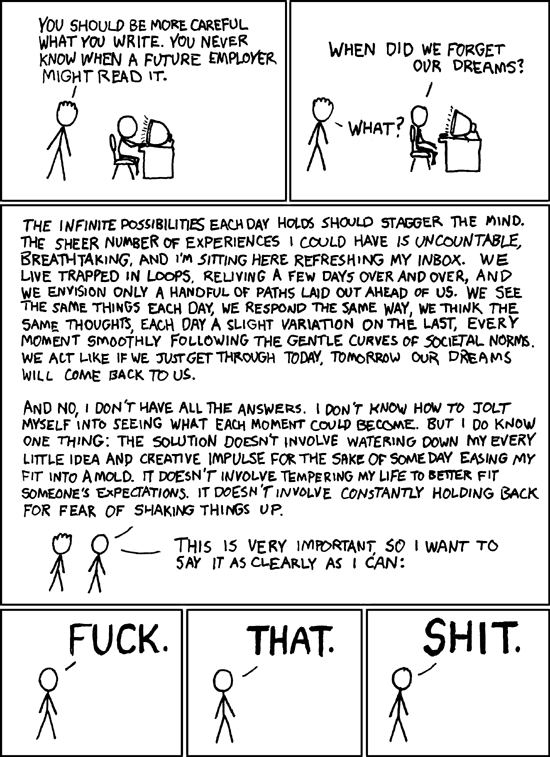
In preparation, here's an xkcd comic that sums up a little of where I'm going.

Saturday, April 17, 2010

The New Thing is coming in 2 days

Bill Cunningham over at Pulp 2.0 tweeted the following: "Quit asking permission to create something."

He then followed up with this post (which I will now sample and remix):


You don't need anyone's permission to write, film, draw, compose - whatever.  You just need to fail at it for awhile.  

Anything worthwhile that's been created, invented, theorized and developed has been the result of failure. Lots and lots of failure. 

People look at the end product and get intimidated by its slickness. They don't see the many iterations - the many failures - that led to the success. 

Don't get intimidated by the end product. Keep trying. Keep failing. Learn from those failures

Do it, and if you like it - great. If not, if you can live without it - then you feel good about moving on.

The New Thing isn't about asking for permission. It's a discussion.

Oh, and Andrew and Lucy made this in an evening.


29,032 views at the time I wrote this.

Friday, April 16, 2010

The New Thing is coming in 3 days

Here's a post by Clay Shirky that made me question what I'm about to do. I've edited the quote I found most relevant:

In the future, at least some methods of producing video for the web will become as complex, with as many details to attend to, as television has today ...

(However ...)

The most watched minute of video made in the last five years shows baby Charlie biting his brother’s finger. (Twice!) That minute has been watched by more people than the viewership of American Idol, Dancing With The Stars, and the Superbowl combined. (174 million views and counting.)


Some video still has to be complex to be valuable, but ... expensive bits of video made in complex ways now compete with cheap bits made in simple ways. “Charlie Bit My Finger” was made by amateurs, in one take, with a lousy camera. No professionals were involved in selecting or editing or distributing it. Not one dime changed hands anywhere between creator, host, and viewers. A world where that is the kind of thing [means] complexity is neither an absolute requirement nor an automatic advantage.

Thursday, April 15, 2010

The New Thing is coming in 4 days

Seth Godin wrote one of the most important things I've read this year: the implications of having an idea that infects others.

I've mentioned this post before - it ties in to the idea of 'stickiness' that I've been blogging about in my synopsis of Made to Stick. Stickiness is a way of describing how memorable an idea is and how easy it is to transfer that idea from one person to another.

Say I write a blog post that gets 12 readers. How many people does that first generation of 12 readers tell it to? How many people does that second generation tell? As Seth says:

If you start with 10,000 fans and have an idea that on average nets .8 new people per generation, that means that 10,000 people will pass it on to 8000 people, and [they'll pass it on to] 6400 people, etc.
... Pretty soon, [your idea] dies out.

On the other hand, if you start with 100 people (99% less!) [but your] idea is twice as good (1.5 net passalong) it doesn't take long before you overtake the other plan. That's not even including the compounding of new people getting you people.

But wait! If your idea is just a little more viral, a 1.7 passalong, wow, huge results. Infinity, here we come.

The New Thing takes this as its starting point.

Wednesday, April 14, 2010

The New Thing is coming in 5 days

This is important. Svend linked me to this great talk by Ed Catmull a co-founder of Pixar, about their corporate culture, and story-creation process (it's about an hour long):


Here's the big thing I took away from it:

When you start to make ... anything (a film, a game, anything) it isn't very good. You have to go through a lot of steps to get to good. You can feel you're making progress if you can see it's taking a step forward every three to six months.

So there's some success criteria from the people at Pixar: it doesn't need to be perfect; it just needs to be moving forward regularly. From my experience, there are many ways I can tell one of my projects has taken a step forward, including:
  • I've deepened my understanding of the material
  • I've found a simpler, more elegant way of expressing the idea
  • I've figured out what it's really about
What's important for me, though, is that I think this applies to more than just creating ... stuff. I think it applies to personal development, time management, and the feeling I want of being on top of my life. This principle (a step forward every three to six months) takes the pressure off needing the 'perfect' system that makes everything all right. It's shown me that it's good and reasonable to think of my life as a work-in-progress, as long as I'm happy that I'm actually progressing (taking those steps forward).

In the last two years the big steps forward have been PLAY, getting comfortable with dating, and free writing (which I'll talk about very soon). Next is the New Thing - which will be coming in five days.

More things I took away from the Pixar talk after the jump ...


Sunday, April 11, 2010

Made to Stick: Tell me a Story

The right story makes you act

In Made to Stick, the Heath brothers describe six principles that make your idea sticky - that make it easy for people to remember and tell others about. Those six principles (and the effects they have) are:
  1. Simple ideas help you remember.
  2. Unexpected ideas make you pay attention.
  3. Concrete ideas help you understand.
  4. Credible ideas make you believe.
  5. Emotional ideas make you care.
  6. The right story makes you act.
Principle 6 (the right story makes you act) is something that I've seen in a book I reviewed last year (The Elements of Persuasion).

Stories demonstrate how you can act - what steps you can take, what obstacles you might face, how to overcome them, and what results you might expect. In The Elements of Persuasion, Richard Maxwell and Robert Dickman talk about the role of the Hero - the character who embodies your message, and demonstrates "how to live your story".

A well-told story gives your audience enough information so they can mentally test how they would handle the situation. This mental rehearsal is the next best thing to actually doing something. As the Heath brothers say, stories are like flight simulators for the brain.


Sunday, April 04, 2010

Made to Stick: Let's get Emotional

Here are a couple of anti-smoking ads for you to watch, and then I'll describe what Made to Stick has to say about the role of emotion in delivering an effective message.


Compared to this:


These two ads started airing at almost the same time in the US. When teenagers were asked if they remembered any anti-smoking ads, 22 percent thought of the first 'Truth' campaign, while only 3 percent thought of the second 'Think' campaign.

Why is this important? Why is it important that more people remember the highly emotive ad that creates feeling of rebellion, resentment and belonging to a peer group than the lighter, gentler 'Think' ads?

Made to Stick suggests a couple of reasons emotion is important:

1) Feeling an emotion means you care. When people care, they're more likely to remember and they're more likely to act on what you're saying

2) The more we reason and think, the more our ability to feel is inhibited. Analysis prevents compassion. Made to Stick cites several examples of ads in the 'World Vision helping children in developing countries' genre. That feeds back into Point (1) - basically, the less you think, the more you act.


Friday, April 02, 2010

Testosterone!

With the A-Team and The Losers coming out,(*) it's going to be a good year for action movies in which a band of elite soldiers are betrayed by someone (causing them to seek revenge).

(*) And the Expendables, but I don't trust that yet.


I'm surprised at how fun the A-Team looks, and concerned at how the trailer for the Losers seems too fun - doesn't quite capture the tone I liked from the comics.

... Hmm. OK. After actually watching the new Expendables trailer - I've changed my mind. All three of these films have great casting, and look like they're going to deliver my fix of badass.