Showing posts with label film. Show all posts

Sunday, June 16, 2013

This week, I've been learning Adobe Premiere and After Effects

I recut the Jenni's Angels 48 Hour film from 2010: 'Ultimate Monster Fighter: Showdown' (UMF:S). It was a small project to ease back into editing and teach myself the basics of Adobe Premiere.

'The Hunt' is the result:


As I looked over the raw footage of UMF:S, I felt that I really wanted to concentrate on the story of the fight between Jon and Kerina. Figuring out the beats of that story and how to play it tighter and more seriously than UMF:S took a while.

It became clear that it'd be cool to insert a special effect into one of the sequences of the fight. Until this week, I'd never created a special effect but I've watched Norman and Andrew use After Effects to do some great stuff, so I decided to boot it up and teach myself how to use it (google proved helpful).

The weak spot is definitely my sound mixing skills. I haven't figured how to balance all of the elements yet, and that's crucial to any film playing properly.

I'm looking forward to doing more of this.

Here's the original 'Ultimate Monster Fighter: Showdown':


... which is, itself, a sequel to 'Monster Hunter IV: Beyond Repair':

Sunday, August 26, 2012

Disappear Into Light (2012)

Just watched Leonie's documentary "Disappear into Light", which is about the production of Jo Randerson's play "Good Night. The End."

I know quite a few of the cast and crew involved in this, and it's amazing watching the very natural process of talented people try to find a creative process that works for them.

The doco creates a real sense of tension during rehearsals by simply observing the process of trying to find the best way to discover the truth in scenes and characters. It's also great at illustrating some components of what makes up a scene (from the actors' POV): the actions that accompany a line of dialogue and the intent behind the line, the timing and delivery of lines between actors, and how important trust and a good communication process are between actors and director.

The whole thing culminates with a vivid depiction of the point in pre-production when cast and crew know their parts and what they have to do, and people are having fun pulling the show together, but everyone is also starting to focus on the approach of Opening Night.

I haven't found a dedicated webpage for this, so here's a link to a press release: http://www.scoop.co.nz/stories/CU1205/S00214/disappear-in-light.htm

And here's an interview with the director: http://wellywoodwoman.blogspot.co.nz/2012/05/leonie-reynolds-jo-randerson-disappear.html

Sunday, April 22, 2012

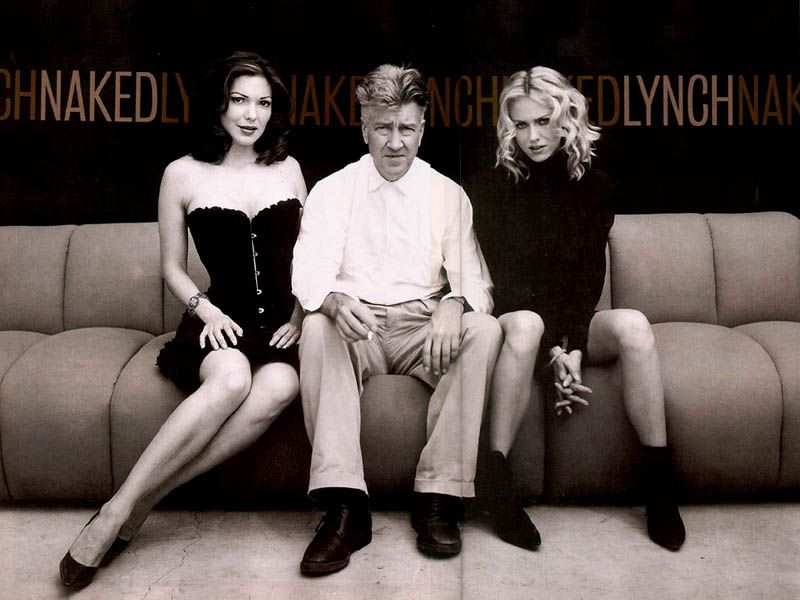
I’m rewatching Mulholland Drive (2001) ****

I really didn't like Mulholland Drive when I saw it at its premiere at the NZ Film Festival in 2001/2002, and this is the first time I’ve been back to David Lynch's film.

So I’m coming at this (very literal) review as someone who’s seen it before, has utterly vague memories of how the story plays out (there’s a blue box and a crazy director and a Lost Highway ‘reality’ twist in it), and who remembers the audience (and me) being profoundly alienated by the movie after it finished. What you're about to read are my real-time reactions, as I re-watch the film.

The movie starts with an upbeat highly stylized green-screen dance number. I have absolutely no memory of this. And no idea about how it thematically relates to the rest of the story. I do notice however, that for some reason it starts to become disturbing after about a minute – but I have no idea why (there are some discordant notes in the music, and possibly some subliminal images in the background, and – possibly – some disturbing facial expressions or body language from some of the dancers).

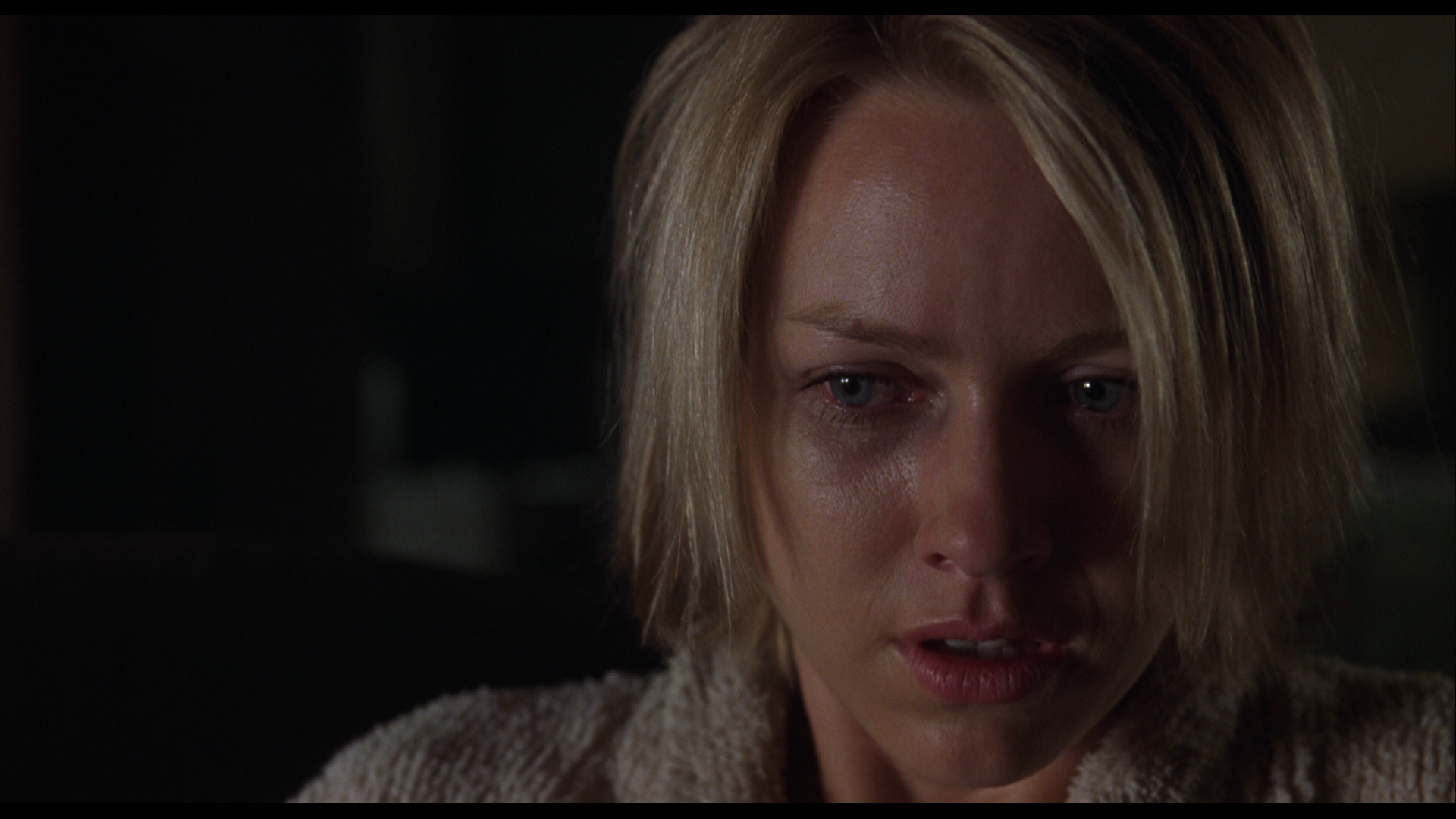
When we cut into the movie proper, I expect to see Naomi Watts (newly arrived to LA) leaving LAX in the middle of the day with an elderly couple: that’s my memory of how the movie starts.

Instead, we cut to the middle of the night and a violent noir based car crash and hunt for a missing person. Who is the beautiful woman I remember first appearing in the middle of the film. This stuff is perfectly executed: there’s a Lynchian off-centre quality to it, but it’s tight, makes me car about the as-yet-unnamed character, sets up a world surrounding her, and even has a lovely ending (showing how she plausibly sneaks into an empty house).

And from there we cut to something I also remembered happening in the middle of the film – so I completely throw out my assumptions that I have any idea what’s going to happen next – another perfectly executed sequence in which a man sitting in a diner describes a nightmare he had, and then we see him experience it in real life.

There are lots of nice techniques used in this ‘real nightmare’ sequence: camera angles gradually rising above the head of the man having the nightmare (to put him in a weak, vulnerable position); a threatening hum growing louder in the score; dialogue seeming to cut out as the panic in the scene increases (very reminiscent of the arrival of David Bowie in Fire Walk with Me).

At the moment, none of these three things seem to have anything to do with each other. My working hypothesis, then, is that Mulholland Drive is a movie of very cool, slightly-connected short films.

And now, 18 minutes into the film, Naomi Watts (who plays what I remember to be the main character) shows up.

Over the course of the next 50 minutes, the movie continues to present what appears to be great self-contained short films (a really funny casting meeting between a film director and two Mafioso; a series of pratfalls involving a hitman with really bad luck) – but we keep cutting back to Naomi Watts (Betsie), who is now interacting with the beautiful car-crash woman (Rita). The tone of their scenes and plot details that emerge establish Mulholland Drive fairly firmly as a noir (a bag full of thousands of dollars; a beautiful woman with amnesia; the sense that powerful forces are hunting for them).

However, there’s another tone that’s being layered in as well: horror. It comes from the scenes that surround the Betsie-Rita plot; from music cues; from events that happen to Betsie (a possibly psychic woman delivers a dire warning). In the cleverest use of subtext to deliver horror, Betsie and Rita have a conversation in the same diner where the man from the start of the movie relayed his nightmare. Without using any overt camera angles or musical cues, Lynch is effortlessly able to create tension – and the dread that the mysterious figure from the man’s nightmare will suddenly appear here.

There’s also the subtlest (and, then, increasingly slightly-less-subtle) hints of romance flickering to life between Betsie and Rita. I remember this becomes more important as the film goes on.

All the while, though, the film is knitting together the ‘short films’ into an over-arching plot: the unlucky hitman is (a) possibly working for the two Mafioso and (b) searching for Rita. The film director (Adam) has been forced to cast a woman in his film – a woman who looks a lot like Betsie. If he does cast Betsie, however, that will be the wrong woman – and very bad things will happen.

It’s the anticipation of that that’s keeping me interested in the film at the moment. The rest of it is good: coherent, funny, idiosyncratic and sexy – but I want to see how the Adam and Betsie sides of the plot collide.

And all the while, I’m remembering that at some point in the future there’s going to be a scene in a nightclub, and that the consequences of that scene will totally shift the tone and storyline of the film. I’m fascinated to know when that’ll happen, how much story will be left afterward (an epilogue? an entire act?), and whether I’ll be invested in that ‘reality twist’. I can certainly remember feeling betrayed or alienated by it last time I saw it.

Anyway, back in the moment: the film spends the next 20 minutes directly addressing all of the questions I’m interested in, and in a really fascinating and oblique way. There’s a audition, yes – but it’s both a fake-out (in that it’s revealed to be a different movie than Adam’s) and filled with really interesting subtext: about exploitation in Hollywood, about the different ways performance can be used to affect the emotional presentation of a script, and it also demonstrates that Betty actually has talent – something the film to date has been a little shy about dealing with, preferring to show her as a naïve country girl who might be a big shot in her hometown but who is out of her depth in LA.

(Speaking of which, Mulholland Drive also shows us a lot of different economic and geographic facets of LA. It has a real sense of place and feels complex.)


The Adam and Betty meeting also doesn’t go how I expected (instead of a sitcom misunderstanding there’s a complete capitulation), but it gives us something better: an attraction or connection between Adam and Betty that I want to see more of.

And from there, the movie hits its strongest streak of sustained narrative: following Betty and Rita through an investigation, a break-in, a discovery, sex and love, returned memories, a surreal performance, a disappearance, an amazing performance of Roy Orbison’s Crying (which really feels like we’re saying goodbye to our characters and the status quo – seriously, this is a transcendent moment in the film) and finally the truth about the blue box.

It’s during this streak that a bunch of overt optical effects start getting used: multiple images of Betty and Rita layered over each other while they panic; some odd lens flare en route to the performance; an almost Evil Dead camera push-in outside the mysterious Silencio club.

And then the twist.

I actually wish I was struggling to interpret what was going on: is this the afterlife? A flashback? Did Betty never really exist at all? Was the first 110 minutes of the film just a dream?

But at the moment, eight minutes in to the revelation of what’s on the other side of the blue box, the interpretation seems pretty obvious: what we’ve just watch is an idealized version of Diane’s love and life, and it’s either a dream or the final moments before she shoots herself.

However, rather than feeling betrayed by that (as I now remember I did during my first viewing), I can make the argument that the structure of the film so far has prepared me for this. I’ve spent a lot of time feeling like I was watching a series of short films. This section is also like a short film, but with a massive switch in tone: from horror-noir with a dash of romance to a piece about depression with a dash of the craziness and jealousy of a failed relationship.

(And to be fair, the film does lay in a lot of hints throughout the first hour and a half: among others, Betty describes the apartment she’s staying in as a “dream place”; when she arrives in LA – and there’s a lot of cute dialogue like that.)
  
The biggest problem with this “It was all a dream” structure is that the storylines I was invested in and wanted to see closure in won’t happen. I’ll never find out how Adam resolves his problems with the Mafia (although I can assume that everything ended happily after he chose ‘the right girl’ for his film). The unlucky hitman may not have a place in this new reality, so he’s a tangent. The man with the nightmare either doesn’t relate to the film or becomes a massive commentary and early hint about the nature of the film. This is a variant of what I call the ‘John Locke’ problem (from Lost): we think we’re following one character around, and then it turns out we’re actually following another.

Now, as the film continues, and shows me the close-to-the-starting shot of a car driving driving up a hill at night. What is Mulholland Drive trying to do now? Loop us back to the start of the film but with Betty/Diane in the car instead of Rita/Camilla?

No. It’s giving us a magical experience of Diane and Rita/Camilla apparently in love and going to a party hosted by Adam, … and then taking it all away from us in a wave of jealousy, loss, insecurity, not fitting in, barely repressed anger.

And then what the fuck?

The film cuts away from the party – an incredible hard-cut on Diane’s utter anger and the first frame of an emotional clusterfuck – into … another reality? That’s my first thought: that now we’re in the ‘real world’, one where Betty/Diane has become (or was all along) a hooker we saw incidentally in a previous scene, hanging out with the hitman.

And this hard-cut has taken us into the diner where the nightmare took place again – instantly raising a sensation of impending dread …

… this is, actually, pretty great stuff …

But it’s not another reality – it’s a flash-forward, to Diane putting a hit on Camilla.

Which gives me everything I need to (roughly) figure out the film’s true structure:
  • When we first enter/wake into this ugly new reality (after opening the blue box), that’s at the end of the timeline
  • Dianne and Camilla are friends
  • Camilla leaves Dianne
  • Dianne discovers Camilla is dating Adam, and that those two are getting married
  • Dianne orders the hit
  • Dianne, depressed (this is where we first switch into her reality)
  • The hit happens (perhaps it’s the failed murder attempt at the beginning?)
  • Dianne kills herself after being haunted.

I was going to rewatch the last 20 minutes of the film, to confirm this, but while I was putting the finishing touches on this post, Film Critic Hulk did it for me, in a great piece from someone who’s watching the film 11 times:


This is a insightful critique that confirms a lot of what I thought, but it's also given me a lot more to think about (including the role of the Cowboy). To my surprise, I now think I'll be rewatching this film again.


Saturday, September 03, 2011

How my Film Festival turned out (I liked 6.5 out of my 7 films)

Cave of Forgotten Dreams:


What I said before the film: I've always wanted to see the paintings in Chauvet-Pont-D'Arc, and a 3D tour guided by Werner Herzog seems like my best bet to achieve this dream.


My take: A thought-provoking, poetic, slightly challenging guide through the cave paintings of early cro-magnons. The experience was so vivid that a few times I totally drifted off and imagined what it would have been like to have lived 35,000 years ago. I'll definitely see this again.


Recommended to: John-Paul


13 Assassins:


What I said before the film: Takeshi Miike does a samurai film that's better than his best film? That's some hype I need to check out for myself.


My take: This film has a great set-up that examines how duty and honour collide with morality, when you serve a really loathsome villain who happens to be related to the Emperor. I was a fan of how most of the movie unfolded, but I felt the start of the epic final battle was far too comic-book (in the sense of being detached from a sense of reality). However, that soon faded and that final action sequence was a really brutal and satisfying series of slugfests and murders.


Recommended to: Pearce (who has surely already seen it), Chuck, Dean, Keane, Wayne.


Taxi Driver: 


What I said before the film: I really disliked this the first time I saw it, but I suspect I completely missed the point. Seeing a restored print in 35mm seems like the best way to determine what I think of it.


My take: A great portrayal of a place and time (1970s New York), and of the mind and POV of a mentally unstable man.

In fact, it made me think about how effective the script-writer and the editor can be in a highly-POV based movie: selecting what to show the viewer and what emphasis to place on it. Nearly every scene contained an element of sex, race, or violence that reinforced Travis' world-view.

As for that ending: Scorsese is on the record as saying it's literal, that Travis survives and is hailed as a hero (but that he'll probably do it again, and next time he won't be so lucky). I don't think the film supports that, though: when I look at the trouble Travis caused the presidential campaign on three separate occasions, I can't believe that Cybill Sheppard would treat him the way she does at the end - and if I can't believe that, then it undermines the reality of the ending for me.


Recommended to: ... a hard call. Perhaps Jennifer, given that it's a landmark 70s movie.


Another Earth: 


What I said before the film: Seeing the trailer after Sundance sold me on the tone it looks like this film's going for: introspective, melancholic science-fiction.


(This trailer contains spoilers, but they're so good that I think it's worth watching.)


My take: Far more of an indie movie than a science-fiction film. It's maybe 95% indie to 5% science fiction. In its indie A-plot, Another Earth focuses on two wounded people - one of them trying to find a reason to live; the other trying to atone. However, its B-plot (of a second identical Earth suddenly appearing in the night sky) contains four spectacular scenes.


All the way through watching this, I thought the film had another gear that it was going to shift into, a gear involving spaceships and Michael Bay-esque slo-mo training montages. Instead the film goes in a radically different direction - one that I enjoyed just as much because it was so true to the characters.


The film's premise makes a promise to the viewer, and Another Earth totally delivers on that promise. It delivers on it in such an understated way that I was still having realisations about its implications a day later. The ending strongly implies that Brit Marling (who's fantastic as both a script-writer and an actor, and I hope we see a lot more of her) has really been (and will continue to be) a hero, and that her choices involving William Mapother's character were right for a lot of reasons.


Recommended to: Chris


Martha Marcy May Marlene: 


What I said before the film: my must-see of the festival due to the subject matter: a young woman trying to leave a cult.


My take: Aaaahhhh. High expectations - you almost always screw with me.  Yes, this is a fantastic film, at least for the first hour. It's subtle, it feels psychologically accurate, and John Hawkes (as the cult leader) and Elizabeth Olsen (as the newest member of the cult) give great performances where you completely understand everything they're doing without needing to spell it out with dialogue.

The script also uses an flashback structure that immediately gets us into interesting situations in both the present day and the past. Another benefit of the structure is that it allows Olsen's character to make some really inexplicable, potentially audience-alienating decisions which then get explained and well-motivated later on when we see the same situations repeated with other characters.


The film has a major flaw, though, that meant I increasingly couldn't buy into it. The major relationship in the present-day story is between Olsen and her big sister (Sarah Paulson). There's a lot of good material in there: a sense of history and emotional baggage between the two of them, which is only aggravated by Olsen's refusal to explain what happened to her. But the problem is that the structure of most of their scenes together is identical - Big Sister tries to find out what happened, Little Sister blocks her, Big Sister gets increasingly frustrated.

I found myself rewriting that aspect of the film as I watched it (never a good sign). In my rewrite, the older sister is more proactive in trying to find out what had happened; she tries different techniques and approaches to opening her sister up. She wouldn't necessarily need to succeed, and I'd keep all of the other pressures in the older sister's life that are stressing her out, ... but making the older sister smarter and more focused makes her an antagonist for Olsen (and makes her silence even more meaningful).


Recommended to: Luke, Debbie, Matt, Svend, Morgue, Mike, Sophie and Simon (if you want to re-capture some of that Phoenix or Apocalypse World vibe.)


Troll Hunter: 


What I said before the film: Actually, I'm a little suspicious of this one. I fear that a mocumentary about troll disposal experts in Scandanavia might actually be a little too silly to be good, but I'm prepared to take a chance on it.


My take: So much fun. The film makes the masterful decision to play things pretty conventionally for a long long time, making it a character study/surveillance of a weirdo recluse ... and then, when things start to get into potentially silly territory, the film leavens it at every stage with touches of horror, suspense, and pathos. And some pretty cool action sequences.

Recommended to: Gino


Overall: I give the 2011 New Zealand International Film Festival a 6.5 out of 7.

Sunday, August 07, 2011

Ask yourself this: Have you meddled with the primal forces of the universe lately?

Network is an amazing script and an amazing movie. Reading this article at Daily Kos (Daily Kos: "Network" and Our Current Epistemic Crisis) reminded me of my favourite moment in a film filled with great speeches, great silences, and amazing performances.

Fair warning: this is a massive spoiler - not in terms of plot but in terms of the film's emotional flow.

Newscaster Howard Beale has been giving a series of riveting, rabble-rousing speeches on his TV show. Ratings are soaring.

During one speech, he rips into a take-over deal where a Saudi Arabian conglomerate will buy out the TV network he works for. The chair of the company that owns the network, Arthur Jensen, asks Howard to meet him and discuss Howard's latest speech.


Watch the video. It's about 5 minutes long. Here's the transcript:


You have meddled with the primal forces of nature, Mr. Beale, and I won't have it!! Is that clear?! You think you've merely stopped a business deal. That is not the case. The Arabs have taken billions of dollars out of this country, and now they must put it back!

It is ebb and flow, tidal gravity! It is ecological balance!

You are an old man who thinks in terms of nations and peoples.

There are no nations. There are no peoples. There are no Russians. There are no Arabs. There are no third worlds. There is no West. There is only one holistic system of systems, one vast and immane, interwoven, interacting, multivariate, multinational dominion of dollars. Petro-dollars, electro-dollars, multi-dollars, reichmarks, rins, rubles, pounds, and shekels.

It is the international system of currency which determines the totality of life on this planet. That is the natural order of things today. That is the atomic and subatomic and galactic structure of things today! And YOU have meddled with the primal forces of nature, and YOU WILL ATONE!

Am I getting through to you, Mr. Beale?

You get up on your little twenty-one inch screen and howl about America and democracy.

There is no America. There is no democracy. There is only IBM and ITT and AT&T and DuPont, Dow, Union Carbide, and Exxon. Those are the nations of the world today.

What do you think the Russians talk about in their councils of state -- Karl Marx? They get out their linear programming charts, statistical decision theories, minimax solutions, and compute the price-cost probabilities of their transactions and investments, just like we do.

We no longer live in a world of nations and ideologies, Mr. Beale. The world is a college of corporations, inexorably determined by the immutable bylaws of business.

The world is a business, Mr. Beale. It has been since man crawled out of the slime.

And our children will live, Mr. Beale, to see that perfect world in which there's no war or famine, oppression or brutality -- one vast and ecumenical holding company, for whom all men will work to serve a common profit, in which all men will hold a share of stock, all necessities provided, all anxieties tranquilized, all boredom amused.

Wednesday, July 27, 2011

My Film Festival

I love how everyone's film festival experience is completely different. I read Dan Slevin's Preview: 2011 Film Festival, and there's almost no overlap between us (except for an architecture doco that's on my C-list).


Anyway, tickets have been bought, and here's what I'm definitely going to:

Cave of Forgotten Dreams: I've always wanted to see the paintings in Chauvet-Pont-D'Arc, and a 3D tour guided by Werner Herzog seems like my best bet to achieve this dream.


13 Assassins: Takeshi Miike does a samurai film that's better than his best film? That's some hype I need to check out for myself.


Taxi Driver: I really disliked this the first time I saw it, but I suspect I completely missed the point. Seeing a restored print in 35mm seems like the best way to determine what I think of it.


Another Earth: Seeing the trailer after Sundance sold me on the tone it looks like this film's going for: introspective, melancholic science-fiction.


Troll Hunter: Actually, I'm a little suspicious of this one. I fear that a mocumentary about troll disposal experts in Scandanavia might actually be a little too silly to be good, but I'm prepared to take a chance on it.


And I'm also intending to go to these daytime sessions:

Martha Marcy May Marlene: my must-see of the festival due to the subject matter: a young woman trying to leave a cult.

Metropolis: Just like with Greed, you only get a few chances to see classics on the big screen. I'm going to take this one.

Saturday, October 09, 2010

The Hobbit: Wingnut vs Unions (Round 2)

Oops! This should have auto-posted days ago, but it's been stuck in my Drafts folder. I'll post it now, and I've scheduled some more posts to appear while I'm on holiday. See you next weekend!

There have been some further exchanges of press releases and articles in the Peter Jackson/Wingnut Films vs the Media Entertainment and Arts Alliance (MEAA) battle for hearts and minds. In my Round 1 post, I focused on breaking down the initial press releases between the two organisations. In Round 2, I want to look at the analyses and comments from The Standard and Kiwiblog to see whether viewing the issue through a more political lens can throw some light on things.

First, though, I might try and summarise my current understanding of the positions of both parties. This is definitely a work in progress and I don't guarantee its accuracy; part of why I'm writing these posts is to try and figure out exactly what is going on here.

The MEAA is representing its New Zealand subsidiary, NZ Actors' Equity. The MEAA's negotiations are intended to provide actors in the production of the Hobbit with access to residuals (dividends) from the film's distribution. Providing residuals for actors appearing in a production is standard international practice. As 'Anonymous' pointed out in the comments to my previous post (and I'm paraphrasing), the New Zealand contract would also give people the protections of employment law (such as minimum wage, right to challenge dismissal etc).

Wingnut Films (through the public face of Peter Jackson) takes the position that the MEAA is no longer a legal entity as it was struck off the Ministry of Economic Development’s (MED) Register of Incorporated Societies last week (source: Screen Hub, via Kiwiblog). Because it's no longer a legal entity, it can't be negotiated with (*).

* Which ignores the fact, if I've got the timeline correct, that 
MEAA was a legal entity in NZ when it issued its August 17 letter.

Wingnut states that if they hire an actor who is a member of SAG (the American-based actors' guild), they honour the provisions in the SAG contract dealing with residuals. Their press release also states:
For the Hobbit, Warner Brothers have agreed to create a separate pot of profit participation, which will be divided up amongst non-SAG actors who are cast in the film. This was not done because of any pressure from Guilds or Unions - it was actually Warners doing the decent thing, and New Zealand and Australian actors will be the principle beneficiaries. SAG members have their pot, and non-SAG members now have theirs.
Finally, Wingnut is also positioning this as a fight for the survival of the New Zealand film industry (or at least its ability to attract big-budget overseas productions to film on location here).

A particular point of contention seems to be the number / percentage of New Zealand actors that are represented by this union. As Svend pointed out in the previous post's comments, there's a standard figure of 80-90 actors, with the initial Wingnut press release estimating the available pool of NZ actors as between 1000 and 2000. An alternative calculation, here, indicates that 588 people identified their occupation as 'actor' in the 2006 census, and the initial Wingnut press release estimates the membership of NZ Actors' Equity as being between 100-200 actors.

There's an attributed quote over at Russell Brown's Hard News post about this that might shed some light on this issue:

"John Barnett told me he suspected the union let its registration lapse (by failing to file reports for the last three years) to avoid having to reveal the size of its membership." (opinion)

And there's one question I still want to know the answer to is, "How much would employing unionised actors with contracts that give them residuals cost The Hobbit production?"

Anyway. On with my cutting and pasting of other people's posts on this subject. IrishBill at The Standard has a nice summary of a particular perspective on the issue ('Union boycotts Jackson'):
I’ve known quite a few film workers over the years, workers who were happy to work long hours for bugger all money when the industry was in its infancy simply because there wasn’t much money about and they were getting valuable experience.


But nowadays the industry has established itself, there’s clearly enough money for Jackson to have his own private jet and international stars are here shooting on a regular basis.

The thing is the terms and conditions haven’t changed – film workers are still being paid peanuts, being treated as independent contractors to avoid employment law, missing out on royalties and being blacklisted if they dare to complain.

...

The man with the $68m private jet and the castle and the millions of dollars of vintage aeroplanes and the knighthood says the union is greedy because it wants a fair deal for its members. And it’s not a matter of him keeping sub-standard work conditions, it’s a matter of national importance!
Digging through the comments thread for insights produced the following not-necessarily-verified observations:

  • There were actors in LOTR who were unable to profit properly from their use in the film (for money made from licensing products bearing their image) because there are no effective collective agreeements here.
     
  • Since 2006 NZ Actors’ Equity has been an ‘autonomous’ branch of the Media, Entertainment & Arts Alliance and has been an affiliate member of the Council of Trade Unions under its MEAA name. It was struck off the Ministry of Economic Development’s Register of Incorporated Societies last week under its registered name of Media, Entertainment and Arts Alliance.It is therefore an unregistered union under the Employment Relations Act and is therefore legally unable to negotiate a collective agreement for its members. It’s also illegal for Peter Jackson to enter into negotiations with them for the same reason.
     
  • You get the impression that there is some pretty significant blacklisting goes on inside the industry. The only real way of fighting that is to do it collectively.
     
  • As far as I know there’s been debate for quite a while about the relative lack of unionisation of Kiwis working in the international film and TV industry in NZ (for crews as well as cast). It has been argued that one of the advantages is that things get done quicker because there’s less job demarcation, meaning the crew don’t need to wait for the person/s with the allocated job title to get something done. But the disadvantage is insufficient protections for workers.
     
  • It’s not Aussies telling us what to do at all .... The MEAA is the union for actors and similar workers in Australia, who have had a formal alliance with our version here for some time. They act on behalf of our actors at their request, not by way of an imposition.
     
  • These actors are employed as independent contractors, which means they have no collective bargaining rights, no rights to holidays, minimum wages etc. It\’s a great way to avoid employment obligations and the reason why Jackson can claim that NZ law doesn\’t allow them to collectively negotiate. Of course, there’s a way around it : they could be employed as employees and then there wouldn\’t be any argument about their right to negotiate.


A comment in a subsequent post at the Standard provides a little bit of historical context

On Campbell Live just now, Bruce Hopkins (actor in Hercules, Xena, LOTR), threw some light on the Jackson-actors’ union issue. It seems it goes back to some time in the 90s when the Nats deregulated unions, and set a minimum limit on the number of members needed to form a union. The actors’ didn’t have enough members to be a union & have tried attaching themselves to other unions in the past. But this wasn’t very satisfactory because they were attached to unions they had nothing in common with. So, then a key leader put out a call for a union to affiliate with in Melbourne, and MEA responded.

So, basically, they have a history of not being able to negotiate bottom-line conditions of employment. This issue pre-dates LOTR. And Kiwi actors are about the only ones in the world who haven’t been able to negotiate a basic agreement.
... which was contested in a subsequent comment:
I think Bruce should stick to the acting (which he’s rather good at) because his history is FUBAR. He might start by asking someone at the CTU to send him a copy of the Employment Relations Act – which was passed by the Fifth Labour Government.

More interesting opinions, this time from Russell Brown at Hard News:

The present unrest seems to have begun with this letter last October from the US-based Screen Actors Guild, which reiterates the SAG's Global Rule One and states that a New Zealand or Australian performer must be covered by either a SAG or an MEAA agreement to work on a New Zealand production.

The conspiracy theory, which I heard yesterday from one producer, is that the SAG is looking to protect its own members by preventing so-called "runaway productions" in Australia and New Zealand. They've succeeded in Australia, the theory goes, and now they're turning to New Zealand.
And finally, Gordon Campbell summarises the 'employee' versus 'independent contractor' dynamic nicely in his post at scoop.co.nz. I'm going to excerpt large chunks of it here, because (again) I think it helps build a broader historical context for what's going on:

According to Spada (the NZ producers association), it is against the law to enter a collective agreement with the ‘independent contractors’ that comprise the sector, and industry practice has been known to everyone (and set out in the so-called industry ‘Pink Book’) for the past 15 years.


This is a debatable version of history. In reality, the people insisting that the sector is comprised of ‘independent contractors’ are the producers themselves. The Jackson productions have been instrumental in fostering that climate – and yet now, if you believe Spada, they feel bound by a situation that enables them to require workers to manage their own tax affairs, arrange their own insurance, and qualify for no penalty rates for working at night, or on weekends or public holidays?
Conspicuously, Spada has failed to mention the case of James Bryson, an ‘independent contractor’ on LOTR who duly signed papers to that effect. After he was dismissed, Bryson asked the courts to enable him to pursue a personal grievance case. Despite the existing paperwork that Bryson had signed, the lower court found – and this was later backed up by the Supreme Court – that the determining factor was the reality of the employment situation, and not the paperwork. Bryson, the courts decided, was really in an employee situation – and thus, he could use the personal grievance mechanisms available to him under our industrial law.

That’s very relevant to the current dispute. Because it means that if the employment situation really is an employee one in most or all respects, the mechanisms open to employees – such as collective bargaining – should be available. This leaves Jackson with at least a couple of options. He could volunteer to waive the demand that the people he hires accept the (arguably, bogus) status of ‘independent contractor’ and start treating his workers onset as what many of them would seem to be in practice : namely, employees. Or short of that – he could recognise that the contractors can negotiate collectively with his Three Foot Seven company over conditions on The Hobbit – and this, arguably, can be done legally if done openly, and without the aim of carrying out wage and price fixing within a negotiated market.

OK, there's lots of lots of links and extracted comments and quotes there. What are your thoughts on the above? I'm going to mull over it for a while, and try and bring it all together after I get back from my holiday. In the meantime, I'll be setting the blog to auto-post some book and music reviews.

    Tuesday, September 28, 2010

    The Hobbit: Wingnut vs Unions (Round 1)

    I feel like the current negotiation-by-press release between Peter Jackson/Wingnut Films and the Media, Entertainment and Arts Alliance is worth some closer analysis.

    What I thought I'd do is have a look at the bigger blog posts and press releases I can find, and extract facts and negotiating positions from them. Going into this, I don't have a strong opinion about the outcome; I'd say my default attitude is that I think unions are a useful and sometimes necessary counter-balance to the power held by an employer.

    I think what I'll do is start with the stuff.co.nz article where I first read about this: Jackson fights to save Hobbit. Here are the first two paragraphs:

    Sir Peter Jackson says he is fighting to save The Hobbit films, thousands of jobs and the New Zealand film industry in the face of a threatened actors' boycott orchestrated by an "Australian bully boy" union.

    The Media, Entertainment and Arts Alliance (MEAA) says Hollywood stars Sir Ian McKellen, Cate Blanchett and Hugo Weaving support a boycott of the film because actors may be employed on inferior non-union contracts. 
    I'll try breaking down the rest of this article into 'verifiable facts',(*) 'opinions' and 'leverage' (for a negotiation).

    * Just because a fact is 'verifiable' doesn't mean I've verified it. It just 
    means someone's making a claim that could be fact-checked.

    • Jackson said he was a "very proud and loyal member" of three Hollywood unions (verifiable fact)
    • [Jackson is] "not anti-union in the slightest". (opinion)
    • He always honoured actors' union conditions if they were union members (verifiable fact/opinion)
    These first three points are presenting Peter Jackson as a reasonable individual to negotiate with.


    • "An Australian bully-boy [is trying] to gain a foothold in this country's film industry. They want greater membership, since they get to increase their bank balance." (opinion)
    • "I feel growing anger at the way this tiny minority is endangering a project that hundreds of people have worked on over the last two years, and the thousands about to be employed for the next four years, [and] the hundreds of millions of Warner Brothers dollars that is about to be spent in our economy." (opinion/leverage)
    • Losing The Hobbit would leave New Zealand "humiliated on the world stage" (opinion/leverage)
    • "Warners would take a financial hit that would cause other studios to steer clear of New Zealand", Jackson said. (leverage)
    • "If The Hobbit goes east [East Europe in fact], look forward to a long, dry, big-budget movie drought in this country. (leverage)
    • "We have done better in recent years with attracting overseas movies  and the Australians would like a greater slice of the pie, which begins with them using The Hobbit to gain control of our film industry." (opinion)
    Jackson presents the MEAA's demands as a financial entity muscling in on New Zealand, operating purely for profit and power, and simultaneously trying to ruin the NZ film industry (a long, dry, big-budget movie drought) and 'gain control of our film industry'. These quotes also use quite a bit of emotive language ('anger', 'humiliated', and a general tone of fear).

    The interesting thing that struck me about this section was the idea that Warners would be spending hundreds of millions of dollars on this project in New Zealand. The natural question to ask is, "How much would allowing unionised actors to work on the Hobbit cost the production?"

    • The International Federation of Actors, which represents the world's seven major actors unions and actors in 100 countries, has told members not to act in The Hobbit until they get a union contract.(verifiable fact)
    • MEAA national director Simon Whipp said "all performers" were concerned about the lack of standard union contracts for the US$150 million (NZ$204m) two-part Hobbit films.(verifiable fact/opinion/leverage)
    • "We have spoken to all the performers who have been approached, or are rumoured to be involved in, the production and all have expressed strong support [for the boycott]."(leverage)
    The article summarises the problems with a lack of union contracts as leading "to concern about whether The Hobbit producers would pay fees contained in a standard union contract, such as payments from DVD sales and video rentals."
    • "Those are the things all of us are concerned about and differentiate New Zealand, from a performer's perspective, from working almost anywhere else in the English-speaking world."(verifiable fact)
    Support for Peter Jackson's position comes from South Pacific Pictures chief executive John Barnett

    • Barnett says the Australian union's claims are duplicitous and inaccurate and made by an organisation with no legal standing in New Zealand."The MEAA has been struck off the register (of NZ incorporated societies) for failing to file any reports in the last three years, which is one reason that the production company can't enter into any agreement with it. (verifiable fact)
    • The claim that actors were at the mercy of production companies was a complete misrepresentation as there were absolute guarantees about working conditions which had been in place for the past 15-20 years. (verifiable fact)

    Now I'm wondering what the absolute guarantees are that Barnett has mentioned.

    At this point, I think it'd be a good idea to find the MEAA's original press release at scoop.co.nz. The press release itself is simply advising members of international actors guilds not to accept work on The Hobbit, which it categorises as a non-union production. The press release links to a 'Hobbit Factsheet', which links to a series of letters written to Wingnut and then to MGM and New Line.

    The first letter,'Re: ENGAGEMENT OF PERFORMERS ON THE HOBBIT', contains the following points:

    • For some time it has been a concern for performers around the world that our colleagues working in New Zealand are not being engaged on union negotiated agreements. (opinion)
    The letter goes on to state:

    Recently, The International Federation of Actors (FIA) became aware that the production of “The Hobbit” intends to hire performers under non-union contracts.
    For this reason FIA, at its most recent meeting, unanimously passed the following motion:
    “Resolved, that the International Federation of Actors urges each of its affiliates to adopt instructions to their members that no member of any FIA affiliate will agree to act in the theatrical feature film “The Hobbit” until such time as the producer has entered into a collective bargaining agreement with the Media Entertainment & Arts Alliance for production in New Zealand providing for satisfactory terms and conditions for all performers employed on the production”.
    FIA therefore encourages you to meet immediately with representatives of the Media Entertainment and Arts Alliance in order to reach an agreement covering all performers engaged on this production.

    Given the bluntness with which this position is stated, I can see why Jackson might have reacted by categorising the MEAA's approach as bullying.

    The second letter restates the position:
    We would encourage you to meet with representatives of the Media Entertainment & Arts
    Alliance (MEAA) as soon as possible. In the interim we are advising our members to refuse to sign contracts for this production until they receive confirmation from us that a satisfactory resolution has been reached with MEAA. (leverage)
    The MEAA's 'Hobbit Factsheet' summarises the position since the letters were sent:

    • The producers, through their lawyers, have refused to negotiate with the union. (verifiable fact)
    • The producers claim it would be unlawful (and a breach of New Zealand competition laws) for the
      producer to enter into an agreement with the union covering the engagement of performers on the
      production. (verifiable fact)
    • The Alliance has obtained legal advice that there are a variety of lawful means which could be used to
      establish the minimum wages, working conditions and residuals for performers on the production.(verifiable fact)
    This difference of opinion - whether it's legal for the union and the producer to enter into an agreement - seems like something that's either (a) easy and obvious to resolve, or (b) liable to end up working its way up to the Court of Appeal over the course of three to four years before a judgment is issued.

    • The producers have indicated that, notwithstanding the request to meet and discuss the terms of
      engagement of performers on the production, they intend to make imminent offers to performers. (verifiable fact)
    • In addition, they have now advised that they propose to pay some performers “residuals” on the
      production. These residuals are significantly less than the Alliance’s usual agreements in every respect.
      The producers have offered 2% of distributors gross receipts to commence for exploitations 2 years after the first US theatrical release of the film. However, it is unclear on what they would be based (for
      example what about sales which occur before the 2 years relating to use after the two year period), how these residuals would be divided between the performers and how they would be enforceable.
      It is not clear which performers may be offered this arrangement. (verifiable fact/opinion)
    • Under all Alliance agreements all performers are entitled to share in residual payments and there is no
      uncertainty about how each performer’s share is calculated or about enforceability. (verifiable fact/opinion)
    • The producers have advised they do not intend to negotiate with the union. Consequently the usual
      provisions of the New Zealand contract would apply. These include a provision which permit the
      producer to terminate the contract at any time without obligation to pay out the performer’s contract.
      This provision could also be used to justify non-payment of any residual obligation which may have been agreed above (even after the performer has performed all their work on the film and even if the
      performer’s work is used in the film). This clause alone makes the residual offer above meaningless. (verifiable fact/leverage)
    To summarise (hopefully reasonable accurately), the MEAA says that Wingnut are about to start contracting actors, offering them residuals (" a payment made to the performer in a creative work for subsequent screenings of the work") that are at less-than-standard rates. The New Zealand contracts (*) can be terminated at any point, even after the performer's finished filming and their performance is included in the finished product; the termination of that contract means the producers don't have any obligation to pay residuals.

    * It's unclear (but I'm assuming that) the contracts referred to in
    the final bullet-point are the ones intended for just New Zealand 
    actors, rather that for every actor (New Zealand and international).

    If that's accurate, it seems like a hell of a loophole to have in your contract. Even if you assume the company you're working for will act completely in good faith and not screw you over, it still seems like an avoidable risk.

    Next up, I'll have a look at the left and right wing analyses of this from The Standard and Kiwiblog. I'll also check through Peter Jackson's actual press release to see if there's any further nuance that the Dominion Post/Stuff article missed out, and through the CTU's press release.

    Friday, April 30, 2010

    A New Thing Bonus Feature: The Lone Gun Manifesto

    Clive Davies-Frayne at the filmutopia blog (one of my new favourite reads for thinking about script-writing and film production) posted this film-making manifesto, which I found so inspiring that I asked him for permission to reproduce it in full. So, here's Clive, distilling 12 years of experience into how to make a film:


         The Lone Gun Manifesto

    For the last twelve years I've been banging my head against the wall, trying to figure out how to deal with the insanity of the movie industry, whilst at the same time exploring the equally insane world of micro-budget movie making. The problem is that neither system works. The industry becomes more and more obsessed with playing it safe and the independents largely try to imitate the work patterns of the industry, only with less money. For people like me it's a nightmare, because what I want to do is make movies and have people watch them... and, to do that without investing three years of my life and all of my money into a project which then flounders around the ridiculous distribution system.

    Anyway, after many years of pondering the problems of funding, shooting and distributing movies, I believe I have an answer. However, it means completely changing the way we think about movies. It is a production philosophy designed to let creative people make brilliant movies quickly, cheaply and without exploiting the people who contribute to its making.

    Here are the headlines:

    1) One DSLR camera, One person, One microphone (The lone gun shoots alone)
    2) Strip movie making down to the basics - a camera, a great story and some actors
    3) A lone gun never asks for permission to shoot at a location
    4) Put something original and honest in front of the camera
    5) Think like a photographer, not like a film-maker
    6) Money is for food, transport and a dedicated hard-drive for each project and nothing else
    7) Natural light only
    8) Everyone who works on a movie, has the right to distribute that movie for free or for profit
    9) No credits before the title ever, regardless of how famous someone is.
    10) The end product must be cinema quality (capable of projection to cinema sizes without falling apart)
    11) A creative common license for the movie (how open you go is up to you, but people must be able to share and alter it for free)
    12) If you’re going to be a gorilla… you may as well wear the full monkey suit.

    OK. In practical terms this means that you are shooting in public places,but never in such a way that anyone is aware you are shooting. That's why it is done best with a standard DSLR camera. (I really want to see someone figure out how to do this with the RED by the way!)

    In terms of the sound recording there are two alternatives: radio mics for all cast - or the way I am doing it, a $30 pair of binaural mics, (which look like iphone headphones) jacked into a portable digital recorder. (I've tested this method and the sound quality is phenomenal, once you've got the hang of it) To use the binaural system, the actors have to set away the sound, which is placed in shot between them... and one of them is given a Zippo cigarette-lighter to clack at the start of a scene, which gives you the cue for syncing the audio.

    In reality this means you are only filming mastershots. You can't control the environment to get coverage. However, this really, really speeds up the production process. Basically, you and the actors pick your location. You decide where you are going to place the camera. When you're set up, they walk into the set up, set away the audio and play out the scene. Because there is no crew and no lines to edit, the acting can be completely natural (think Woody Allen circa Manhattan).

    Here's the list of kit I use (feel free to improvise better solutions):

    1) A good DSLR camera
    2) A portable digital audio recorder
    3) A microphone (not the kind you’re thinking about.. The one I use cost $40)
    4) A Zippo cigarette lighter
    5) A small beanbag
    6) A computer with some professional editing software on it
    7) Some actors
    8) A pocket sized notebook
    9) A brilliant idea for a movie
    10) A script
    11) A dedicated hard drive
    12) An idea about how you’re going to build an audience

    One of the things that I think makes this philosophy work is that the writer/director decides in advance, to give everyone who contributes to the movie the rights to distribute the movie for free or for profit. My project has been running for four weeks so far - we’re in writing and pre-production. The first actor I attached has already told me he has friends at a European TV station, to whom he would like to give the finished movie... along with a raft of international arts festivals. Neither of those two distribution options would ever have occurred to me. I'm working on free distribution via iTunes and also on getting a US theatrical release via some of my US contacts. Once you take the rights shackles off a project, it's amazing what happens. Seriously amazing.

    Finally, I know there are issues about working this way. It forces moviemakers to give up a lot. However, the freedoms it gives in return, to just work with a team of people quickly and creatively to make a movie, more than pays off for any restrictions.

    And… finally, if you know of anyone who would make an outstanding movie, if only they had this one piece of paper, then give it to them. Pass this on to the people you believe it will inspire.

    Thanks for reading this - up the revolution!

    Wednesday, April 14, 2010

    The New Thing is coming in 5 days

    This is important. Svend linked me to this great talk by Ed Catmull a co-founder of Pixar, about their corporate culture, and story-creation process (it's about an hour long):


    Here's the big thing I took away from it:

    When you start to make ... anything (a film, a game, anything) it isn't very good. You have to go through a lot of steps to get to good. You can feel you're making progress if you can see it's taking a step forward every three to six months.

    So there's some success criteria from the people at Pixar: it doesn't need to be perfect; it just needs to be moving forward regularly. From my experience, there are many ways I can tell one of my projects has taken a step forward, including:
    • I've deepened my understanding of the material
    • I've found a simpler, more elegant way of expressing the idea
    • I've figured out what it's really about
    What's important for me, though, is that I think this applies to more than just creating ... stuff. I think it applies to personal development, time management, and the feeling I want of being on top of my life. This principle (a step forward every three to six months) takes the pressure off needing the 'perfect' system that makes everything all right. It's shown me that it's good and reasonable to think of my life as a work-in-progress, as long as I'm happy that I'm actually progressing (taking those steps forward).

    In the last two years the big steps forward have been PLAY, getting comfortable with dating, and free writing (which I'll talk about very soon). Next is the New Thing - which will be coming in five days.

    More things I took away from the Pixar talk after the jump ...


    Monday, April 27, 2009

    You tube time travel

    And to continue with the time travel theme, a choose-your-own adventure delivered via youtube. Any ideas how make one of these things?

    Saturday, April 18, 2009

    Zombies - Bad Plans and Romero films

    Hat-tip to Simon for showing me this thread: a simple-minded teenager high on sugar products describes what he would do in the event of a zombie outbreak, and has his plan ripped to shreds by various asshats, gun fanatics, and people who take George Romero films EXTREMELY seriously.

    BTW, I just watched 'Diary of the Dead', Romero's latest flick. Good cheap fun, not ground-breaking, but nice to see Romero doing a road-trip version of the zombie film. While the idea that the survivors travel around in an RV felt a little like 'The Walking Dead' to me, it was a great way of cheaply conveying a sense of scope to the outbreak (and that scope was nicely helped along by lots of internet footage).

    Biggest problem: it doesn't quite figure out the right tone of how to mock its student film-maker protagonists.

    Biggest asset: Samuel the Amish zombie fighter.

    Biggest innovation: unlike 'Cloverfield', 'Blair Witch', 'Rec', or 'Doom', this film occasionally managed to really capture the thrills and terror of a first person shooter. Nice work.

    Wednesday, April 15, 2009

    Progress Report

    Old Thing #2: I've sent off an enquiry email about The Limit. The second round of producer submissions has finally begun. Sean, you are now under strict instructions to stage an intervention on me if I attempt another unpaid rewrite.

    Old Thing #3: I've figured out a way to structure the game's presentation; hopefully it'll be way easier to follow now. But there is much writing to be done.

    Tuesday, April 14, 2009

    Old Thing #1 is done

    I've sent off the outline for this feature to the director. Probably a few more emails and meetings before it's all closed off, but as far as I'm concerned it's finally done.

    Now to send the enquiry email and close off Old Thing #2.

    Wednesday, April 08, 2009

    Slightly Less Ambiguous Progress Report 2

    Here's how things stand:

    Old Thing 1: I am currently re-editing, and writing a little bit of new material one scene away from locking down this treatment (it's a scene I didn't expect to be problematic, but I think I can get through it if I just focus on the characters rather than the plot) and will probably get away within the next week or two two or three days.

    Old Thing 2: I need to compose have composed an enquiry email to a producer about my feature - now to send the damn thing.

    Old Thing 3: need to completely rewrite (with examples), integrate artwork, and try to release as an ashcan in time for Day of Games on May 16.

    Tuesday, March 31, 2009

    Ambiguous Progress Report

    Here's where I stand:

    Old Thing 1: am currently re-editing, writing a little bit of new material, and will probably get away within the next week or two.

    Old Thing 2: need to compose an enquiry email to a producer, and send the damn thing.

    Old Thing 3: need to completely rewrite (with examples), integrate artwork, and try to release as an ashcan in time for Day of Games on May 16.

    Sunday, October 12, 2008

    Useful links

    Here's the stuff that made it through my cull of Google Reader this week:

    Let's make some animated movies. I haven't played around with either of these sites yet, but the tutorials make it sound like it simply a matter of typing and clicking to create a short film. (h/t Pulp 2.0)

    Xtranormal
    Goanimate

    Also over at Pulp 2.0, Bill Cunningham talks about having a 'pulp notes' file, a nice tool for storing fragments of dialogue and ideas for later use.

    Let Michael Caine teach you about film-acting.

    I link to Morgue linking to Matt and Jon's applications for the Evil League of Evil. Really good, sharp characteristions from both teams (and I suspect Morgue might also find himself in contention for his 15-second cameo as the Devil's Advocate.)

    Vincent Baker has written a new fantasy RPG. At the moment it's free, because he wants to see if it's readable - is it communicating the play experience he wants?

    Here's a hack to improve pretty anything in your life. I first read this on Seth Godin's blog, but Trent over at the Simple Dollar generalises it.

    The Casual Kitchen compiles a whole bunch of links on low-cost cooking.

    An overview of some of the thinking about climate change we'll be doing as a society and as individuals over the next few years. Check it out.

    Some Paul Krugman and Americablog linkage to analysis of the financial crisis:

    If you want to kick arse at folding t-shirts, then here's how: (a 22-second instructional video)

    Have a great week

    Tuesday, January 15, 2008

    Zero budget filmmaking

    If we get war movie in this year's 48 Hour film contest, we should do something a little like this:

    Thursday, May 31, 2007

    48 - Yessss!!!!!!!!!

    Our film, Destination Earth, got runner-up for the Audience Favourite award. That was pretty much our team's goal this year, and it gives us (I think) a good shot of making the DVD.

    Time to celebrate!