.gif)
Showing posts with label review. Show all posts
Showing posts with label review. Show all posts
Tuesday, February 19, 2013

Monday, February 18, 2013
Sunday, February 17, 2013
Just gave some feedback on a game about Mars colonisaton
http://story-games.com/forums/discussion/17980/life-on-mars-beta-feedback-playtesters-wanted#Item_1
'Life On Mars' is a fascinating examination of how to present and teach a game. It's about three pages long, and each page introduces new rules into a game about a group of colonists travelling to and exploring Mars.
The game's being written for a competition that's due in two weeks. It's in a rough state at the moment, but I'll be checking out the next / finished version.
http://heartofthedeernicorn.com/downloads/lifeonmars-beta.pdf
'Life On Mars' is a fascinating examination of how to present and teach a game. It's about three pages long, and each page introduces new rules into a game about a group of colonists travelling to and exploring Mars.
The game's being written for a competition that's due in two weeks. It's in a rough state at the moment, but I'll be checking out the next / finished version.
http://heartofthedeernicorn.com/downloads/lifeonmars-beta.pdf
Sunday, September 02, 2012
The Newsroom
Do they film two versions of every ep (dramatic and farce), then splice them together in the editing room?
I enjoy THE NEWSROOM, but the only way this show makes sense to me is if I imagine that, on the set, Team Sorkin film two versions of every scene: the drama version (interesting situations and commentary; competent characters pushing for excellence) and the sit-com version (concerned primarily with romantic entanglements, filled with characters that start to flail socially and physically when confronted with matters of the heart, and with a soft spot towards farce). In the editing room, they seem to decide at random which version of a scene they'll put into the final cut.
I prefer the episodes when the ratio is 90% drama version, 10% sit-com. See Episode 3 for a really excellent example.
I enjoy THE NEWSROOM, but the only way this show makes sense to me is if I imagine that, on the set, Team Sorkin film two versions of every scene: the drama version (interesting situations and commentary; competent characters pushing for excellence) and the sit-com version (concerned primarily with romantic entanglements, filled with characters that start to flail socially and physically when confronted with matters of the heart, and with a soft spot towards farce). In the editing room, they seem to decide at random which version of a scene they'll put into the final cut.
I prefer the episodes when the ratio is 90% drama version, 10% sit-com. See Episode 3 for a really excellent example.
Sunday, August 26, 2012
Disappear Into Light (2012)
Just watched Leonie's documentary "Disappear into Light", which is about the production of Jo Randerson's play "Good Night. The End."
I know quite a few of the cast and crew involved in this, and it's amazing watching the very natural process of talented people try to find a creative process that works for them.
The doco creates a real sense of tension during rehearsals by simply observing the process of trying to find the best way to discover the truth in scenes and characters. It's also great at illustrating some components of what makes up a scene (from the actors' POV): the actions that accompany a line of dialogue and the intent behind the line, the timing and delivery of lines between actors, and how important trust and a good communication process are between actors and director.
The whole thing culminates with a vivid depiction of the point in pre-production when cast and crew know their parts and what they have to do, and people are having fun pulling the show together, but everyone is also starting to focus on the approach of Opening Night.
I haven't found a dedicated webpage for this, so here's a link to a press release: http://www.scoop.co.nz/stories/CU1205/S00214/disappear-in-light.htm
And here's an interview with the director: http://wellywoodwoman.blogspot.co.nz/2012/05/leonie-reynolds-jo-randerson-disappear.html
I know quite a few of the cast and crew involved in this, and it's amazing watching the very natural process of talented people try to find a creative process that works for them.
The doco creates a real sense of tension during rehearsals by simply observing the process of trying to find the best way to discover the truth in scenes and characters. It's also great at illustrating some components of what makes up a scene (from the actors' POV): the actions that accompany a line of dialogue and the intent behind the line, the timing and delivery of lines between actors, and how important trust and a good communication process are between actors and director.
The whole thing culminates with a vivid depiction of the point in pre-production when cast and crew know their parts and what they have to do, and people are having fun pulling the show together, but everyone is also starting to focus on the approach of Opening Night.
I haven't found a dedicated webpage for this, so here's a link to a press release: http://www.scoop.co.nz/stories/CU1205/S00214/disappear-in-light.htm
And here's an interview with the director: http://wellywoodwoman.blogspot.co.nz/2012/05/leonie-reynolds-jo-randerson-disappear.html
Saturday, April 28, 2012
The Avengers: a non-spoilery consideration of its pacing issues
This isn't a spoiler; it's the premise: The Avengers are a bunch of super-heroes that team up to fight global threats. That means the structure of the film is pretty reasonable:
Act One: In which a Threat emerges and some characters are introduced
Act Two (First Half): In which we witness a series of decidedly awkward encounters between characters
Act Two (Second Half): In which some stuff happens, and we observe the aftermath of that stuff.
Act Three: In which some further stuff occurs.
Here's my review of the movie:
 It's in the first half of Act Two that the majority of those pacing issues occur. And I think it comes down to this: the role of an antagonist is to force characters to change. Now, I think the antagonist in The Avengers (who, now I think about it, could be considered to be Nick Fury ... but that's a discussion for another day) does force every single character to change - and in ways that really reinforce one of the film's main interests: the nature of teamwork.
However, when you're watching it, notice what the antagonist does and doesn't do during the first half of Act Two. Ask yourself what their goals are, and whether they achieve them. Ask yourself: what is the immediate threat that the Avengers are dealing with? That's certainly what I'll be doing during my second and third viewing of the film - and it's the answers to those questions that created the intermittent bursts of slow pacing for me.
... Also: it's one of the funniest blockbusters I've seen in years.
Act One: In which a Threat emerges and some characters are introduced
Act Two (First Half): In which we witness a series of decidedly awkward encounters between characters
Act Two (Second Half): In which some stuff happens, and we observe the aftermath of that stuff.
Act Three: In which some further stuff occurs.
Here's my review of the movie:
The Avengers (2012) ***** Holy. Shit. Pacing issues don't detract from splendid characterisations and great action scenes. The bar is raised.

However, when you're watching it, notice what the antagonist does and doesn't do during the first half of Act Two. Ask yourself what their goals are, and whether they achieve them. Ask yourself: what is the immediate threat that the Avengers are dealing with? That's certainly what I'll be doing during my second and third viewing of the film - and it's the answers to those questions that created the intermittent bursts of slow pacing for me.
... Also: it's one of the funniest blockbusters I've seen in years.
Sunday, April 22, 2012
I’m rewatching Mulholland Drive (2001) ****

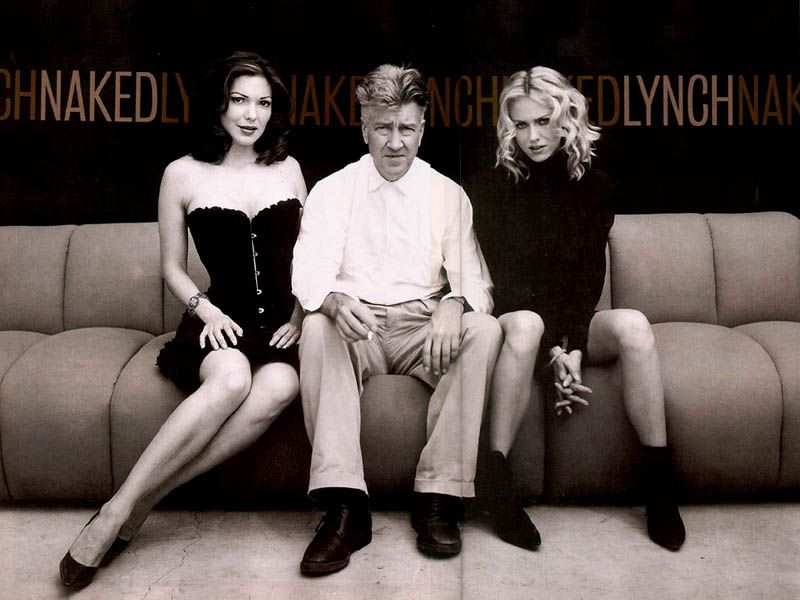
I really didn't like Mulholland Drive when I saw it at its premiere at the NZ Film Festival in 2001/2002, and this is the first time I’ve been back to David Lynch's film.
So I’m coming at this (very literal) review as someone who’s seen it before, has utterly vague memories of how the story plays out (there’s a blue box and a crazy director and a Lost Highway ‘reality’ twist in it), and who remembers the audience (and me) being profoundly alienated by the movie after it finished. What you're about to read are my real-time reactions, as I re-watch the film.
The movie starts with an upbeat highly stylized green-screen dance number. I have absolutely no memory of this. And no idea about how it thematically relates to the rest of the story. I do notice however, that for some reason it starts to become disturbing after about a minute – but I have no idea why (there are some discordant notes in the music, and possibly some subliminal images in the background, and – possibly – some disturbing facial expressions or body language from some of the dancers).
When we cut into the movie proper, I expect to see Naomi Watts (newly arrived to LA) leaving LAX in the middle of the day with an elderly couple: that’s my memory of how the movie starts.
Instead, we cut to the middle of the night and a violent noir based car crash and hunt for a missing person. Who is the beautiful woman I remember first appearing in the middle of the film. This stuff is perfectly executed: there’s a Lynchian off-centre quality to it, but it’s tight, makes me car about the as-yet-unnamed character, sets up a world surrounding her, and even has a lovely ending (showing how she plausibly sneaks into an empty house).
And from there we cut to something I also remembered happening in the middle of the film – so I completely throw out my assumptions that I have any idea what’s going to happen next – another perfectly executed sequence in which a man sitting in a diner describes a nightmare he had, and then we see him experience it in real life.
There are lots of nice techniques used in this ‘real nightmare’ sequence: camera angles gradually rising above the head of the man having the nightmare (to put him in a weak, vulnerable position); a threatening hum growing louder in the score; dialogue seeming to cut out as the panic in the scene increases (very reminiscent of the arrival of David Bowie in Fire Walk with Me).
At the moment, none of these three things seem to have anything to do with each other. My working hypothesis, then, is that Mulholland Drive
And now, 18 minutes into the film, Naomi Watts (who plays what I remember to be the main character) shows up.
Over the course of the next 50 minutes, the movie continues to present what appears to be great self-contained short films (a really funny casting meeting between a film director and two Mafioso; a series of pratfalls involving a hitman with really bad luck) – but we keep cutting back to Naomi Watts (Betsie), who is now interacting with the beautiful car-crash woman (Rita). The tone of their scenes and plot details that emerge establish Mulholland Drive

However, there’s another tone that’s being layered in as well: horror. It comes from the scenes that surround the Betsie-Rita plot; from music cues; from events that happen to Betsie (a possibly psychic woman delivers a dire warning). In the cleverest use of subtext to deliver horror, Betsie and Rita have a conversation in the same diner where the man from the start of the movie relayed his nightmare. Without using any overt camera angles or musical cues, Lynch is effortlessly able to create tension – and the dread that the mysterious figure from the man’s nightmare will suddenly appear here.
There’s also the subtlest (and, then, increasingly slightly-less-subtle) hints of romance flickering to life between Betsie and Rita. I remember this becomes more important as the film goes on.
All the while, though, the film is knitting together the ‘short films’ into an over-arching plot: the unlucky hitman is (a) possibly working for the two Mafioso and (b) searching for Rita. The film director (Adam) has been forced to cast a woman in his film – a woman who looks a lot like Betsie. If he does cast Betsie, however, that will be the wrong woman – and very bad things will happen.
It’s the anticipation of that that’s keeping me interested in the film at the moment. The rest of it is good: coherent, funny, idiosyncratic and sexy – but I want to see how the Adam and Betsie sides of the plot collide.
And all the while, I’m remembering that at some point in the future there’s going to be a scene in a nightclub, and that the consequences of that scene will totally shift the tone and storyline of the film. I’m fascinated to know when that’ll happen, how much story will be left afterward (an epilogue? an entire act?), and whether I’ll be invested in that ‘reality twist’. I can certainly remember feeling betrayed or alienated by it last time I saw it.
Anyway, back in the moment: the film spends the next 20 minutes directly addressing all of the questions I’m interested in, and in a really fascinating and oblique way. There’s a audition, yes – but it’s both a fake-out (in that it’s revealed to be a different movie than Adam’s) and filled with really interesting subtext: about exploitation in Hollywood, about the different ways performance can be used to affect the emotional presentation of a script, and it also demonstrates that Betty actually has talent – something the film to date has been a little shy about dealing with, preferring to show her as a naïve country girl who might be a big shot in her hometown but who is out of her depth in LA.
(Speaking of which, Mulholland Drive

The Adam and Betty meeting also doesn’t go how I expected (instead of a sitcom misunderstanding there’s a complete capitulation), but it gives us something better: an attraction or connection between Adam and Betty that I want to see more of.

And from there, the movie hits its strongest streak of sustained narrative: following Betty and Rita through an investigation, a break-in, a discovery, sex and love, returned memories, a surreal performance, a disappearance, an amazing performance of Roy Orbison’s Crying (which really feels like we’re saying goodbye to our characters and the status quo – seriously, this is a transcendent moment in the film) and finally the truth about the blue box.
It’s during this streak that a bunch of overt optical effects start getting used: multiple images of Betty and Rita layered over each other while they panic; some odd lens flare en route to the performance; an almost Evil Dead camera push-in outside the mysterious Silencio club.
And then the twist.
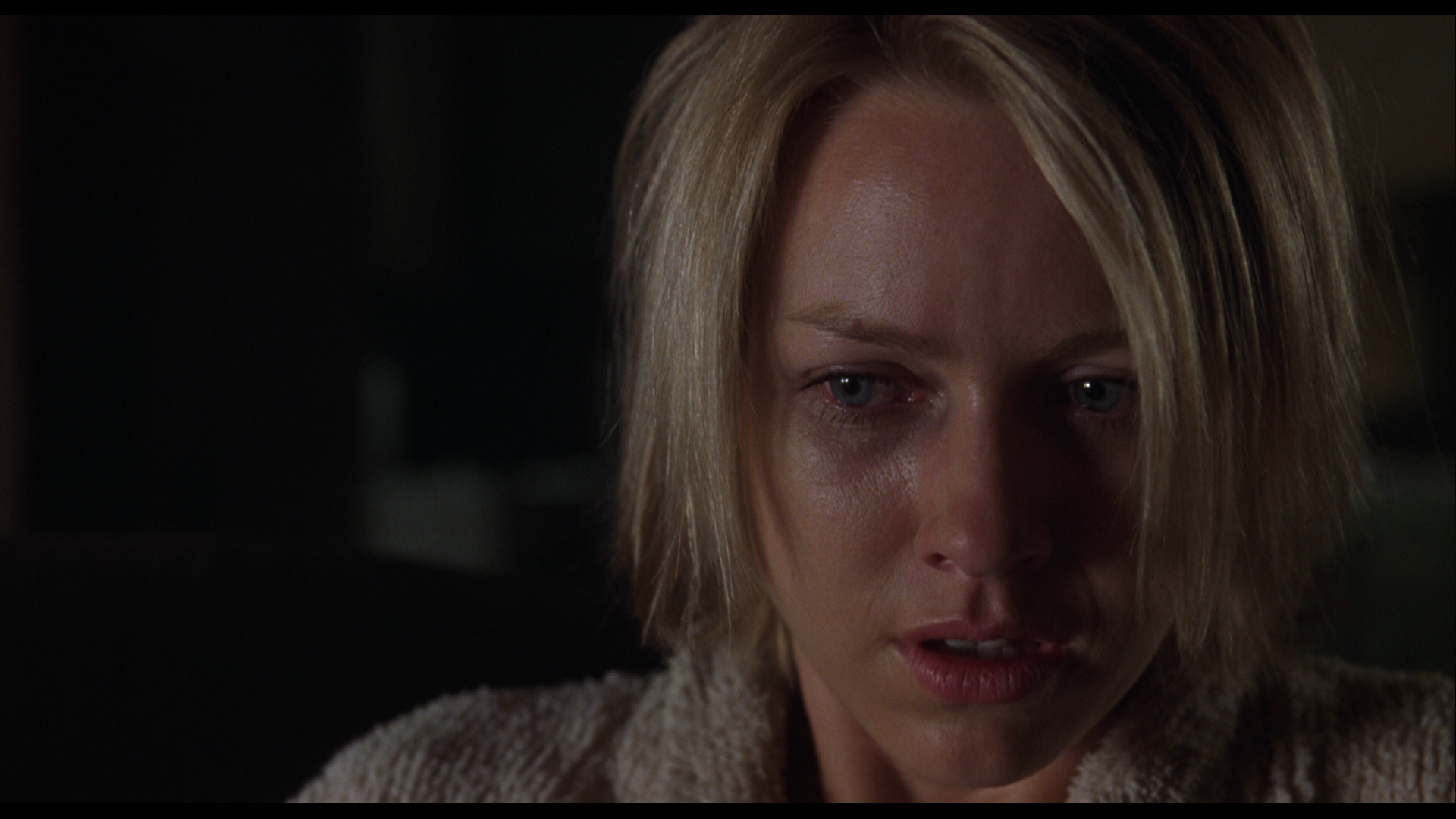
I actually wish I was struggling to interpret what was going on: is this the afterlife? A flashback? Did Betty never really exist at all? Was the first 110 minutes of the film just a dream?
But at the moment, eight minutes in to the revelation of what’s on the other side of the blue box, the interpretation seems pretty obvious: what we’ve just watch is an idealized version of Diane’s love and life, and it’s either a dream or the final moments before she shoots herself.
However, rather than feeling betrayed by that (as I now remember I did during my first viewing), I can make the argument that the structure of the film so far has prepared me for this. I’ve spent a lot of time feeling like I was watching a series of short films. This section is also like a short film, but with a massive switch in tone: from horror-noir with a dash of romance to a piece about depression with a dash of the craziness and jealousy of a failed relationship.
(And to be fair, the film does lay in a lot of hints throughout the first hour and a half: among others, Betty describes the apartment she’s staying in as a “dream place”; when she arrives in LA – and there’s a lot of cute dialogue like that.)
The biggest problem with this “It was all a dream” structure is that the storylines I was invested in and wanted to see closure in won’t happen. I’ll never find out how Adam resolves his problems with the Mafia (although I can assume that everything ended happily after he chose ‘the right girl’ for his film). The unlucky hitman may not have a place in this new reality, so he’s a tangent. The man with the nightmare either doesn’t relate to the film or becomes a massive commentary and early hint about the nature of the film. This is a variant of what I call the ‘John Locke’ problem (from Lost): we think we’re following one character around, and then it turns out we’re actually following another.
Now, as the film continues, and shows me the close-to-the-starting shot of a car driving driving up a hill at night. What is Mulholland Drive
No. It’s giving us a magical experience of Diane and Rita/Camilla apparently in love and going to a party hosted by Adam, … and then taking it all away from us in a wave of jealousy, loss, insecurity, not fitting in, barely repressed anger.
And then what the fuck?
The film cuts away from the party – an incredible hard-cut on Diane’s utter anger and the first frame of an emotional clusterfuck – into … another reality? That’s my first thought: that now we’re in the ‘real world’, one where Betty/Diane has become (or was all along) a hooker we saw incidentally in a previous scene, hanging out with the hitman.
And this hard-cut has taken us into the diner where the nightmare took place again – instantly raising a sensation of impending dread …
… this is, actually, pretty great stuff …
But it’s not another reality – it’s a flash-forward, to Diane putting a hit on Camilla.
Which gives me everything I need to (roughly) figure out the film’s true structure:
- When we first enter/wake into this ugly new reality (after opening the blue box), that’s at the end of the timeline
- Dianne and Camilla are friends
- Camilla leaves Dianne
- Dianne discovers Camilla is dating Adam, and that those two are getting married
- Dianne orders the hit
- Dianne, depressed (this is where we first switch into her reality)
- The hit happens (perhaps it’s the failed murder attempt at the beginning?)
- Dianne kills herself after being haunted.
I was going to rewatch the last 20 minutes of the film, to confirm this, but while I was putting the finishing touches on this post, Film Critic Hulk did it for me, in a great piece from someone who’s watching the film 11 times:
Sunday, April 01, 2012
Rewatching West Wing Season 1
"One victory in a year stinks in the life of an administration."
Toby Ziegler
I used to think of The West Wing as a show about political geniuses who were inspiring in the way they overcame all obstacles to advance a progressive agenda.
One thing that my rewatch of the show is hammering home is how not true that is. Really, The West Wing is about a bunch of very smart characters who are in a little bit over their heads. They understand most of the rules of the game, but they don't have a plan. Instead they get distracted by the details, the everyday distractions, and the personal scandals they (often inadvertantly) create.
By the time episode 19 ('Let Bartlet be Bartlet'; the source of the Toby Ziegler quote, above) rolls around, we've seen one genuine achievement (getting a nominee onto the Supreme Court), and two or three minor legislative achievements (including a weak gun-control bill). The team is disenchanted with politics and their ability to make a difference and stay true to their values: a disillusionment that's been growing over the course of the series to date.
But at this point the series turns everything around and fires up the team. It's a really stirring moment, and I'm looking forward to seeing what comes next - mostly because I know it doesn't last: Season 5 (after the re-election) is defined by a sense of 'drift' and aimlessness in the administration; Leo's return to the staff later on is marked by him setting up a chart identifying what they want to achieve in the time the team has remaining in the White House (a focus that is abandoned as the show continues). Even in the turnaround that's shown in this episode, there's no sense of objectives being set - as a result, the show seems to exist to illustrate various aspects of Washington DC political life, rather than show how a team advances their agenda.
However, these last episodes of Season 1 and opening episodes of Season 2 are great, as they remind us why these characters are an impressive team we want to root for.
Toby Ziegler
I used to think of The West Wing as a show about political geniuses who were inspiring in the way they overcame all obstacles to advance a progressive agenda.
One thing that my rewatch of the show is hammering home is how not true that is. Really, The West Wing is about a bunch of very smart characters who are in a little bit over their heads. They understand most of the rules of the game, but they don't have a plan. Instead they get distracted by the details, the everyday distractions, and the personal scandals they (often inadvertantly) create.
By the time episode 19 ('Let Bartlet be Bartlet'; the source of the Toby Ziegler quote, above) rolls around, we've seen one genuine achievement (getting a nominee onto the Supreme Court), and two or three minor legislative achievements (including a weak gun-control bill). The team is disenchanted with politics and their ability to make a difference and stay true to their values: a disillusionment that's been growing over the course of the series to date.
But at this point the series turns everything around and fires up the team. It's a really stirring moment, and I'm looking forward to seeing what comes next - mostly because I know it doesn't last: Season 5 (after the re-election) is defined by a sense of 'drift' and aimlessness in the administration; Leo's return to the staff later on is marked by him setting up a chart identifying what they want to achieve in the time the team has remaining in the White House (a focus that is abandoned as the show continues). Even in the turnaround that's shown in this episode, there's no sense of objectives being set - as a result, the show seems to exist to illustrate various aspects of Washington DC political life, rather than show how a team advances their agenda.
However, these last episodes of Season 1 and opening episodes of Season 2 are great, as they remind us why these characters are an impressive team we want to root for.
Monday, November 28, 2011
Is Breaking Bad about putting more and more pressure on ordinary people?
Because if that's it's thing - having to make decisions under lots of pressure, and those decisions leading to terrible consequences and even more terrible decisions that need to be made - then I can see how (a) it becomes a great but tough watch, like Mike said, and (b) how, after a few seasons, it might be difficult to find a plausible, satisfying way to wrap up the show. However, it's great to see the writers keep re-focusing the responsibility back onto Walt, any time it looks like he's going to run away from making a choice.
And the show has won a lot of credit from me by making Walt's wife (Skylar) a character who takes smart, completely-believable actions. It gives me confidence that eventually the whole cast are going to be well-motivated and interesting.
And the show has won a lot of credit from me by making Walt's wife (Skylar) a character who takes smart, completely-believable actions. It gives me confidence that eventually the whole cast are going to be well-motivated and interesting.
About Breaking Bad's visual style
I'd describe it as sympathetic but impersonal. The camera (and the script) treats Walt, his family, and Captain Cook as people it likes, but there's also with a degree of distance: for instance, when Walt's lying unconscious on the carwash floor, or the Captain's in the car with his former cooking-partner, Emilio. I got the impression that anyone could die at any point, and the camera would just be happy to watch it happen and then keep recording what happens next.
A good tone for this sort of low-crime show to hit.
A good tone for this sort of low-crime show to hit.
Sunday, November 27, 2011
OK, Breaking Bad is off to a good start.
It's done a fantastic job of creating characters who are either sympathetic or memorable assholes, and it's doing the 'reasonably smart people trying to figure out the logistics of committing crime', which is totally my favourite genre. But most impressive of all, the pilot episode did an outstanding job of conveying Walt White's complex thought processes and making the decisions he makes believable entirely via subtext and performance - no need to resort to voice-overs, clumsy commentary by other characters, or on-the-nose speeches.
Looking forward to Episode 2.
Looking forward to Episode 2.
Saturday, September 03, 2011
How my Film Festival turned out (I liked 6.5 out of my 7 films)
Cave of Forgotten Dreams:
What I said before the film: I've always wanted to see the paintings in Chauvet-Pont-D'Arc, and a 3D tour guided by Werner Herzog seems like my best bet to achieve this dream.
What I said before the film: I've always wanted to see the paintings in Chauvet-Pont-D'Arc, and a 3D tour guided by Werner Herzog seems like my best bet to achieve this dream.

My take: A thought-provoking, poetic, slightly challenging guide through the cave paintings of early cro-magnons. The experience was so vivid that a few times I totally drifted off and imagined what it would have been like to have lived 35,000 years ago. I'll definitely see this again.
Recommended to: John-Paul
13 Assassins:
What I said before the film: Takeshi Miike does a samurai film that's better than his best film? That's some hype I need to check out for myself.
What I said before the film: Takeshi Miike does a samurai film that's better than his best film? That's some hype I need to check out for myself.

My take: This film has a great set-up that examines how duty and honour collide with morality, when you serve a really loathsome villain who happens to be related to the Emperor. I was a fan of how most of the movie unfolded, but I felt the start of the epic final battle was far too comic-book (in the sense of being detached from a sense of reality). However, that soon faded and that final action sequence was a really brutal and satisfying series of slugfests and murders.
Recommended to: Pearce (who has surely already seen it), Chuck, Dean, Keane, Wayne.
Taxi Driver:
What I said before the film: I really disliked this the first time I saw it, but I suspect I completely missed the point. Seeing a restored print in 35mm seems like the best way to determine what I think of it.
What I said before the film: I really disliked this the first time I saw it, but I suspect I completely missed the point. Seeing a restored print in 35mm seems like the best way to determine what I think of it.
My take: A great portrayal of a place and time (1970s New York), and of the mind and POV of a mentally unstable man.
In fact, it made me think about how effective the script-writer and the editor can be in a highly-POV based movie: selecting what to show the viewer and what emphasis to place on it. Nearly every scene contained an element of sex, race, or violence that reinforced Travis' world-view.
As for that ending: Scorsese is on the record as saying it's literal, that Travis survives and is hailed as a hero (but that he'll probably do it again, and next time he won't be so lucky). I don't think the film supports that, though: when I look at the trouble Travis caused the presidential campaign on three separate occasions, I can't believe that Cybill Sheppard would treat him the way she does at the end - and if I can't believe that, then it undermines the reality of the ending for me.
Recommended to: ... a hard call. Perhaps Jennifer, given that it's a landmark 70s movie.
Another Earth:
What I said before the film: Seeing the trailer after Sundance sold me on the tone it looks like this film's going for: introspective, melancholic science-fiction.
What I said before the film: Seeing the trailer after Sundance sold me on the tone it looks like this film's going for: introspective, melancholic science-fiction.
(This trailer contains spoilers, but they're so good that I think it's worth watching.)
My take: Far more of an indie movie than a science-fiction film. It's maybe 95% indie to 5% science fiction. In its indie A-plot, Another Earth focuses on two wounded people - one of them trying to find a reason to live; the other trying to atone. However, its B-plot (of a second identical Earth suddenly appearing in the night sky) contains four spectacular scenes.
All the way through watching this, I thought the film had another gear that it was going to shift into, a gear involving spaceships and Michael Bay-esque slo-mo training montages. Instead the film goes in a radically different direction - one that I enjoyed just as much because it was so true to the characters.
The film's premise makes a promise to the viewer, and Another Earth totally delivers on that promise. It delivers on it in such an understated way that I was still having realisations about its implications a day later. The ending strongly implies that Brit Marling (who's fantastic as both a script-writer and an actor, and I hope we see a lot more of her) has really been (and will continue to be) a hero, and that her choices involving William Mapother's character were right for a lot of reasons.
Recommended to: Chris
Martha Marcy May Marlene:
What I said before the film: my must-see of the festival due to the subject matter: a young woman trying to leave a cult.
What I said before the film: my must-see of the festival due to the subject matter: a young woman trying to leave a cult.

My take: Aaaahhhh. High expectations - you almost always screw with me. Yes, this is a fantastic film, at least for the first hour. It's subtle, it feels psychologically accurate, and John Hawkes (as the cult leader) and Elizabeth Olsen (as the newest member of the cult) give great performances where you completely understand everything they're doing without needing to spell it out with dialogue.


The film has a major flaw, though, that meant I increasingly couldn't buy into it. The major relationship in the present-day story is between Olsen and her big sister (Sarah Paulson). There's a lot of good material in there: a sense of history and emotional baggage between the two of them, which is only aggravated by Olsen's refusal to explain what happened to her. But the problem is that the structure of most of their scenes together is identical - Big Sister tries to find out what happened, Little Sister blocks her, Big Sister gets increasingly frustrated.
I found myself rewriting that aspect of the film as I watched it (never a good sign). In my rewrite, the older sister is more proactive in trying to find out what had happened; she tries different techniques and approaches to opening her sister up. She wouldn't necessarily need to succeed, and I'd keep all of the other pressures in the older sister's life that are stressing her out, ... but making the older sister smarter and more focused makes her an antagonist for Olsen (and makes her silence even more meaningful).

Recommended to: Luke, Debbie, Matt, Svend, Morgue, Mike, Sophie and Simon (if you want to re-capture some of that Phoenix or Apocalypse World vibe.)
Troll Hunter:
What I said before the film: Actually, I'm a little suspicious of this one. I fear that a mocumentary about troll disposal experts in Scandanavia might actually be a little too silly to be good, but I'm prepared to take a chance on it.
What I said before the film: Actually, I'm a little suspicious of this one. I fear that a mocumentary about troll disposal experts in Scandanavia might actually be a little too silly to be good, but I'm prepared to take a chance on it.
My take: So much fun. The film makes the masterful decision to play things pretty conventionally for a long long time, making it a character study/surveillance of a weirdo recluse ... and then, when things start to get into potentially silly territory, the film leavens it at every stage with touches of horror, suspense, and pathos. And some pretty cool action sequences.
Recommended to: Gino
Overall: I give the 2011 New Zealand International Film Festival a 6.5 out of 7.
Tuesday, August 02, 2011
Eaarth: A first look at our new planet
There's a reason Bill McKibben's book 'eaarth' has an extra 'a' in the title.(*) He wants to vividly demonstrate that climate change has already happened. He's saying that we now live on a new planet, Eaarth: a planet that looks superficially similar to the Earth we grew up on but one that's becoming an increasingly hostile place to support human life.
McKibben wants to make the point that "the planet on which our civilisation evolved no longer exists", and that we've travelled to our new planet propelled by a huge burst of fossil fuels and carbon dioxide. McKibben spend the first chapter of his book demonstrating the increasingly hostile environment of our new planet by quoting news article after news article. I've reproduced three of the ones that hit home hardest with me, here:
Maldives May Relocate Due to Global Warming: "Mohamed Nasheed, the island nation’s new president, has announced a plan to buy a new homeland, just in case his sinking country completely disappears."
Kiribati Islanders Seek Land to Buy as Rising Seas Threaten - Bloomberg: "Kiribati, a Pacific island-nation in danger of being submerged because of global warming, may purchase land elsewhere to relocate its people, President Anote Tong said"
No more drought: it's a 'permanent dry' - Climate Watch - theage.com.au: "DROUGHT will become a redundant term as Australia plans for a permanently drier future, according to the nation's urban water industries chief.
And climate experts yesterday predicted the present drought would continue, signalling a cruel summer for farmers and sparking fears of higher food prices.
'The urban water industry has decided the inflows of the past will never return,' Water Services Association of Australia executive director Ross Young said. 'We are trying to avoid the term 'drought' and saying this is the new reality.'"
Even the IMF is starting to get peak oil « The Standard: "Like the warning from the American military — by 2015 there are likely to be “serious shortages” in oil supply. Like the warnings from the German military, Lloyds of London, the IEA and others (reviewed in a report from our own Parliamentary library). Now we can add the IMF to the list:
WSJ: IMF: “Increased Scarcity” Ahead For Oil Markets
Governments should brace for “increased scarcity” in global oil markets and the risk of additional sharp price spikes in the coming years, the International Monetary Fund warned Thursday. …"
It's fascinating stuff, and I'm looking forward to reading and digging into this more. Next up, McKibben's going to examine the various ways in which we've exceeded the limitations of our planet, and then he's going to talk about a new economic model.
You might want to check out this really excellent (20 minute) talk by Naomi Klein, too. She takes the BP Gulf of Mexico oil spill as her starting point, and discusses how and why people can fail to make wise long-term decisions.
(*) McKibbon is the founder of 350.org, which advocates
that the safe level of carbon in the Earth's atmosphere
is 350 parts per million (ppm). Above that level,
and the effects of global warming become more
and more likely to be activated.(**)
(**) Our atmosphere's already at 391 ppm.
McKibben wants to make the point that "the planet on which our civilisation evolved no longer exists", and that we've travelled to our new planet propelled by a huge burst of fossil fuels and carbon dioxide. McKibben spend the first chapter of his book demonstrating the increasingly hostile environment of our new planet by quoting news article after news article. I've reproduced three of the ones that hit home hardest with me, here:
Maldives May Relocate Due to Global Warming: "Mohamed Nasheed, the island nation’s new president, has announced a plan to buy a new homeland, just in case his sinking country completely disappears."
Kiribati Islanders Seek Land to Buy as Rising Seas Threaten - Bloomberg: "Kiribati, a Pacific island-nation in danger of being submerged because of global warming, may purchase land elsewhere to relocate its people, President Anote Tong said"
No more drought: it's a 'permanent dry' - Climate Watch - theage.com.au: "DROUGHT will become a redundant term as Australia plans for a permanently drier future, according to the nation's urban water industries chief.
And climate experts yesterday predicted the present drought would continue, signalling a cruel summer for farmers and sparking fears of higher food prices.
'The urban water industry has decided the inflows of the past will never return,' Water Services Association of Australia executive director Ross Young said. 'We are trying to avoid the term 'drought' and saying this is the new reality.'"
Even the IMF is starting to get peak oil « The Standard: "Like the warning from the American military — by 2015 there are likely to be “serious shortages” in oil supply. Like the warnings from the German military, Lloyds of London, the IEA and others (reviewed in a report from our own Parliamentary library). Now we can add the IMF to the list:
WSJ: IMF: “Increased Scarcity” Ahead For Oil Markets
Governments should brace for “increased scarcity” in global oil markets and the risk of additional sharp price spikes in the coming years, the International Monetary Fund warned Thursday. …"
It's fascinating stuff, and I'm looking forward to reading and digging into this more. Next up, McKibben's going to examine the various ways in which we've exceeded the limitations of our planet, and then he's going to talk about a new economic model.
You might want to check out this really excellent (20 minute) talk by Naomi Klein, too. She takes the BP Gulf of Mexico oil spill as her starting point, and discusses how and why people can fail to make wise long-term decisions.
Sunday, January 02, 2011
TV: The Walking Dead (Season 1)
Just finished watching Season 1 of The Walking Dead, Frank Darabont's adaptation of Robert Kirkman's comic series about the survivors of a zombie apocalypse.
To begin with, the TV series eases viewers into the world of zombies. It ends episodes with lighter moments to give viewers a reason to tune back in; it plays out basic zombie-siege scenarios to show how this sort of world works. It also introduces some broadly drawn characters to hate, some characters to care but be suspicious about and delivers some big emotional moments.
And, about halfway through the season it destabilises the status quo, one of the comics' signature moves. It's around this point that the sense of loss of our normal world starts to be felt keenly: the people we'll miss, the luxuries we no longer have, and the absence of authority to solve problems or maintain social norms.
And then, finally, the show demonstrates what being a zombie really means. It shows us essential scenes of characters accepting death and ends with a final episode that feels little forced but effectively removes hope that 'Authority' will save the day (of course, it takes an hour to do this whereas the opening of Zombieland achieves the same effect in 30 seconds). I agree with elements of Alan Sepinwall's review, that the episode sets up some excellent interpersonal stuff between Rick, Shane and Lori that's going to explode soon, and that:
What immediately struck me is how the TV series, right from the pilot episode, homes in on the thematic heart that took the comics 30 or 40 issues to slowly unveil: the idea that the cost of surviving in a brutal world filled with cannibalistic monsters is that we will eventually become monsters ourselves. One of the strengths of the Walking Dead (TV and comics) is in showing the struggle between 'the urge to be decent and civilised' and the easy but slippery slope of solving problems pragmatically, which leads to characters struggling with callousness and evil.
The whole series has a nice slow pace to it that reflects the comics source material. I watched it a bit critically to begin with, wondering if it would live up to my expectations and fondness for the comics. That was particularly true for Andrew Lincoln, the actor playing lead character Rick Grimes. But a moment about halfway through the pilot - where Rick grieves for the loss of his family - completely sold me on Lincoln's performance, and from then on I completely cared about Rick's quest to find answers and hope (I'm being ambiguous about the plot to avoid spoilers).
The whole series has a nice slow pace to it that reflects the comics source material. I watched it a bit critically to begin with, wondering if it would live up to my expectations and fondness for the comics. That was particularly true for Andrew Lincoln, the actor playing lead character Rick Grimes. But a moment about halfway through the pilot - where Rick grieves for the loss of his family - completely sold me on Lincoln's performance, and from then on I completely cared about Rick's quest to find answers and hope (I'm being ambiguous about the plot to avoid spoilers).
To begin with, the TV series eases viewers into the world of zombies. It ends episodes with lighter moments to give viewers a reason to tune back in; it plays out basic zombie-siege scenarios to show how this sort of world works. It also introduces some broadly drawn characters to hate, some characters to care but be suspicious about and delivers some big emotional moments.
And, about halfway through the season it destabilises the status quo, one of the comics' signature moves. It's around this point that the sense of loss of our normal world starts to be felt keenly: the people we'll miss, the luxuries we no longer have, and the absence of authority to solve problems or maintain social norms.
And then, finally, the show demonstrates what being a zombie really means. It shows us essential scenes of characters accepting death and ends with a final episode that feels little forced but effectively removes hope that 'Authority' will save the day (of course, it takes an hour to do this whereas the opening of Zombieland achieves the same effect in 30 seconds). I agree with elements of Alan Sepinwall's review, that the episode sets up some excellent interpersonal stuff between Rick, Shane and Lori that's going to explode soon, and that:
there is no cure coming, no savior. There is only [the survivors], and their wits and resourcefulness and whatever weapons and shelter they can obtain or build. Their hope can't continue to be that this nightmare goes away one day; now the best they can dream of is finding a way to keep living inside the nightmare. And that's a very tough mindset for these characters to have to embrace, and a fine starting point for the longer second season.
I'm looking forward to watching it.
Friday, December 17, 2010
Books: October to November
During this time period I started to realise that not every book was worth blogging about; so, rather than a comprehensive list, these book posts are moving more towards some edited highlights.
Kashmir is a screenplay about three specialists hunting down Osama bin Laden. An enjoyable, fast read. Probably still available at scriptshadow, if you want to google for it.
After watching Surrogates, the Bruce Willis movie about people who stay at home and live their lives through remote drones that look like them, I felt like I needed more exploration of that idea. Kil'n People by David Brin is a noir version of the story (rather than an action-adventure), and it contains both a twisty mystery, great uses of the first person narrator, and a lot of excellent ideas about what would happen if you could clone yourself, live 5 different lives, and then reabsorb the memories of those clones. I was a little disapointed with the mysticism that ended the book, but (overall) a good read.
The Ask and the Answer is the sequel to The Knife of Never Letting Go. As I mentioned last time, I was resisting reading this, but Jenni told me that the book shifted from a single narrator to alternating between two points of view. That (plus the third POV she hinted would be introduced in the third book) was enough to get me reading it again. The Ask and Answer was great at getting me to like the characters again, but in terms of plotting it became a little bit plodding and event-based (this happened then this happened) without any real sense of meaning behind the events. I stopped reading it twice because I almost lost sympathy with the main male character; the author deliberately pushes the line here. However, the story built to an excellent finale.
The sequel, Monsters of Men, is just excellent. Definitely the best of the series; flipping between three different points of view means that the plot is advanced without the annoying 'knock the protagonist out' tricks of the first book. There are cliffhangers with nearly every chapter, and I'm a sucker for battle scenes of mass combat - the ambushes and strategies - which this book definitely delivers.
Overall, this Chaos Walking series has a great payoff but it was definitely a struggle for me to get there.
Exegisis is a short little science fiction tale about an artificial intelligence sending emails to its creator. An ok, fast read with one or two moments of genuine insight about how the world might 'look' to an AI.
How to Make it All Work is about looking at your life from a high-level perspective, setting goals and how to recognise when you're heading in the 'right' direction for you. I'm still figuring out how to apply stuff from this book; I think it'll be up for a re-read in a few months.
The Race is the second book by Richard North Patterson I've read this year. He's got a thing for writing well-researched thrillers which I approve of. This one is about a Republican presidential primary: overall, the story felt a little familiar to me, having watched Seasons 6 and 7 of The West Wing and followed the last few US elections and mid-terms fairly closely, but it's got a great final act (set at the Republican convention, illustrating the wheelings and dealings that go on). It's also interesting in that the book addresses the internal contradictions and unstable alliances between the different social groups that make up the Republican party (or at least did, pre-Tea Party).
While the first two books of Jessica Amanda Salmondson's Tomoe Gozen trilogy are fun, they didn't really move me. Her stories about a doomed female samurai have quite a bit to say about honour and feminism, but they felt a little disposable. The third book, Thousand Shrine Warrior, is infused with a melancholy mood and Tomoe becomes part of a fascinating moral dilemma: each person that Tomoe is forced to kill in order to save her life is actually part of a grander plan of revenge. That sense of doom and the awareness that violence only made the problem worse lifted this book into Yojimbo style territory. While the ending felt too easy, to me, I would love to read more Tomoe adventures (and I'd definitely want to see a film of this particular story).
Kashmir is a screenplay about three specialists hunting down Osama bin Laden. An enjoyable, fast read. Probably still available at scriptshadow, if you want to google for it.
After watching Surrogates, the Bruce Willis movie about people who stay at home and live their lives through remote drones that look like them, I felt like I needed more exploration of that idea. Kil'n People by David Brin is a noir version of the story (rather than an action-adventure), and it contains both a twisty mystery, great uses of the first person narrator, and a lot of excellent ideas about what would happen if you could clone yourself, live 5 different lives, and then reabsorb the memories of those clones. I was a little disapointed with the mysticism that ended the book, but (overall) a good read.
The Ask and the Answer is the sequel to The Knife of Never Letting Go. As I mentioned last time, I was resisting reading this, but Jenni told me that the book shifted from a single narrator to alternating between two points of view. That (plus the third POV she hinted would be introduced in the third book) was enough to get me reading it again. The Ask and Answer was great at getting me to like the characters again, but in terms of plotting it became a little bit plodding and event-based (this happened then this happened) without any real sense of meaning behind the events. I stopped reading it twice because I almost lost sympathy with the main male character; the author deliberately pushes the line here. However, the story built to an excellent finale.
The sequel, Monsters of Men, is just excellent. Definitely the best of the series; flipping between three different points of view means that the plot is advanced without the annoying 'knock the protagonist out' tricks of the first book. There are cliffhangers with nearly every chapter, and I'm a sucker for battle scenes of mass combat - the ambushes and strategies - which this book definitely delivers.
Overall, this Chaos Walking series has a great payoff but it was definitely a struggle for me to get there.
Exegisis is a short little science fiction tale about an artificial intelligence sending emails to its creator. An ok, fast read with one or two moments of genuine insight about how the world might 'look' to an AI.
How to Make it All Work is about looking at your life from a high-level perspective, setting goals and how to recognise when you're heading in the 'right' direction for you. I'm still figuring out how to apply stuff from this book; I think it'll be up for a re-read in a few months.
The Race is the second book by Richard North Patterson I've read this year. He's got a thing for writing well-researched thrillers which I approve of. This one is about a Republican presidential primary: overall, the story felt a little familiar to me, having watched Seasons 6 and 7 of The West Wing and followed the last few US elections and mid-terms fairly closely, but it's got a great final act (set at the Republican convention, illustrating the wheelings and dealings that go on). It's also interesting in that the book addresses the internal contradictions and unstable alliances between the different social groups that make up the Republican party (or at least did, pre-Tea Party).
While the first two books of Jessica Amanda Salmondson's Tomoe Gozen trilogy are fun, they didn't really move me. Her stories about a doomed female samurai have quite a bit to say about honour and feminism, but they felt a little disposable. The third book, Thousand Shrine Warrior, is infused with a melancholy mood and Tomoe becomes part of a fascinating moral dilemma: each person that Tomoe is forced to kill in order to save her life is actually part of a grander plan of revenge. That sense of doom and the awareness that violence only made the problem worse lifted this book into Yojimbo style territory. While the ending felt too easy, to me, I would love to read more Tomoe adventures (and I'd definitely want to see a film of this particular story).
Monday, November 22, 2010
Apollo 13: Mission Control is a must see
I am still recovering from how good a time I had at Apollo 13: Mission Control on Saturday night. This is a play at Downstage recreating the Apollo 13 disaster: audience members play members of Mission Control and have to perform vital tasks throughout the night in order to bring the astronauts back home again safely (I’ll talk a bit more about this merging between being an audience member and a performer in a few paragraphs).
Here’s who I think should go see this: Jenni, Lee, Norman, Luke, Sam, Matt, Debz, Mike Sands, Bryn, Jacqui, Karen, Malcolm, Donna, Sophie, Simon Shuker and anyone else who thinks it might be quite cool to pretend to be part of Mission Control for a couple of hours.
Without going into spoilers, I totally got to be a hero during the course of the evening: identifying a potential danger on the ship; representing Mission Control during a TV interview with Walter Cronkite, and (eventually) taking charge of Mission Control itself for about 5 minutes – which meant I was spotlighted on stage with about 200 people watching me as I averted a complete and total meltdown.
Fracking brilliant.
The Audience / Performer Split
Talking about it with Jennifer afterwards made me aware of something I hadn’t considered about attending an ‘interactive theatre experience’.(*) She said that she never forgot that she was an audience member, watching a performance. I, on the other hand, really got into it; I took my role as Guidance Comms Officer really seriously and totally brought in to the drama of the mission.
(*) It’s basically a LARP.
In some ways, it’s like the observation that people play games for different reasons: some people play to hang out with their friends; some people play to win; in the case of role-playing games, some people play to stay in-character while others play to construct a challenging story.
Your reason for being there and what you want out of it will give you a completely different experience from someone sitting right beside you who’s there for different reasons.
In my case, taking it seriously and buying in to the reality of the show had the benefit of getting me “into character”, so that when I was chosen to take part in a live interview on TV with Walter Cronkite(invisotext), I was totally in the zone and able to entertain the audience with my answers. I also, seriously, wanted to win: I have no idea if you can ‘fail’ Apollo 13, but I wanted to do everything we could to help it succeed; in effect I was trying to clock the performance.
Digging in to why it was so good
I had no idea, when I arrived at Downstage, that I was going to have one of the best creative experiences of my year to date. I expected to have heaps of fun, and I fully intended to get into it as much as I could … but to have it affect me this much?
So, it’s resonating but I’m not sure why. There are a lot of different factors at play here: my life of science-fiction and space flight; taking charge in a crisis; being in the spotlight; acting; a bit of improve and script-writing.
It seems important to me to dig into this a bit deeper to try and figure out exactly why I’m so stoked by this. If anyone wants to help me figure it out, please feel free to ask questions in the comments.
Thursday, November 11, 2010
Books: April to June
The Knife of Never Letting Go is the first in a trilogy of young adult novels. It should be right up my alley (which is a reference that seems much more relevant to me now that I've moved to an apartment in an alleyway): the series is set on a world that's been colonised by people from Earth, who have had a nasty conflict with the indigenous species, and as a result been infected with a disease that has given everybody uncontrollable telepathy. Coupled with that, the protagonist is trying to escape from the village he lives in, a village populated only by men, most of whom are homicidal patriarchal fascists.
But the book really bugged me. While the author made me care about the main character, he also stuck strongly to a first person POV coupled with a few 'unreliable narrator' tricks. As a result, I felt cheated by the frequency with which information was withheld that the main character knew (or should know), and annoyed at how often the author had to knock the main character out in order to advance the plot.
I've been on the fence about trilogies for many years now - reluctant to read them because for the most part I think they're padding. At the end of Knife, I decided not to read the next two books in the series: while the main character was trapped, indebted to the men he'd spent the whole book trying to escape - an army of men who'd just taken over the whole planet - I wasn't particularly interested in how he would get out of this situation. I just expected he would, and felt no obligation to read two more books to find out how it happened.
It took a few months, but Jenni changed my mind about this (more to come in the next book review post) ...
Reading Knife also reinforced my hatred of modern dust jackets on books. Sure, the design work that goes into a contemporary book is top notch, but I swear that the blurbs give away plot spoilers up to about page 200. It's infuriating.
Jenni lent me What's the Worst that Could Happen? It's her novel about a super-hero whose power is that she can see the worst case scenario for every course of action. I enjoyed reading it, and quickly saw the potential in it. Jenni blogged about our feedback session.
Then I organised a trans-humanist science-fiction death match. I got out two books from the library, read the first chapter of each and then chose which one to continue.
I chose Newton's Wake by Ken McLeod because its Scottish protagonist seemed to have more of an edge. It's a fairly interesting soap opera about the aftermath of a war with AIs and first contact with a distant colony, but by the end, the story was a little confusing and felt like a failure.
Then, when I switched back to Glasshouse by Charles Stross, I was impressed by how smart it was. Our hero needs to go into the 30th century equivalent of witness protection. He signs up for an experiment to recreate 20th century society, where our social and moral codes are enforced by a points system. Things quickly deteriorate as the experiment's participants decide to play to win (and ignore the fact that there's a darker agenda going on). A great examination of how our culture ticks, and a tight little thriller.
In my last book review, I mentioned that there was a book that scared me. Kindred by Octavia Butler is it. It's the story of an African-American woman from the 1970s who's thrown back in time about 150 years to the Antebellum South. What I realised is that I can watch trashy horror films and read Thomas Ligotti short stories all I like, but this story - about this character who seemed very real and very human, thrust into absolutely the worst environment for her - well, this story didn't feel safe. After the first two chapters, I had no idea where it was going or how far it could go, and I ended up putting it down.
I switched, instead, to The Bohr Maker, a science-fiction novel about nano-technology, that felt ... superficial to me in comparison to Kindred (which I was still thinking about). The story follows two protagonists - well, one of them's mostly just a character who things happen to for the majority of the book, and the other is so unsympathetic that I wouldn't have been unhappy to see him/it fail entirely. Perhaps that's a good technique ... it certainly kept the outcome I wanted the book to have alive and in question for me, but made The Bohr Maker a bit of a tough read
Afterwards, I went back to Kindred, and read another two or three chapters. Just when I thought it was settling into a predictable groove, Butler threw a massive curveball into the situation, one that I found very compelling.
After reading to see how that resolved, I had to decompress for a while. I ripped through Roadside Picnic by Stanislaw Lem. My memories of this have faded now, but I found this a tight, fast read infused with melancholy and a sense of transcendence. Actually: recommended. It felt like good Philip K. Dick.
Finally, I finished Kindred and was satisfied with how it all wrapped up. If you're familiar with the RPG Steal Away Jordan, Kindred is one of the media inspirations for that game.
The Sparrow is a definite contender for the best book I've read this year. It's a first contact story: humanity has picked up radio broadcasts of music from the vicinity of Alpha Centauri. The story follows (and deals with the aftermath of) an expedition funded by Jesuit priests to Rakhat, the world that is sending the music. What struck me most about this story was its sense of humour, the lightness of touch and sense of truth in its characterisations and the way it deals with issues of guilt, celibacy, the nature of God and faith - all wrapped in a vivid writing style. Jenni, Helen R: you might like this one.
But the book really bugged me. While the author made me care about the main character, he also stuck strongly to a first person POV coupled with a few 'unreliable narrator' tricks. As a result, I felt cheated by the frequency with which information was withheld that the main character knew (or should know), and annoyed at how often the author had to knock the main character out in order to advance the plot.
I've been on the fence about trilogies for many years now - reluctant to read them because for the most part I think they're padding. At the end of Knife, I decided not to read the next two books in the series: while the main character was trapped, indebted to the men he'd spent the whole book trying to escape - an army of men who'd just taken over the whole planet - I wasn't particularly interested in how he would get out of this situation. I just expected he would, and felt no obligation to read two more books to find out how it happened.
It took a few months, but Jenni changed my mind about this (more to come in the next book review post) ...
Reading Knife also reinforced my hatred of modern dust jackets on books. Sure, the design work that goes into a contemporary book is top notch, but I swear that the blurbs give away plot spoilers up to about page 200. It's infuriating.
Jenni lent me What's the Worst that Could Happen? It's her novel about a super-hero whose power is that she can see the worst case scenario for every course of action. I enjoyed reading it, and quickly saw the potential in it. Jenni blogged about our feedback session.
Then I organised a trans-humanist science-fiction death match. I got out two books from the library, read the first chapter of each and then chose which one to continue.
I chose Newton's Wake by Ken McLeod because its Scottish protagonist seemed to have more of an edge. It's a fairly interesting soap opera about the aftermath of a war with AIs and first contact with a distant colony, but by the end, the story was a little confusing and felt like a failure.
Then, when I switched back to Glasshouse by Charles Stross, I was impressed by how smart it was. Our hero needs to go into the 30th century equivalent of witness protection. He signs up for an experiment to recreate 20th century society, where our social and moral codes are enforced by a points system. Things quickly deteriorate as the experiment's participants decide to play to win (and ignore the fact that there's a darker agenda going on). A great examination of how our culture ticks, and a tight little thriller.
In my last book review, I mentioned that there was a book that scared me. Kindred by Octavia Butler is it. It's the story of an African-American woman from the 1970s who's thrown back in time about 150 years to the Antebellum South. What I realised is that I can watch trashy horror films and read Thomas Ligotti short stories all I like, but this story - about this character who seemed very real and very human, thrust into absolutely the worst environment for her - well, this story didn't feel safe. After the first two chapters, I had no idea where it was going or how far it could go, and I ended up putting it down.
I switched, instead, to The Bohr Maker, a science-fiction novel about nano-technology, that felt ... superficial to me in comparison to Kindred (which I was still thinking about). The story follows two protagonists - well, one of them's mostly just a character who things happen to for the majority of the book, and the other is so unsympathetic that I wouldn't have been unhappy to see him/it fail entirely. Perhaps that's a good technique ... it certainly kept the outcome I wanted the book to have alive and in question for me, but made The Bohr Maker a bit of a tough read
Afterwards, I went back to Kindred, and read another two or three chapters. Just when I thought it was settling into a predictable groove, Butler threw a massive curveball into the situation, one that I found very compelling.
After reading to see how that resolved, I had to decompress for a while. I ripped through Roadside Picnic by Stanislaw Lem. My memories of this have faded now, but I found this a tight, fast read infused with melancholy and a sense of transcendence. Actually: recommended. It felt like good Philip K. Dick.
Finally, I finished Kindred and was satisfied with how it all wrapped up. If you're familiar with the RPG Steal Away Jordan, Kindred is one of the media inspirations for that game.
The Sparrow is a definite contender for the best book I've read this year. It's a first contact story: humanity has picked up radio broadcasts of music from the vicinity of Alpha Centauri. The story follows (and deals with the aftermath of) an expedition funded by Jesuit priests to Rakhat, the world that is sending the music. What struck me most about this story was its sense of humour, the lightness of touch and sense of truth in its characterisations and the way it deals with issues of guilt, celibacy, the nature of God and faith - all wrapped in a vivid writing style. Jenni, Helen R: you might like this one.
Wednesday, October 06, 2010
Books: March to April
While I've lost track of some of the books I've read during the last couple of months, but that's been compensated for by the introduction of a new system for getting books out that's paying great dividends: I read reviews of books that sound interesting; type them into a file on my phone; by the time I get to the library to get something out, I've forgotten the exact plot of the book so I choose something at random, get it out without reading the back cover (which I've found usually contains massive spoilers for up to 200 pages of a book), and then read it with a completely fresh eye.
Going into books blind has been fun!
Lost for books to read, I pulled a Roger Zelazny novel that I've owned for years out my 'To Read' bookshelf. Turns out it was the second book in a series, but it had a pretty good recap of events in it. I was about 80 pages in when I realised that I'd be going to the library the next day and getting out the other four books in the series.
Zelazny's 'Ambert' quintet is fun, smart high fantasy with a taste of Moorcockian surreality ... but most of all, it's a noir. The third book, Sign of the Unicorn, is basically a series of flashbacks explaining backstories (and in some cases, twisted motivations) of the lead character's family members. Later in this post, I'm going to be talking about my dislike of trilogies and series, but this was good. Like, 'finishing one of the books every night' good.
Declare is the first Tim Powers novel I've read. What starts as a reasonably normal Le Carre-esque Cold War spy thriller slowly becomes an alternate-history biography of Kim Philby and a textbook study of how to slowly reveal a complicated mythology. Like a Clive Barker novel by way of John Le Carre, it inspired me to immediately get out another Tim Powers: Last Call - a story about a gambler who once lost a very important game of poker, and is now about to pay the price for it.
Gino: Read Last Call. Anyone else, if you're interested in the Tarot, the story of the Fisher King, or stories that feel like 80s style Clive Barker with less gruesomeness and less misanthropy, check it out too.
Pearce bought a copy of Life's Lottery by Kim Newman, which I immediately seized from him and read three times over the next three nights. This is the literary Choose Your Own Adventure novel I've always wanted to read. A story where the main character changes his very personality based on the choices you make. The story covers about 40 years, centring around Thatherite and Blarite Britain, was constantly riveting and insightful ... and I still feel like I haven't tapped all of its depths. It was also a great deal more magical realist (and violent) than I expected, with a fantastic authorial voices that sometimes talks directly to the reader (and sometimes passes judgement on you).
(Great to see that my propensity for cheating at Choose Your Own Adventure books is undiminished; at one point I think I had four fingers stuck in various pages so that I could try out various alternatives.)
After waking up from a dream in which I had bought a roleplaying game about a city under the ocean, I decided to read 20,000 Leagues Under the Sea. First thing that surprised me: it was in the children's section of the library. Second thing: it's effectively the 1860s version of hard sci-fi. Jules Verne seems to be striving to make every detail seems as plausible as possible based on the science and engineering capabilities of the time. Third thing: it's kinda boring. The book is mostly a travelogue that spends very little time fleshing out its characters, and the big incidents of the book are separated by many pages worth of descriptions of fish.
While reading this, I struggled to see how you could adapt this into a feature film for the 21st century. Surely the sense of wonder about the undersea world has been lost. I didn't get to see Oceans at the Film Festival (which might have changed my mind), but it sounds like I happily avoid the narrator-rage that people experienced in listening to Pierce Brosnan for 84 minutes.
How to Get Rich was a fun non-fiction read about how to be an entrepreneur. Unsparing in its description of the prices you'd have to pay in order to be rich, and filled with a lot of wisdom. Along with the Four Hour Work Week, this is one I think I'm going to have to re-read.
Next post, why I finished The Knife of Never Letting Go (the first book in a trilogy), and didn't feel the need to read the rest of the series; and a book that scared me.
Going into books blind has been fun!
Lost for books to read, I pulled a Roger Zelazny novel that I've owned for years out my 'To Read' bookshelf. Turns out it was the second book in a series, but it had a pretty good recap of events in it. I was about 80 pages in when I realised that I'd be going to the library the next day and getting out the other four books in the series.
Zelazny's 'Ambert' quintet is fun, smart high fantasy with a taste of Moorcockian surreality ... but most of all, it's a noir. The third book, Sign of the Unicorn, is basically a series of flashbacks explaining backstories (and in some cases, twisted motivations) of the lead character's family members. Later in this post, I'm going to be talking about my dislike of trilogies and series, but this was good. Like, 'finishing one of the books every night' good.
Declare is the first Tim Powers novel I've read. What starts as a reasonably normal Le Carre-esque Cold War spy thriller slowly becomes an alternate-history biography of Kim Philby and a textbook study of how to slowly reveal a complicated mythology. Like a Clive Barker novel by way of John Le Carre, it inspired me to immediately get out another Tim Powers: Last Call - a story about a gambler who once lost a very important game of poker, and is now about to pay the price for it.
Gino: Read Last Call. Anyone else, if you're interested in the Tarot, the story of the Fisher King, or stories that feel like 80s style Clive Barker with less gruesomeness and less misanthropy, check it out too.
Pearce bought a copy of Life's Lottery by Kim Newman, which I immediately seized from him and read three times over the next three nights. This is the literary Choose Your Own Adventure novel I've always wanted to read. A story where the main character changes his very personality based on the choices you make. The story covers about 40 years, centring around Thatherite and Blarite Britain, was constantly riveting and insightful ... and I still feel like I haven't tapped all of its depths. It was also a great deal more magical realist (and violent) than I expected, with a fantastic authorial voices that sometimes talks directly to the reader (and sometimes passes judgement on you).
(Great to see that my propensity for cheating at Choose Your Own Adventure books is undiminished; at one point I think I had four fingers stuck in various pages so that I could try out various alternatives.)
After waking up from a dream in which I had bought a roleplaying game about a city under the ocean, I decided to read 20,000 Leagues Under the Sea. First thing that surprised me: it was in the children's section of the library. Second thing: it's effectively the 1860s version of hard sci-fi. Jules Verne seems to be striving to make every detail seems as plausible as possible based on the science and engineering capabilities of the time. Third thing: it's kinda boring. The book is mostly a travelogue that spends very little time fleshing out its characters, and the big incidents of the book are separated by many pages worth of descriptions of fish.
While reading this, I struggled to see how you could adapt this into a feature film for the 21st century. Surely the sense of wonder about the undersea world has been lost. I didn't get to see Oceans at the Film Festival (which might have changed my mind), but it sounds like I happily avoid the narrator-rage that people experienced in listening to Pierce Brosnan for 84 minutes.
How to Get Rich was a fun non-fiction read about how to be an entrepreneur. Unsparing in its description of the prices you'd have to pay in order to be rich, and filled with a lot of wisdom. Along with the Four Hour Work Week, this is one I think I'm going to have to re-read.
Next post, why I finished The Knife of Never Letting Go (the first book in a trilogy), and didn't feel the need to read the rest of the series; and a book that scared me.
Tuesday, August 24, 2010
Books: February to March
The Iliad occupied most of February. I worked my way through two translations: the funny, pulpy Rieu, and the beautifully written Fagles. It's an impressive war story with a surprising focus not on the beginning or end of the war, but on the showdown between Hector and Achilles. It makes me keen to read the 7-part graphic novel Age of Bronze that tells the story of the war from Paris' dream to the post-Trojan Horse slaughter.
The Hunger Games started off as a ho-hum rip-off of Battle Royale and a third of the way through the book became utterly gripping due to a single character reveal. Vivid, tough, brutal and the sequel (coming up in a few paragraphs) is even better.
I read the script for Tell No One, an adaptation of a Harlen Coben novel. A fast tight read with that thriller plot arc: amazing hook, great second act where you have no idea what's going on, and then a conventional finale. Conventional, but with strong emotional pay-offs.
It makes me think about Se7en, which follows a similar structure but whose finale transcends the conventions through some magical combination of simplicity, implication and acting. However, I've always been taken with the idea that the true ending to Se7en involves David obeying John Doe's instructions: becoming Wrath, conducting the execution, and then - in full view of the camera - blowing his own brains out.
I know that version of the movie could never have been made in 1995, but there's such a dramatic purity (and relentless logic) to that ending that I can't help reshooting it in my head (heh) every time I watch it.
Bully In Sight is an English book about bullying. A little bit of research for Workplace Bully, natch.
The Complete Indigo Prime - in my mind, Indigo Prime is a classic 2000AD serial, riffing off of Sapphire and Steel, and creating an amazing story about reality engineers saving the universe. Turns out that it's far crazier, patchier and more incoherent than I ever remembered, and that I read far less of it than I thought. Nice long story arc involving Jack the Ripper and a time-travelling train, though.
Catching Fire is the sequel to The Hunger Games, which is basically a version of Battle Royale (teenagers fight to the death in the wilderness for the amusement of spectators) in post-apocalyptic America, with a fair bit of class warfare thrown in for good measure. It took me a while to warm up to the Hunger Games, but Catching Fire was excellent - mostly because it completely defied my expectations about how it would play out.
If it's the obligation of the writer to find the way forward that you didn't expect but realise makes perfect sense, then Susan Collins definitely fulfilled her obligation to me. I won't say I'm a raving fan, but I am very much looking forward to Mockingjay.
Shafts of Strife was published as a comic in the Listener in the 80s. I can remember the beginning and the end but had no idea it told such a tight little story.
I followed that up with Aliens vs Pooh, courtesy of Mr Morgue.
The Complete Persepolis is a lovely story about a girl growing up in Iran, that contains an unexpected detour into another country that I found delightful, funny, boring, off-topic and ultimately moving. It's odd to read an autobiography that straddles the line between finding a deeper meaning in the author's life, and just being a series of events that happened.
Dark Days is the sequel to the graphic novel 30 Days of Night. It didn't leave much of an impression on me, except that there were some good action sequences.
The Hunger Games started off as a ho-hum rip-off of Battle Royale and a third of the way through the book became utterly gripping due to a single character reveal. Vivid, tough, brutal and the sequel (coming up in a few paragraphs) is even better.
I read the script for Tell No One, an adaptation of a Harlen Coben novel. A fast tight read with that thriller plot arc: amazing hook, great second act where you have no idea what's going on, and then a conventional finale. Conventional, but with strong emotional pay-offs.
It makes me think about Se7en, which follows a similar structure but whose finale transcends the conventions through some magical combination of simplicity, implication and acting. However, I've always been taken with the idea that the true ending to Se7en involves David obeying John Doe's instructions: becoming Wrath, conducting the execution, and then - in full view of the camera - blowing his own brains out.
I know that version of the movie could never have been made in 1995, but there's such a dramatic purity (and relentless logic) to that ending that I can't help reshooting it in my head (heh) every time I watch it.
Bully In Sight is an English book about bullying. A little bit of research for Workplace Bully, natch.
The Complete Indigo Prime - in my mind, Indigo Prime is a classic 2000AD serial, riffing off of Sapphire and Steel, and creating an amazing story about reality engineers saving the universe. Turns out that it's far crazier, patchier and more incoherent than I ever remembered, and that I read far less of it than I thought. Nice long story arc involving Jack the Ripper and a time-travelling train, though.
Catching Fire is the sequel to The Hunger Games, which is basically a version of Battle Royale (teenagers fight to the death in the wilderness for the amusement of spectators) in post-apocalyptic America, with a fair bit of class warfare thrown in for good measure. It took me a while to warm up to the Hunger Games, but Catching Fire was excellent - mostly because it completely defied my expectations about how it would play out.
If it's the obligation of the writer to find the way forward that you didn't expect but realise makes perfect sense, then Susan Collins definitely fulfilled her obligation to me. I won't say I'm a raving fan, but I am very much looking forward to Mockingjay.
Shafts of Strife was published as a comic in the Listener in the 80s. I can remember the beginning and the end but had no idea it told such a tight little story.
I followed that up with Aliens vs Pooh, courtesy of Mr Morgue.
The Complete Persepolis is a lovely story about a girl growing up in Iran, that contains an unexpected detour into another country that I found delightful, funny, boring, off-topic and ultimately moving. It's odd to read an autobiography that straddles the line between finding a deeper meaning in the author's life, and just being a series of events that happened.
Dark Days is the sequel to the graphic novel 30 Days of Night. It didn't leave much of an impression on me, except that there were some good action sequences.
Sunday, April 11, 2010
Made to Stick: Tell me a Story

The right story makes you act
In Made to Stick, the Heath brothers describe six principles that make your idea sticky - that make it easy for people to remember and tell others about. Those six principles (and the effects they have) are:
- Simple ideas help you remember.
- Unexpected ideas make you pay attention.
- Concrete ideas help you understand.
- Credible ideas make you believe.
- Emotional ideas make you care.
- The right story makes you act.
Stories demonstrate how you can act - what steps you can take, what obstacles you might face, how to overcome them, and what results you might expect. In The Elements of Persuasion, Richard Maxwell and Robert Dickman talk about the role of the Hero - the character who embodies your message, and demonstrates "how to live your story".
A well-told story gives your audience enough information so they can mentally test how they would handle the situation. This mental rehearsal is the next best thing to actually doing something. As the Heath brothers say, stories are like flight simulators for the brain.
Subscribe to:
Posts (Atom)