I'm teaching myself how to use a new presentation tool called prezi. Here's something I made: some advice on how to play a game called Apocalypse World.
.gif)
Showing posts with label presentations. Show all posts
Showing posts with label presentations. Show all posts
Thursday, July 07, 2011

Tuesday, December 21, 2010
Long Range Thinking: Ready for the most exciting phase in human history?
This TED presentation is a must-see: it makes dealing with climate change and related problems seem achievable, and the presenter (Johan Rockstrom) delivers a fantastically engaging first half presentation via an inflatable globe and some unconventional stage moves, before moving into an assertive, more pragmatic second half.
He makes the case that this will be the most exciting 30 years in human history, as we undergo an unprecendented social and economic transformation in order to make the Earth a viable, ongoing business proposition for 9 billion people.
Rockstrom lists nine parameters (or 'safety fences') that humanity has to operate within. Basically, he sets out an owner's guide to operating the Earth. Those parameters are:
- climate change
- ozone levels
- ocean acidification
- levels of nitrogen and phosphorus
- freshwater use
- rate of biodiversity loss
- changes in land use
- air pollution
- chemical pollution
Rockstrom identifies three of these parameters as having already passed into the danger zone:
- climate change
- levels of nitrogen and phosphorus
- rate of biodiversity loss
By setting parameters that we have to operate within, and identifying the ones that urgently need to be dealt with, Rockstrom makes dealing with climate change and its related problems seem achievable.
Highly recommended (and a hat-tip to Hot Topic, where I first saw this presentation on the quadruple squeeze.)
He makes the case that this will be the most exciting 30 years in human history, as we undergo an unprecendented social and economic transformation in order to make the Earth a viable, ongoing business proposition for 9 billion people.
Rockstrom lists nine parameters (or 'safety fences') that humanity has to operate within. Basically, he sets out an owner's guide to operating the Earth. Those parameters are:
- climate change
- ozone levels
- ocean acidification
- levels of nitrogen and phosphorus
- freshwater use
- rate of biodiversity loss
- changes in land use
- air pollution
- chemical pollution
Rockstrom identifies three of these parameters as having already passed into the danger zone:
- climate change
- levels of nitrogen and phosphorus
- rate of biodiversity loss
By setting parameters that we have to operate within, and identifying the ones that urgently need to be dealt with, Rockstrom makes dealing with climate change and its related problems seem achievable.
Highly recommended (and a hat-tip to Hot Topic, where I first saw this presentation on the quadruple squeeze.)
Monday, December 07, 2009
Synopsis: Made to Stick (An Overview)
Made to Stick is the most interesting book I've read this year.(*) It shows you how to make your arguments and presentations more memorable and more believable.
(*) 'Made to Stick' ties with 'In Praise of Slow' for the book I've read this year that's been most useful in my life.
The authors, two brothers called Chip and Dan Heath, describe six principles that make your story 'sticky'. By 'sticky', they mean that an audience is likely to remember what you've said, believe what you've said, and then tell other people what you've said.
The six principles are:
I'm going to go into more detail on each principle in later posts. For now, here's a preview:
Simplicity: you need to create a proverb
In order to make your message sticky, your message needs to simple and profound. Easy to remember and easy to pass on. A good example of what you're aiming for is a proverb (for instance, 'Do unto others as you would have others do unto you').
To achieve this simplicity, you'll need to be ruthless in your efforts to reduce your message to its core. You'll need to exclude everything that doesn't matter.
Unexpectedness: this sub-heading demonstrates my point
People will remember your message if you suprise them. Be counter-intuitive; violate their expectations.
You can also ask questions that reveal to your audience they have gaps in their knowledge. That generates interest and curiousity, and they'll listen to you as you fill those gaps.
Concreteness: talk about people, not percentages
You need to explain your ideas at a human, everyday level. Use real examples, vivid images, and natural speech.
Credibility: how do you make people believe you?
This section talks about how to craft your message so that it helps people test your idea for themselves.
Emotions: how do you make someone care?
Mother Teresa once said, "If I look at the mass, I will never act. If I look at the one, I will."
You make someone care by making them feel. We are wired to feel things for people: specific people, who are known to us, or seem real. It's not easy for us to feel something for a mass of people or an abstraction.
Stories: preparing us for action
Stories teach us how to act once we believe in the message.
Keep a message simple so that people can remember it and pass it on. Craft your message so that people want to learn more, believe what you're saying, and know what you want them to do next.
Why do we need these principles?
Can you remember ever explaining something and then suddenly realising that your audience wasn't really following what you were saying?
Specifically, can you remember doing stuff like:
The six principles are weapons that can be used to fight the curse of knowledge and create a story that your audience can follow, understand, remember and spread.
I'll dig into them in later posts. In the meantime, here' sTrent's review of 'Made to Stick', over at The Simple Dollar.
Here are my first impressions of the book.
I first mentioned Made to Stick way back when I was synopsising Presentation Zen.
(*) 'Made to Stick' ties with 'In Praise of Slow' for the book I've read this year that's been most useful in my life.
The authors, two brothers called Chip and Dan Heath, describe six principles that make your story 'sticky'. By 'sticky', they mean that an audience is likely to remember what you've said, believe what you've said, and then tell other people what you've said.
The six principles are:
- Simplicity
- Unexpectedness
- Concreteness
- Credibility
- Emotions
- Stories
I'm going to go into more detail on each principle in later posts. For now, here's a preview:
Simplicity: you need to create a proverb
In order to make your message sticky, your message needs to simple and profound. Easy to remember and easy to pass on. A good example of what you're aiming for is a proverb (for instance, 'Do unto others as you would have others do unto you').
To achieve this simplicity, you'll need to be ruthless in your efforts to reduce your message to its core. You'll need to exclude everything that doesn't matter.
Unexpectedness: this sub-heading demonstrates my point
People will remember your message if you suprise them. Be counter-intuitive; violate their expectations.
You can also ask questions that reveal to your audience they have gaps in their knowledge. That generates interest and curiousity, and they'll listen to you as you fill those gaps.
Concreteness: talk about people, not percentages
You need to explain your ideas at a human, everyday level. Use real examples, vivid images, and natural speech.
Credibility: how do you make people believe you?
This section talks about how to craft your message so that it helps people test your idea for themselves.
Emotions: how do you make someone care?
Mother Teresa once said, "If I look at the mass, I will never act. If I look at the one, I will."
You make someone care by making them feel. We are wired to feel things for people: specific people, who are known to us, or seem real. It's not easy for us to feel something for a mass of people or an abstraction.
Stories: preparing us for action
Stories teach us how to act once we believe in the message.
Keep a message simple so that people can remember it and pass it on. Craft your message so that people want to learn more, believe what you're saying, and know what you want them to do next.
Why do we need these principles?
Can you remember ever explaining something and then suddenly realising that your audience wasn't really following what you were saying?
Specifically, can you remember doing stuff like:
- discovering while you were talking that there was something vital they needed to know in order to understand your point
- using jargon
- assuming your audience knew about things that had happened earlier in the week
- skipping over the basics and discussing reasonably advanced or complicated details
- not finishing sentences, because it was very clear in your own head what you meant
- realising that you'd told the story out of order
The six principles are weapons that can be used to fight the curse of knowledge and create a story that your audience can follow, understand, remember and spread.
I'll dig into them in later posts. In the meantime, here' sTrent's review of 'Made to Stick', over at The Simple Dollar.
Here are my first impressions of the book.
I first mentioned Made to Stick way back when I was synopsising Presentation Zen.
Saturday, October 03, 2009
Synopsis: Made to Stick (Introduction)
This will be the last of my 'How do you make story' reviews for a while, but before I dig into what Made to Stick is about I wanted to mention how impressed I am by its design.
I was feeling pretty overloaded yesterday - stretched at work between deadlines and training someone, having to run a game afterwards, and dealing wiht a few relationship issues. So when I finally hopped into bed and picked up 'Made to Stick' I was torn between wanting to read a bit of this book that I'd finally been able to pick up from the library, and finally going to sleep.
So, I pick it up (just to check it out) and the first thing I notice is its cover:

Immediately, I try to peel away that 'To' label ... but the library has carefully plastic-wrapped the cover. So I turn to the inside jacket, to read a bit of a description, and see that part of the book is going to be about discussing urban legends and conspiracy theories and why they spread so effortlessly. Reading through the rest of the jacket's copy, I can see that this is going to be my sort of book.
And it reminds me of this post by Seth Godin: The Purpose of a Book Cover
Simplicity: How do you strip an idea to its core without turning it into a silly sound bite? See how Army commanders force siplicity into their battle plans - page 25
Credibility: How do you get people to believe your idea? See how NBA coaches engineered an experience that made the dangers of AIDS more palpable to their players - page 162
(That AIDS example is genius, btw. If you're just interested in flicking through the book at the library, I'd recommend it.)
So I check out the examples - which are well written, entertaining and illustrative. Then I check out the table of contents which says there's an 'Easy Reference Guide' at the back of the book. That guide is a 5 page summary of the ideas in the book - which is exactly what I want most books to have, because it saves me the work of doing it myself.
By this point, I'm intrigued and entertained enough that I read the whole introduction (which you can check out here, if you're interested).
Basically, this is exactly how I'd like a non-fiction book to be designed. Easing you into the subject matter, giving you a summary of what it says right up front (rather than hiding it in the last chapter), and providing entertaining, concrete examples. I'm looking forward to reading this.
I was feeling pretty overloaded yesterday - stretched at work between deadlines and training someone, having to run a game afterwards, and dealing wiht a few relationship issues. So when I finally hopped into bed and picked up 'Made to Stick' I was torn between wanting to read a bit of this book that I'd finally been able to pick up from the library, and finally going to sleep.
So, I pick it up (just to check it out) and the first thing I notice is its cover:
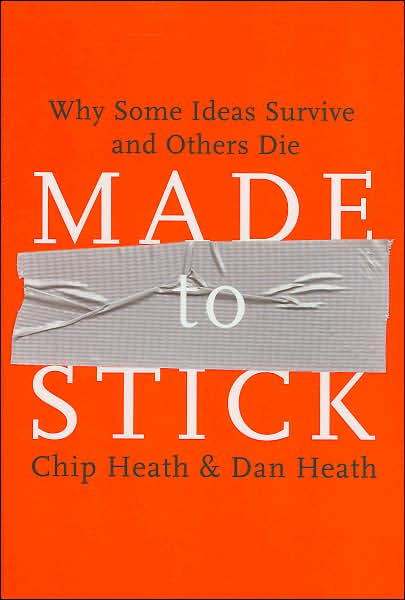
Immediately, I try to peel away that 'To' label ... but the library has carefully plastic-wrapped the cover. So I turn to the inside jacket, to read a bit of a description, and see that part of the book is going to be about discussing urban legends and conspiracy theories and why they spread so effortlessly. Reading through the rest of the jacket's copy, I can see that this is going to be my sort of book.
And it reminds me of this post by Seth Godin: The Purpose of a Book Cover
So I turn to the back cover, again not intending to read the book, just checking it out, and this is what I see: A list of the six qualities of 'stickiness' that the book is going to discuss together with page numbers illustrating the points. Like so:Is the purpose of the cover to sell books, to accurately describe what's in the book, or to tee up the reader so the book has maximum impact?
The third.
... Tactically, the cover sells the back cover, the back cover sells the flap and by then you've sold the book.
Simplicity: How do you strip an idea to its core without turning it into a silly sound bite? See how Army commanders force siplicity into their battle plans - page 25
Credibility: How do you get people to believe your idea? See how NBA coaches engineered an experience that made the dangers of AIDS more palpable to their players - page 162
(That AIDS example is genius, btw. If you're just interested in flicking through the book at the library, I'd recommend it.)
So I check out the examples - which are well written, entertaining and illustrative. Then I check out the table of contents which says there's an 'Easy Reference Guide' at the back of the book. That guide is a 5 page summary of the ideas in the book - which is exactly what I want most books to have, because it saves me the work of doing it myself.
By this point, I'm intrigued and entertained enough that I read the whole introduction (which you can check out here, if you're interested).
Basically, this is exactly how I'd like a non-fiction book to be designed. Easing you into the subject matter, giving you a summary of what it says right up front (rather than hiding it in the last chapter), and providing entertaining, concrete examples. I'm looking forward to reading this.
Friday, September 25, 2009
The Elements of Persuasion: Summary
Recently, I did a bunch of posts summarising a book called The Elements of Persuasion, which is about how to construct stories that people will pay attention to and agree with. I felt that those posts got a bit caught up in the details, so I wanted to create a summary of that summary. Which is what you're about to read.
According to the book, there are five elements of persuasion: Passion, the Hero, the Antagonist, a moment of Awareness, and the Transformation into taking action. Here's a bit more about each of those five elements:
Passion
How do you get other people to care about the idea or cause that you care about?
To begin with, you need to be personally committed; it needs to be your passion. So before you tell your story, you need to ask:
Your Passion is the key to making anyone else care about your story. If people aren't connecting with your story at an emotional level, if they aren't feeling your Passion, then you're telling the wrong story.
What are the advantages of Passion?
Passion cuts through all the competing demands for an audience's attention and makes them listen to you. Check out this presentation by a 13 year old girl to the United Nations:
Passion is communicable. If your story connects with people emotionally, they will spread it for you because it's fun to tell.(*) At the start of this talk, Seth Godin shares an example of a story that spread - a story about a man who worked for the SPCA in San Francisco.
Speaking with Passion has a few more benefits:
The Hero
The Hero personifies the story and shows us how change our lives.
Heroes are changed by living through the story, and they take different actions because they've been changed. That means heroes show us how to change our own lives, and live according to the values in the story.
To use this idea when you're writing your story, start by reducing your story down to its central concept. Then transform that concept into actions. Finally, choose a hero who demonstrates how to take those actions.
It's vital to find the right hero for your story, and if you want to change people's minds and lives then it's best if your hero is real rather than fictional.
One final advantage of having a hero is that it allows the storyteller to unify the audience. By 'unify', I mean that the audience all see and interpret the events of the story through the same point-of-view.
The Antagonist
Antagonists keep the Hero from achieving their goal.
Antagonists don't create conflict; they "clarify what the conflict is about". (I wish I'd taken more notes on this point, because it seems profound!) At the moment I interpret it to mean that stories aren't about 'defeating' the Antagonist, they're about us discovering what we need to change in order to defeat it.
If you're going to persuade people, then they must remember what you've said. Memory and recall are improved when you experience strong emotions. Think about how much you love to hate the villains in Die Hard or Star Wars or [insert a more topical movie reference of your choice here]. Using an Antagonist lets you easily generate strong negative emotions, but at the same time audiences will associate those the negative emotions with the Antagonist - which keeps your Hero sympathetic. And the audience's dislike of the antagonist will get them on the Hero's side.
Choose the 'right' antagonist. One that can be overcome, but not one that's a straw villain (either imaginary, or whose threat is overinflated). And don't demonise the Antagonist - instead, give the hero and the audience a change to learn from them.
Awareness
You want to create a moment of Awareness in the audience where they see the problem for what it is and the actions they need to take to fix it.
Hopefully by this point you'll have also created the Passion to change things and given them a role model of how to change (the Hero). Awareness applies both to the Hero and to the audience; ideally, the audience should share the Hero's realisation that something needs to change.
Transformation
Taking action and changing things transforms you and the world around you.
EDITED TO ADD:
Here are the links to the rest of my posts on the Elements of Persuasion.
Introduction.
The First Element: Passion.
The Second Element: The Hero.
The final three Elements.
According to the book, there are five elements of persuasion: Passion, the Hero, the Antagonist, a moment of Awareness, and the Transformation into taking action. Here's a bit more about each of those five elements:
Passion
How do you get other people to care about the idea or cause that you care about?
To begin with, you need to be personally committed; it needs to be your passion. So before you tell your story, you need to ask:
- Do I really care about what I'm about to say? Do I need to tell this story?
- It is true?
Your Passion is the key to making anyone else care about your story. If people aren't connecting with your story at an emotional level, if they aren't feeling your Passion, then you're telling the wrong story.
What are the advantages of Passion?
Passion cuts through all the competing demands for an audience's attention and makes them listen to you. Check out this presentation by a 13 year old girl to the United Nations:
Passion is communicable. If your story connects with people emotionally, they will spread it for you because it's fun to tell.(*) At the start of this talk, Seth Godin shares an example of a story that spread - a story about a man who worked for the SPCA in San Francisco.
Speaking with Passion has a few more benefits:
- Passion gets your audience ready to want to listen to you; it warms them up
- Passion makes your story seems more vivid and more real
- The more passionate and personal your story is, the easier it is to overcome stage fright; Passion helps you tell your story in a way that makes you appear natural and relaxed
The Hero
The Hero personifies the story and shows us how change our lives.
Heroes are changed by living through the story, and they take different actions because they've been changed. That means heroes show us how to change our own lives, and live according to the values in the story.
To use this idea when you're writing your story, start by reducing your story down to its central concept. Then transform that concept into actions. Finally, choose a hero who demonstrates how to take those actions.
It's vital to find the right hero for your story, and if you want to change people's minds and lives then it's best if your hero is real rather than fictional.
One final advantage of having a hero is that it allows the storyteller to unify the audience. By 'unify', I mean that the audience all see and interpret the events of the story through the same point-of-view.
The Antagonist
Antagonists keep the Hero from achieving their goal.
Antagonists don't create conflict; they "clarify what the conflict is about". (I wish I'd taken more notes on this point, because it seems profound!) At the moment I interpret it to mean that stories aren't about 'defeating' the Antagonist, they're about us discovering what we need to change in order to defeat it.
If you're going to persuade people, then they must remember what you've said. Memory and recall are improved when you experience strong emotions. Think about how much you love to hate the villains in Die Hard or Star Wars or [insert a more topical movie reference of your choice here]. Using an Antagonist lets you easily generate strong negative emotions, but at the same time audiences will associate those the negative emotions with the Antagonist - which keeps your Hero sympathetic. And the audience's dislike of the antagonist will get them on the Hero's side.
Choose the 'right' antagonist. One that can be overcome, but not one that's a straw villain (either imaginary, or whose threat is overinflated). And don't demonise the Antagonist - instead, give the hero and the audience a change to learn from them.
Awareness
You want to create a moment of Awareness in the audience where they see the problem for what it is and the actions they need to take to fix it.
Hopefully by this point you'll have also created the Passion to change things and given them a role model of how to change (the Hero). Awareness applies both to the Hero and to the audience; ideally, the audience should share the Hero's realisation that something needs to change.
Transformation
Taking action and changing things transforms you and the world around you.
EDITED TO ADD:
Here are the links to the rest of my posts on the Elements of Persuasion.
Introduction.
The First Element: Passion.
The Second Element: The Hero.
The final three Elements.
Sunday, August 16, 2009
Crafty Screenwriting on the elements of a story
This is the last post about Crafty Screenwriting, and in it I want to look at what it says about the elements that make up a compelling story. These elements are very similar to the ones in 'Elements of Persuasion', so I think it's worth checking out whether they agree, amplify, or contradict each other.
This is how Alex Epstein summarises the way his elements work:
The character's goal needs to be something we care about. Maybe it's internal (psychological, emotional); maybe it's external (save the world, fall in love). As Alex points out, "We don't have to necessarily be on the hero's side. We just have to be involved emotionally in what he's trying to do."
So, goals help us care about people. A person may be a jerk, but if their goal is one we can admire or get behind (put on the best show possible; kick the Nazis out of Europse), then we can root for them as a protagonist.
For me, one of the biggest tests of this (in recent years) is Daniel Plainview in There Will Be Blood. As a manipulative, obsessive 19th century oil-man, he’s not a character I feel familiar with or whose shoes I want to walk in. And his goal: ‘to con a small community out of its oil at any cost’ isn’t one I can admire or get behind. So why do I root for him? I guess partially it’s because he’s an object of fascination – Daniel Plainview is such an unusual psychological presence; the way he thinks and sees the world just rivets me (plus he’s too dangerous to take your eyes off). And partially it’s because he cares about the boy he’s raising; Plainview’s goal of raising his son well is only a small part of the film, but it’s one I can get behind.
Man, time to watch There Will Be Blood again!
This idea of goals (and methods, I guess) being things we care about also reminds me Humanity checks in the game Sorceror. A protagonist can be a real scum-bag, but they remain worthy of our attention as long as we don’t think “That’s it. I’m done with you; I don’t care what you do any more – you’ve crossed a line and you’re irredeemable as far as I’m concerned.”
Alex also observes that characters without goals lead to stories without drama.
---
The third element is risk, jeopardy, the idea that the character has something to lose. And that what they could lose is worth caring about.
Actually, some of this feels a little tautological. We'll care about a character if the thing they could lose is something we'll care about? It's the idea of 'caring' that needs to be grappled with here.
And I think Alex makes a good crack at answering that at the end of this section:
---
Finally, the main character has "at least one but ideally three basic obstacles in their way." These obstacles are:
1. An External Antagonist or Obstacle: this could be so many things ... environmental (an erupting volcano), social (a corrupt justice system), personal (a masked killer stalking you), widespread (a continent-spanning war), or nearly microscopic (a swiftly growing brain tumour).
Again, we have to care about the antagonists - perhaps because they're sympathetic; perhaps because they're scary as all hell. In fact, check out this quote from James Berardinelli's recent review of Robocop:
3. A Tragic or Comic Flaw (A Psychological Opponent): Indecision, guilt, self-doubt, a death wish, self-loathing, pride. This is all stuff I'm very familiar with from playing lots of Primetime Adventures - most situations can be made much worse if you just give a character enough rope to let their own Issues mess them up.
... oh, and a main character's tragic flaw can reflect the external antagonist or obstacle in some way.
That's it for Crafty Screenwriting. In about a week, I'll be moving on to the last of these books on story construction: "Made to Stick", which talks about why some ideas and stories survive and get passed on from person to person, while others wither and die. You can read excerpts from the intro here, if you're curious.
This is how Alex Epstein summarises the way his elements work:
A main characterMain characters can be unlikeable, but we do have to care about what happens to them. What is it that makes us care? Alex proposes two ways:
... who has a goal that we (the audience) care about.
... The main character is risking a lot
... and they have at least one but ideally three basic obstacles in their way.
- their situation is familiar to us (eg. Dorothy in the Wizard of Oz)
- we enjoy projecting ourselves into their shoes (eg. James Bond if you want to be a hero; D-FENS from Falling Down if you want to work through your rage)
The character's goal needs to be something we care about. Maybe it's internal (psychological, emotional); maybe it's external (save the world, fall in love). As Alex points out, "We don't have to necessarily be on the hero's side. We just have to be involved emotionally in what he's trying to do."
So, goals help us care about people. A person may be a jerk, but if their goal is one we can admire or get behind (put on the best show possible; kick the Nazis out of Europse), then we can root for them as a protagonist.
For me, one of the biggest tests of this (in recent years) is Daniel Plainview in There Will Be Blood. As a manipulative, obsessive 19th century oil-man, he’s not a character I feel familiar with or whose shoes I want to walk in. And his goal: ‘to con a small community out of its oil at any cost’ isn’t one I can admire or get behind. So why do I root for him? I guess partially it’s because he’s an object of fascination – Daniel Plainview is such an unusual psychological presence; the way he thinks and sees the world just rivets me (plus he’s too dangerous to take your eyes off). And partially it’s because he cares about the boy he’s raising; Plainview’s goal of raising his son well is only a small part of the film, but it’s one I can get behind.
Man, time to watch There Will Be Blood again!
This idea of goals (and methods, I guess) being things we care about also reminds me Humanity checks in the game Sorceror. A protagonist can be a real scum-bag, but they remain worthy of our attention as long as we don’t think “That’s it. I’m done with you; I don’t care what you do any more – you’ve crossed a line and you’re irredeemable as far as I’m concerned.”
Alex also observes that characters without goals lead to stories without drama.
---
The third element is risk, jeopardy, the idea that the character has something to lose. And that what they could lose is worth caring about.
Actually, some of this feels a little tautological. We'll care about a character if the thing they could lose is something we'll care about? It's the idea of 'caring' that needs to be grappled with here.
And I think Alex makes a good crack at answering that at the end of this section:
Jeopardy puts the hero in play.I like that phrasing. The hero (who's someone we care about because we identify with them or want to be with them) is now at risk of being transformed, harmed, or losing something vital to their life. They are in play; the thing that they are risking is (essentially) themselves.
---
Finally, the main character has "at least one but ideally three basic obstacles in their way." These obstacles are:
1. An External Antagonist or Obstacle: this could be so many things ... environmental (an erupting volcano), social (a corrupt justice system), personal (a masked killer stalking you), widespread (a continent-spanning war), or nearly microscopic (a swiftly growing brain tumour).
Again, we have to care about the antagonists - perhaps because they're sympathetic; perhaps because they're scary as all hell. In fact, check out this quote from James Berardinelli's recent review of Robocop:
One of the standout elements of Robocop is the despicability of the villains. These aren't mealy mouthed bad guys - they are vile, mustache-twirling cretins who deserve horrible, painful deaths. It takes a talented director to fashion characters that become targets of such extreme vitriol. This is what Verhoeven wants; the more deeply viewers hate the bad guys, the more they will be involved in the outcome. It's nice for an audience to like the hero, but more important that they loathe the villain.And this quote from Crafty Screenwriting addresses the other side:
If your hero has an obstacle instead of an antagonist, we still have to care about it. If your hero is crossing the Antarctic, you have to find a way to make us feel what is grand and compelling about a lot of ice. In a movie about climbing Everest, you are going to have to make us care about a really big rock.2. An Intimate Opponent: Someone on the main character's side who is working at cross-purposes to them.
3. A Tragic or Comic Flaw (A Psychological Opponent): Indecision, guilt, self-doubt, a death wish, self-loathing, pride. This is all stuff I'm very familiar with from playing lots of Primetime Adventures - most situations can be made much worse if you just give a character enough rope to let their own Issues mess them up.
... oh, and a main character's tragic flaw can reflect the external antagonist or obstacle in some way.
That's it for Crafty Screenwriting. In about a week, I'll be moving on to the last of these books on story construction: "Made to Stick", which talks about why some ideas and stories survive and get passed on from person to person, while others wither and die. You can read excerpts from the intro here, if you're curious.
Friday, August 14, 2009
Crafty Screenwriting on pitching
Alex Epstein's book 'Crafty Screenwriting' also has a lot to say about pitching that I think it relevant to the process of creating a story. As I mentioned earlier, he fiercely advocates NOT writing down your story for as long as possible, and instead actually telling it to people.
Why wouldn't you write down your story? Alex suggests that writing it down 'freezes' your story, making you reluctant to make big / necessary changes to it. He uses the example of 'While You Were Sleeping', whose writers pitched the film for 5 years before realising how much it would be improved by having the GUY be the one in the coma. It was easy to change the story because nothing was written down.
Alex also says that writing down your story can make it easy to overlook its flaws. I can related to this - my eyes have certainly skimmed over sections of my outlines before, as I 'know' what it's trying to convey and don't need to pay attention to it. As a result, whole sections have wound up needing to be deleted or re-arranged in finished scripts.
The best way to find out if your hook or story works is to tell it to people. Tell it out loud, over and over again, to whoever will listen.(*) Telling it allows you to see what people respond to. And because you're not writing it down, it allows you to figure out what bits of it are memorable or not.
(*) Candidates for telling your story to include co-workers, friends, your mum, kids, strangers on the bus, muggers, priests in confessional boothes.
Basically, the process of telling your story will give you an opportunity to naturally flesh it out, elaborate on it, and deepen it.
Alex also suggests three questions to think about while you're telling your story:
Telling lets you immediately see the reaction to your story.
Telling mean you can hear when YOU get bored or confused.
Telling forces you to create a story that's so simple, clear and logical that you can remember it. It forces you to remember what comes next.
But what if the idea of telling someone your story completely freaks you out? Well, there are some alternatives:
Why wouldn't you write down your story? Alex suggests that writing it down 'freezes' your story, making you reluctant to make big / necessary changes to it. He uses the example of 'While You Were Sleeping', whose writers pitched the film for 5 years before realising how much it would be improved by having the GUY be the one in the coma. It was easy to change the story because nothing was written down.
Alex also says that writing down your story can make it easy to overlook its flaws. I can related to this - my eyes have certainly skimmed over sections of my outlines before, as I 'know' what it's trying to convey and don't need to pay attention to it. As a result, whole sections have wound up needing to be deleted or re-arranged in finished scripts.
The best way to find out if your hook or story works is to tell it to people. Tell it out loud, over and over again, to whoever will listen.(*) Telling it allows you to see what people respond to. And because you're not writing it down, it allows you to figure out what bits of it are memorable or not.
(*) Candidates for telling your story to include co-workers, friends, your mum, kids, strangers on the bus, muggers, priests in confessional boothes.
Basically, the process of telling your story will give you an opportunity to naturally flesh it out, elaborate on it, and deepen it.
Alex also suggests three questions to think about while you're telling your story:
- Is your listener interested in your hook at all? If not, then (a) rephrase it and try again, or (b) come up with a better idea.
- What does it remind them of? Check these other, similar stories out.
- What do they tell you? They may have ideas and criticisms. Listen to them. Even if they're off-base, you'll find out what sort of things they expected to hear or see when you told them your pitch.
Telling lets you immediately see the reaction to your story.
Telling mean you can hear when YOU get bored or confused.
Telling forces you to create a story that's so simple, clear and logical that you can remember it. It forces you to remember what comes next.
But what if the idea of telling someone your story completely freaks you out? Well, there are some alternatives:
- Tell it to yourself
- Write down the basic beats of the story on cards, mix the cards up, and try to put them back together in the right order
- (... and my favourite) Write your story down. Hide those pages. Rewrite it again from memory. Hide those pages. Repeat.
Wednesday, August 12, 2009
Crafty Screenwriting on hooks
I mentioned way back in my synopsising of Presentation Zen that I was going to have to do a bit more reading about the 'how to' part of how to construct a story. That reminded me that of a script-writing manual that I felt might have some relevance - Crafty Screenwriting by Alex Epstein.
Alex advocates coming up with a hook - a description that encapsulates your story in a nutshell and intrigues the audience into wanting to know more. He also fiercely advocates NOT writing down your story for as long as possible, and instead actually telling it to people.
The idea of the hook resonates with the advice I keep reading about reducing your story or presentation down to its core idea, to a single catchy phrase. Why would you do this? Well, I think Alex provides some really good insight here: we all have multiple demands placed on our attention every day - so how do you cut through the noise and make someone pay attention to you?
You have to make them want to know what happens next.
So, a hook is a fresh idea that instantly makes showbiz people want to read your script, and audiences want to see your movie. It makes people want to see how it turns out. Alex provides some examples, such as:
Alex advocates coming up with a hook - a description that encapsulates your story in a nutshell and intrigues the audience into wanting to know more. He also fiercely advocates NOT writing down your story for as long as possible, and instead actually telling it to people.
The idea of the hook resonates with the advice I keep reading about reducing your story or presentation down to its core idea, to a single catchy phrase. Why would you do this? Well, I think Alex provides some really good insight here: we all have multiple demands placed on our attention every day - so how do you cut through the noise and make someone pay attention to you?
You have to make them want to know what happens next.
So, a hook is a fresh idea that instantly makes showbiz people want to read your script, and audiences want to see your movie. It makes people want to see how it turns out. Alex provides some examples, such as:
- A puppeteer finds a secret tunnel into John Malkovich's brain
- There's a bomb on a crowded city bus. If the bus slows down below 50 miles per hour, the bomb goes off
- Three film-makers goes missing in the woods while taping a documentary about a legendary witch. A year later their footage is found.
Saturday, August 08, 2009
Long Range: Ariely on cheating
I'll summarise the main points of Dan Ariely's talk on cheating here. If anyone want to dig into this a little bit deeper, let's hit the comments.
Ariely's saying that people like to think of themselves as a 'good' person ("They like to be able to look themselves in the mirror"). But effectively what that means is that people can cheat a little bit as long as it doesn't change their image of themselves.
That means that the amount a person cheats is NOT affected by:
But you can increase the likelihood that they'll cheat through two simple methods:
(*) Well, the stock-market or a corporation's profits.
I also found this interesting: You can decrease our inclination to cheat / improve our morality simply by making us think about moral things (the 10 Commandments, the Honour code). You don't have to believe in this things for it to have an effect - one of Ariely's experiments showed a statistically significant decrease in cheating (like, no cheating) when atheists swore on the Bible.
One other item of note for this series on long range thinking. Ariely claims that people (tend to) feel that their intuition about things is right. That would mean that it's difficult to motivate yourself to test whether your intuitions or theories about how the world works are actually correct.
Ariely's saying that people like to think of themselves as a 'good' person ("They like to be able to look themselves in the mirror"). But effectively what that means is that people can cheat a little bit as long as it doesn't change their image of themselves.
That means that the amount a person cheats is NOT affected by:
- how much they can potentially earn through cheating
- discovering there's a reduced probability that they'll get caught
But you can increase the likelihood that they'll cheat through two simple methods:
- make what they're cheating or stealing more abstract or symbolic; the less it initially feels like tangible money or valuable goods, the easier it is to cheat or steal it
- be part of a group where it's socially acceptable to cheat
(*) Well, the stock-market or a corporation's profits.
I also found this interesting: You can decrease our inclination to cheat / improve our morality simply by making us think about moral things (the 10 Commandments, the Honour code). You don't have to believe in this things for it to have an effect - one of Ariely's experiments showed a statistically significant decrease in cheating (like, no cheating) when atheists swore on the Bible.
One other item of note for this series on long range thinking. Ariely claims that people (tend to) feel that their intuition about things is right. That would mean that it's difficult to motivate yourself to test whether your intuitions or theories about how the world works are actually correct.
Monday, July 27, 2009
Synopsis: Elements of Persuasion (The Last 3 Elements)
In The Elements of Persuasion (TEOP), the Antagonist is defined as the thing that is keeping your Hero from achieving their goal(s). This 'thing' could be a person, or a disease (if you're a doctor), or a sinking ship (if you're stuck on the Titanic).
An Antagonist isn't used to create conflict; they're used to "clarify what the conflict is about".
So, here's why TEOP thinks you should use an Antagonist. The authors say that if you're going to persuade people, then they must remember what you've said. Citing studies that indicate that experiencing strong emotions increases the chances of remembering something, the authors then point out that using an Antagonist has two advantages:
You've got to choose the 'right' antagonist, though. One that can be overcome. One that's not a straw villain (either imaginary, or whose threat is overinflated). And one that you don't demonise - because that allows your hero and your audience to learn from them. Choose the right antagonist and you're halfway to succeed (in either the goal you've set for your hero or in persuading your audience).
Awareness and Transformation
TEOP kind of peters out in its final two chapters. Rather than providing 'how to' guides on building moments of awareness and transformation into your stories, it shares a bunch of pretty interesting stories about viral marketing and retail architecture. It's become very obvious by this point that TEOP is a business book, but in these last two chapters it becomes extremely (to be generous) 'indirect' in the way it imparts its lessons; very 'show, don't tell'.
So, drawing on material from the book's introduction, 'Awareness' is the moment that allows us to learn from the story and therefore succeed. When I write it like that, it seems that Awareness applies both to the Hero and to the audience.
You want to create a moment of Awareness in the audience where they see the problem for what it is and the actions they need to take to fix it. Hopefully by this point you'll have also created the Passion to change things and given them a model of how to change (the Hero).
As for Transformation ... well, TEOP says that in commercial storytelling this usually involves you getting paid. But more generally, Transformation involves taking action that changes you and the world around you.
That's all I was able to extract in terms of how to apply the Elements of Persuasion from the last 2 chapters.
Criticisms
I should point out that TEOP contains a bunch of interesting stuff that's not totally on-message. Creating teams, tips for presenting stories effectively, advice about finding meaning in your life. Stuff I found useful, but not for this synopsis.
And it turns out that my criticisms boils down to two points: This is a 225 page book that feels like it should be about 100 pages long, something that's tighter, more on-message. And I'm absolutely not the target audience ... well, sort of absolutely not. I can see how to apply some of this to my day-job. But the book is pitched at business leaders and corporate storytellers/marketeers.
Worthy of having a quick flick-through browse, filled with tangents, and it'll make you work to extract its lessons. That's my take on the Elements of Persuasion; now I'm going to try applying its principles, which I have found useful.
An Antagonist isn't used to create conflict; they're used to "clarify what the conflict is about".
So, here's why TEOP thinks you should use an Antagonist. The authors say that if you're going to persuade people, then they must remember what you've said. Citing studies that indicate that experiencing strong emotions increases the chances of remembering something, the authors then point out that using an Antagonist has two advantages:
- you can easily generate strong negative emotions because of them, and
- audiences will associate those the negative emotions with the Antagonist - keeping your Hero sympathetic.
You've got to choose the 'right' antagonist, though. One that can be overcome. One that's not a straw villain (either imaginary, or whose threat is overinflated). And one that you don't demonise - because that allows your hero and your audience to learn from them. Choose the right antagonist and you're halfway to succeed (in either the goal you've set for your hero or in persuading your audience).
Awareness and Transformation
TEOP kind of peters out in its final two chapters. Rather than providing 'how to' guides on building moments of awareness and transformation into your stories, it shares a bunch of pretty interesting stories about viral marketing and retail architecture. It's become very obvious by this point that TEOP is a business book, but in these last two chapters it becomes extremely (to be generous) 'indirect' in the way it imparts its lessons; very 'show, don't tell'.
So, drawing on material from the book's introduction, 'Awareness' is the moment that allows us to learn from the story and therefore succeed. When I write it like that, it seems that Awareness applies both to the Hero and to the audience.
You want to create a moment of Awareness in the audience where they see the problem for what it is and the actions they need to take to fix it. Hopefully by this point you'll have also created the Passion to change things and given them a model of how to change (the Hero).
As for Transformation ... well, TEOP says that in commercial storytelling this usually involves you getting paid. But more generally, Transformation involves taking action that changes you and the world around you.
That's all I was able to extract in terms of how to apply the Elements of Persuasion from the last 2 chapters.
Criticisms
I should point out that TEOP contains a bunch of interesting stuff that's not totally on-message. Creating teams, tips for presenting stories effectively, advice about finding meaning in your life. Stuff I found useful, but not for this synopsis.
And it turns out that my criticisms boils down to two points: This is a 225 page book that feels like it should be about 100 pages long, something that's tighter, more on-message. And I'm absolutely not the target audience ... well, sort of absolutely not. I can see how to apply some of this to my day-job. But the book is pitched at business leaders and corporate storytellers/marketeers.
Worthy of having a quick flick-through browse, filled with tangents, and it'll make you work to extract its lessons. That's my take on the Elements of Persuasion; now I'm going to try applying its principles, which I have found useful.
Thursday, July 23, 2009
Synopsis: Elements of Persuasion (The Hero)
Heroes show us how to change things. That's what I've taken to be the essence of The Elements of Persuasion's (TEOP) discussion about the Hero. They live the story, personify it, and show us how to change our own lives.
Once you've connected with an audience through a shared passion, a hero allows the audience to 'access' the story. (*) Having a hero allows the storyteller to unify the audience, so that they all see the events and meaning of the story through the same point-of-view.
(*) I'm using 'access' to synthesise a whole bunch of concepts in TEOP: the idea of 'connecting the story to the audience's world at a broader level', 'equality', and 'looking at the world through the hero's eyes'.
'What is a hero?' is the obvious question. TEOP describes a few qualities that heroes possess; they are :
The book provides some pretty reasonable examples of corporate and team stories, such as the behind-the-counter routines at Starbucks (story: "This is how you make a really good cup of coffee"), Harley Davidson (story: freedom and fun through getting on a bike ... I guess), and the US Marine Corp (story: Always faithful). (**)
(**) In fact, the book's description of USMC basic training is definitely worth a read, especially its description of the Crucible on pp 99-101 which synopses a 54-hour test of group performance under combat conditions coupled with myth-building. It is both stranger and more interesting than I'd ever imagined basic to be.
TEOP's advice is to reduce your story down to its central concept. Transform that concept into actions. Then choose a hero who demonstrates how to take those actions.
Criticisms
As with the section on passion, I've found that once I've boiled down TEOP's take on the hero, there's a lot of insightful material that I'd never thought of.
However, some negatives are also becoming obvious. The book is primarily directed toward a corporate audience (referring to them as 'corporate storytellers' as some points); in other words, an audience that is not me. That explains a lot about why some of the examples leave me cold.
The idea of associating each element of persuasion with one of the five classical elements seems a bit spurious. Why is the Hero associated with Earth, for instance? You could make an equally good case for Air, Fire, Water, or ... I think 'Spirit' is the fifth element the authors use.
It's a little unclear how to operationalise some of the stuff TEOP talks about. "Heroes stand their ground," says the book. "They control some territory (whether it be physical, emotional, intellectual, or spiritual) of value." Interesting stuff, but more something you the author recognise than something you implement.
There are sections (like the one on active listening) that feel like tangents or padding. I can sort of see how they connect with the aim of the book, but I'm not quite sure when to utilise them in the process of creating and telling your story.
Next up, 'The Antagonist', via a chapter of sticky stories (a chapter that I'm not quite fits in to TEOP's five elements schema).
Once you've connected with an audience through a shared passion, a hero allows the audience to 'access' the story. (*) Having a hero allows the storyteller to unify the audience, so that they all see the events and meaning of the story through the same point-of-view.
(*) I'm using 'access' to synthesise a whole bunch of concepts in TEOP: the idea of 'connecting the story to the audience's world at a broader level', 'equality', and 'looking at the world through the hero's eyes'.
'What is a hero?' is the obvious question. TEOP describes a few qualities that heroes possess; they are :
- the highest common denominator; they bring out the best in themselves, the listener and the story
- complexity; heroes surprise us
- authenticity; heroes are real and charismatic
The book provides some pretty reasonable examples of corporate and team stories, such as the behind-the-counter routines at Starbucks (story: "This is how you make a really good cup of coffee"), Harley Davidson (story: freedom and fun through getting on a bike ... I guess), and the US Marine Corp (story: Always faithful). (**)
(**) In fact, the book's description of USMC basic training is definitely worth a read, especially its description of the Crucible on pp 99-101 which synopses a 54-hour test of group performance under combat conditions coupled with myth-building. It is both stranger and more interesting than I'd ever imagined basic to be.
TEOP's advice is to reduce your story down to its central concept. Transform that concept into actions. Then choose a hero who demonstrates how to take those actions.
Criticisms
As with the section on passion, I've found that once I've boiled down TEOP's take on the hero, there's a lot of insightful material that I'd never thought of.
However, some negatives are also becoming obvious. The book is primarily directed toward a corporate audience (referring to them as 'corporate storytellers' as some points); in other words, an audience that is not me. That explains a lot about why some of the examples leave me cold.
The idea of associating each element of persuasion with one of the five classical elements seems a bit spurious. Why is the Hero associated with Earth, for instance? You could make an equally good case for Air, Fire, Water, or ... I think 'Spirit' is the fifth element the authors use.
It's a little unclear how to operationalise some of the stuff TEOP talks about. "Heroes stand their ground," says the book. "They control some territory (whether it be physical, emotional, intellectual, or spiritual) of value." Interesting stuff, but more something you the author recognise than something you implement.
There are sections (like the one on active listening) that feel like tangents or padding. I can sort of see how they connect with the aim of the book, but I'm not quite sure when to utilise them in the process of creating and telling your story.
Next up, 'The Antagonist', via a chapter of sticky stories (a chapter that I'm not quite fits in to TEOP's five elements schema).
Tuesday, July 21, 2009
Synopsis: Elements of Persuasion (Passion)
The first 'element' of persuasion is the PASSION with which a story is told. 'Passion' is defined as the energy that makes you need to tell a story. The two big advantages of passion are that:
(i) passion can cut through all the competing demands for an audience's attention and make them listen to you
(ii) if your story connects with people emotionally, they will spread it for you because it's fun to tell (*).
(*) I'm not entirely sure the authors justify how that second point follows from a story being told with passion, though. Unless 'passion' is simultaneously "the energy that makes you need to tell a story", and "the emotion you want the story to create."
According to the authors, speaking with passion has another couple of benefits. It warms the audience up (getting them ready to want to listen to you). Passion then makes the story come alive for them; the story seems more vivid and more real.
Apparently, the more passionate and personal your story is, the easier it is to overcome the natural stage fright of telling your story to people. In particular, stories that are personal are easier to remember, and able to be told in a way that makes you appear natural and relaxed. They also increase your likeability and show that you're authentic (talking about something that means something to you).
Which brings me back to the first point: passion is your need to tell a story. The Elements of Persuasion (TEOP)describes itself as being about how to get other people to care about what you care about. The key to this, according to TEOP is that you need to be personally committed and passionately involved (in order to be able to make anyone else care). Before you tell your story, you need to ask:
Criticisms
As I mentioned earlier, I'm also trying to figure out why I've found this book so difficult to read. At this point, I don't really have firm conclusions, but some of the stuff I've noticed while working through these two chapters on Passion are:
(i) passion can cut through all the competing demands for an audience's attention and make them listen to you
(ii) if your story connects with people emotionally, they will spread it for you because it's fun to tell (*).
(*) I'm not entirely sure the authors justify how that second point follows from a story being told with passion, though. Unless 'passion' is simultaneously "the energy that makes you need to tell a story", and "the emotion you want the story to create."
According to the authors, speaking with passion has another couple of benefits. It warms the audience up (getting them ready to want to listen to you). Passion then makes the story come alive for them; the story seems more vivid and more real.
Apparently, the more passionate and personal your story is, the easier it is to overcome the natural stage fright of telling your story to people. In particular, stories that are personal are easier to remember, and able to be told in a way that makes you appear natural and relaxed. They also increase your likeability and show that you're authentic (talking about something that means something to you).
Which brings me back to the first point: passion is your need to tell a story. The Elements of Persuasion (TEOP)describes itself as being about how to get other people to care about what you care about. The key to this, according to TEOP is that you need to be personally committed and passionately involved (in order to be able to make anyone else care). Before you tell your story, you need to ask:
- Do I really care about what I'm about to say?
- It is true?
Criticisms
As I mentioned earlier, I'm also trying to figure out why I've found this book so difficult to read. At this point, I don't really have firm conclusions, but some of the stuff I've noticed while working through these two chapters on Passion are:
- the book occasionally makes some spurious connections between different facts
- some of the books used as examples have quite tenuous connections to the points being made (going from the idea of 'victory through a single strike' as portrayed in the Book of Five Rings to William Safire's (and Presentation Zen's) idea of summing up a story with a single memorable phrase ... well, that's quite a stretch for an analogy
- it's not focusing on the 'How' of how to tell or construct stories; so far, it's more about providing examples of stories. I assume it's hoping we'll learn through reflecting on those stories.
Wednesday, July 15, 2009
Synopsis: The Elements of Persuasion (Introduction)
As a follow-on from Presentation Zen, I'm going to synopsise my notes from re-reading (*) 'The Elements of Persuasion'. This is a book that aims to teach you how to tell more effective stories, or (as the sub-title says) how to 'use stories to pitch better, sell faster, and win more business'.
(*) Actually, I've tried reading it twice before, quitting both times. Hopefully this time through, I'll be able to figure out why.
The Elements of Persuasion (TEOP, from here on in) defines a story as a 'fact, wrapped in an emotion, that compels us to take an action that transforms our world'. The authors, a scriptwriter and a former monk/communications coach, describe stories as having five elements:

Back in a few days for details on the first ... I guess ... element of persuasion: Passion.
EDITED TO ADD:
Here are the links to all my Elements of Persuasion posts.
The First Element: Passion.
The Second Element: The Hero.
The final three Elements.
Summary.
(*) Actually, I've tried reading it twice before, quitting both times. Hopefully this time through, I'll be able to figure out why.
The Elements of Persuasion (TEOP, from here on in) defines a story as a 'fact, wrapped in an emotion, that compels us to take an action that transforms our world'. The authors, a scriptwriter and a former monk/communications coach, describe stories as having five elements:
- The PASSION with which the story is told
- A HERO who leads us through the story and allows us to see it through their eyes
- An ANTAGONIST (or obstacle) that the hero must overcome
- A moment of AWARENESS that allows the Hero to prevail
- The TRANSFORMATION in the hero and the world that results from successfully acting on that Awareness.
Back in a few days for details on the first ... I guess ... element of persuasion: Passion.
EDITED TO ADD:
Here are the links to all my Elements of Persuasion posts.
The First Element: Passion.
The Second Element: The Hero.
The final three Elements.
Summary.
Thursday, July 09, 2009
Presentation: Wake up, Freak out, and then get a grip
Wake Up, Freak Out - then Get a Grip from Leo Murray on Vimeo.
A great example of a compelling metaphor - this one explains the 'tipping point' - and a pretty good visual representation of feedback cycles.
Friday, July 03, 2009
Synopsis: Presentation Zen (Be with your audience)
Presentation Zen (PZ) finishes up with some simple advice for actually delivering your presentation.
First: practice. The aim is to know your material so well that you can present it without referring to any notes. As PZ mentions earlier, the act of developing your story is going to help you develop this mastery of the material.
Second: be fully present when you give your presentation. Focus just on this moment; don't allow yourself to be distracted by thoughts of what happened before you arrived, or what you need to do afterwards.
This advice goes even further - it suggests focusing entirely on the act of presenting, and not on how your presentation is being perceived.
Garr Reynolds, the author of PZ, suggests a few things here:
This quality of 'mindfulness' is, I think, a way of delivering the best possible presentation. You're focusing on conveying the material, which (hopefully) leads to a stronger connection with the audience as they see that it's not about you, it's about what they're learning.
Third: Aim to be as interested in your material as you hope your audience will be. Again, mindfulness helps you share your passion for the material in your presentation with your audience.
How to connect with an audience
Reynolds points out that people's concentration tends to flag after about 15 to 20 minutes. Keeping your presentation as short as it can be is an excellent goal, as is trying to finish before your time runs out.
He also suggests reducing the number of barriers between you and the audience:
First: practice. The aim is to know your material so well that you can present it without referring to any notes. As PZ mentions earlier, the act of developing your story is going to help you develop this mastery of the material.
Second: be fully present when you give your presentation. Focus just on this moment; don't allow yourself to be distracted by thoughts of what happened before you arrived, or what you need to do afterwards.
This advice goes even further - it suggests focusing entirely on the act of presenting, and not on how your presentation is being perceived.
Garr Reynolds, the author of PZ, suggests a few things here:
- "Don't ask 'Will I be appreciated?' or 'Will I win them over?' Ask 'How can I contribute?'
- Think of mistakes as fascinating. Think of mistakes as opportunities to learn (to grow). Let the mistakes go and move on; dwelling on the mistakes will disconnect you from your audience.
This quality of 'mindfulness' is, I think, a way of delivering the best possible presentation. You're focusing on conveying the material, which (hopefully) leads to a stronger connection with the audience as they see that it's not about you, it's about what they're learning.
Third: Aim to be as interested in your material as you hope your audience will be. Again, mindfulness helps you share your passion for the material in your presentation with your audience.
How to connect with an audience
Reynolds points out that people's concentration tends to flag after about 15 to 20 minutes. Keeping your presentation as short as it can be is an excellent goal, as is trying to finish before your time runs out.
He also suggests reducing the number of barriers between you and the audience:
- Don't use a lectern
- Don't sit at the back of the room by the projector
- Don't sit behind a desk
- Keep lights on, so people can see you.
Thursday, June 25, 2009
Presentation Zen: An Example (The Moons of Saturn)
Another presentation - this one comes from TED.com and shows us what it's like on two of Saturn's moons.
There's less reliance on slides in this presentation, more a focus on the passion of the presenter (Carolyn Porco).
There's less reliance on slides in this presentation, more a focus on the passion of the presenter (Carolyn Porco).
Tuesday, June 23, 2009
Presentation Zen: An example (Inbox Zero)
Inbox Zero is a presentation about designing a system to deal with email overload. This youtube video is about an hour long. The presentation starts at about 2.30 minutes and goes for about 30 minutes (followed by a Q&A). The talk is good, the Q&A is so-so.
I have no assessment about the talk itself, although I did note a number of clean slides, and usage of the grid. I also noticed when bullet-point lists were used how my attention became divided between listening to what the presenter was saying and trying to read ahead on the list.
I have no assessment about the talk itself, although I did note a number of clean slides, and usage of the grid. I also noticed when bullet-point lists were used how my attention became divided between listening to what the presenter was saying and trying to read ahead on the list.
Sunday, June 21, 2009
Synopsis: Presentation Zen (Emptiness, Grids and CRAP)
A slide is composed of positive elements (such as text or logos) and empty (a.k.a. 'negative') space. The idea seems to be that you can use negative space to draw attention to the positive elements.
Having empty space in your slide seems like a simple concept, but it's hard to implement; it's very tempting to fill that empty space with lots of other stuff. From what I can tell, the principle to apply is this:
To begin with, look for the empty space in your slides. Once you can see it, use it. Reynolds demonstrates the difference between asymmetrical and symmetrical designs here. Asymmetrical designs activate the empty space and make your design more interesting. Symmetrical designs tend to crush the empty space out to the sides.(*)
* That's because symmetrical designs are centred along a strong vertical axis and are mirrored on both sides.
Guiding the Eye
"A well-designed slide has a clear starting point and guides the viewer through the design."
Presentation Zen provides a couple of tips here:

The red dots at the intersections of these lines are called 'power points'. These are areas where you might consider placing the main subject of the slide.
Using grids to divide your page or slide into thirds will also help you align the various elements on them.
CRAP
Contrast, Repetition, Alignment, Proximity.
This was another moment where I was reading Presentation Zen and realised that it was referring to a book I already own. In this case The Non Designers Design Book, the first book on layout and typography I ever bought. It's a great read, and it made reading about the principles in this section more like revision for me. To quote directly from PZ:
"Use the principle of contrast to create strong dynamic differences among elements that are different. If it is different, make it very different." Contrasts can create a focal point for your slide, clearly pointing out the one element that is dominant. This gives the viewer a starting point to process information.
"Use the principle of repetition to repeat selected elements throughout your slides. This can help give your slides unity and organisation."
"Use of the principle of alignment to connect elements visually (through invisible lines) on a slide. Grids are very useful for achieving good alignment. This will give your slide a clean and well organised look."
"Use the principle of proximity to ensure that related items are grouped together. People will tend to interpret items together or near each other as belonging to the same group." This reminds me of a basic rule of writing: help a reader understand a sentence by grouping related words and concepts together. As an example, compare the previous sentence to this one:
That's it for Section 2 of PZ. Time to take another break -- but over the next week I'll link to a few of the presentations mentioned in chapter 7.
Having empty space in your slide seems like a simple concept, but it's hard to implement; it's very tempting to fill that empty space with lots of other stuff. From what I can tell, the principle to apply is this:
- Start with nothing, and then add.
To begin with, look for the empty space in your slides. Once you can see it, use it. Reynolds demonstrates the difference between asymmetrical and symmetrical designs here. Asymmetrical designs activate the empty space and make your design more interesting. Symmetrical designs tend to crush the empty space out to the sides.(*)
* That's because symmetrical designs are centred along a strong vertical axis and are mirrored on both sides.
Guiding the Eye
"A well-designed slide has a clear starting point and guides the viewer through the design."
Presentation Zen provides a couple of tips here:
- Make sure images (especially of people's eyes) guide the viewer's eyes towards the elements you want them to look at
- Have a clear hierarchy that shows which elements on your slide are the most important, which are less important, and which are least important.

The red dots at the intersections of these lines are called 'power points'. These are areas where you might consider placing the main subject of the slide.
Using grids to divide your page or slide into thirds will also help you align the various elements on them.
CRAP
Contrast, Repetition, Alignment, Proximity.
This was another moment where I was reading Presentation Zen and realised that it was referring to a book I already own. In this case The Non Designers Design Book, the first book on layout and typography I ever bought. It's a great read, and it made reading about the principles in this section more like revision for me. To quote directly from PZ:
"Use the principle of contrast to create strong dynamic differences among elements that are different. If it is different, make it very different." Contrasts can create a focal point for your slide, clearly pointing out the one element that is dominant. This gives the viewer a starting point to process information.
"Use the principle of repetition to repeat selected elements throughout your slides. This can help give your slides unity and organisation."
"Use of the principle of alignment to connect elements visually (through invisible lines) on a slide. Grids are very useful for achieving good alignment. This will give your slide a clean and well organised look."
"Use the principle of proximity to ensure that related items are grouped together. People will tend to interpret items together or near each other as belonging to the same group." This reminds me of a basic rule of writing: help a reader understand a sentence by grouping related words and concepts together. As an example, compare the previous sentence to this one:
- Related words and concepts can be used to help a reader if you group them together as this will make them understand a sentence more easily.
That's it for Section 2 of PZ. Time to take another break -- but over the next week I'll link to a few of the presentations mentioned in chapter 7.
Wednesday, June 17, 2009
Synopsis: Presentation Zen (Designing for simplicity)
I'm going back to my summary of Presentation Zen by Garr Reynolds. Presentation Zen (PZ) is about designing presentations that effectively communicate with the audience. Previously I have summarised Reynolds' ideas on creating the story of your presentation; now it's time to look at his ideas on visually designing the presentation.
He begins with the idea of simplicity - which he defines as a clarity that gets to the heart of the matter.
Achieving simplicity takes time, but it also makes the time that the audience spends paying attention to you far more worthwhile, as they will learn more from your presentation. Comparing the idea of 'simplicity' with ' giving the audience every bit of information', Reynolds makes the point that if you overload people with information, what (if anything) will they remember? He advises focusing only on information that illustrates your core point.
Similarly, if you overload a slide with information, pictures, charts, sidebars and borders, you force the audience to search for relevant information.
Simplicity makes it easy for the audience to understand the heart of what you're saying.
How do you achieve simplicity?
Each presentation's design will have its own logic, layout and rules (*). PZ recommends you: (a) design from the start, and (b) use design to organise information in a way that makes things clearer.
* I believe this - based on my experiences with writing scripts, songs and short stories, everything I've created has had its own internal logic. Once I've figured out what that logic is, it's made writing and redrafting far more effective. In fact, I do consider something to be finished until I figured out its logic and helped it live up to that as much as I can.
Clarity in design is achieved by elimination and omission. In other words, good designs have plenty of empty space.
Reynolds then lays out his essential principles of design:
I'll go into more detail about each of these in the next couple of posts.
He begins with the idea of simplicity - which he defines as a clarity that gets to the heart of the matter.
Achieving simplicity takes time, but it also makes the time that the audience spends paying attention to you far more worthwhile, as they will learn more from your presentation. Comparing the idea of 'simplicity' with ' giving the audience every bit of information', Reynolds makes the point that if you overload people with information, what (if anything) will they remember? He advises focusing only on information that illustrates your core point.
Similarly, if you overload a slide with information, pictures, charts, sidebars and borders, you force the audience to search for relevant information.
Simplicity makes it easy for the audience to understand the heart of what you're saying.
How do you achieve simplicity?
Each presentation's design will have its own logic, layout and rules (*). PZ recommends you: (a) design from the start, and (b) use design to organise information in a way that makes things clearer.
* I believe this - based on my experiences with writing scripts, songs and short stories, everything I've created has had its own internal logic. Once I've figured out what that logic is, it's made writing and redrafting far more effective. In fact, I do consider something to be finished until I figured out its logic and helped it live up to that as much as I can.
Clarity in design is achieved by elimination and omission. In other words, good designs have plenty of empty space.
- Aim to get the maximum effect with a minimum of graphic elements
- Use negative space
- Suggest rather than state
- Subtract rather than add
Reynolds then lays out his essential principles of design:
- Signal vs Noise Ratio
- Picture Superiority Effect
- Empty Space
- Contrast
- Repetition
- Alignment
- Proximity
I'll go into more detail about each of these in the next couple of posts.
Tuesday, June 09, 2009
Synopsis: Presentation Zen (How to Build a Story)
The act of preparing your presentation and finding your core message is the first step in finding your story.
Now begin to create a storyboard that will give your presentation a 'shape'.
Don't go to PC; stay analog - use post-its or a whiteboard.
However, I'm not sure that this has really gotten to grips with how to create a story; the book hasn't lived up to its promise in that regard. As I mentioned in a previous post, I'll be taking a closer look at Elements of Persuasion, writing by a experience scriptwriter / pitcher of movies to Hollywood studio execs.
That's it for the story side of things, though. Time for a break from Presentation Zen. I'll come back to it in a week and break down the Design section of the book.
Step 1: Brainstorming
· Write down everything - be messy, explore every possibility that occurs to you, examine every aspect of your core point
· Mind map, word associate
· Don't settle for the just the obvious or starting ideas you come up with; push
· Approach the presentation with a beginner's mind; don't worry about making mistakes or failing. Instead, adopt an attitude of experimentation and exploration. Try to rid yourself of preconceived ideas.
Step 2: Group and identify.
· Transfer ideas to post-it notes and chunk the post-its into themes.
· Look for the one key idea that is central and memorable to the audience.
Sections of your presentation can start to emerge here (3 can be a good number). Remember: each section needs to serve the core point.
Now begin to create a storyboard that will give your presentation a 'shape'.
Don't go to PC; stay analog - use post-its or a whiteboard.
Step 3: storyboard your presentation (away from the computer)
· One idea per post-it note
· Lay out the post-it notes - rearrange and then rearrange the post-its again, until the flow feels right
· Sketch pictures from the ideas
Step 4: Storyboard on the computer
· Create distinctively formatted slides to demarcate each new section.
· Add visuals to each of these section slides to support your narrative.
Step 5: After creating your presentation, edit
· Eliminate elements that aren't crucial to demonstrating the core point of the talk.
Huh. I've become aware that despite PZ saying that it's not offering a methodology to rigidly follow, what I'm synopsising here is starting to look like just that.
However, I'm not sure that this has really gotten to grips with how to create a story; the book hasn't lived up to its promise in that regard. As I mentioned in a previous post, I'll be taking a closer look at Elements of Persuasion, writing by a experience scriptwriter / pitcher of movies to Hollywood studio execs.
That's it for the story side of things, though. Time for a break from Presentation Zen. I'll come back to it in a week and break down the Design section of the book.
Subscribe to:
Posts (Atom)