This is important. Svend linked me to this great talk by Ed Catmull a co-founder of Pixar, about their corporate culture, and story-creation process (it's about an hour long):
Here's the big thing I took away from it:
When you start to make ... anything (a film, a game, anything) it isn't very good. You have to go through a lot of steps to get to good. You can feel you're making progress if you can see it's taking a step forward every three to six months.
So there's some success criteria from the people at Pixar: it doesn't need to be perfect; it just needs to be moving forward regularly. From my experience, there are many ways I can tell one of my projects has taken a step forward, including:
I've deepened my understanding of the material
I've found a simpler, more elegant way of expressing the idea
I've figured out what it's really about
What's important for me, though, is that I think this applies to more than just creating ... stuff. I think it applies to personal development, time management, and the feeling I want of being on top of my life. This principle (a step forward every three to six months) takes the pressure off needing the 'perfect' system that makes everything all right. It's shown me that it's good and reasonable to think of my life as a work-in-progress, as long as I'm happy that I'm actually progressing (taking those steps forward).
In the last two years the big steps forward have been PLAY, getting comfortable with dating, and free writing (which I'll talk about very soon). Next is the New Thing - which will be coming in five days.
More things I took away from the Pixar talk after the jump ...
In Made to Stick, the Heath brothers describe six principles that make your idea sticky - that make it easy for people to remember and tell others about. Those six principles (and the effects they have) are:
Simple ideas help you remember.
Unexpected ideas make you pay attention.
Concrete ideas help you understand.
Credible ideas make you believe.
Emotional ideas make you care.
The right story makes you act.
Principle 6 (the right story makes you act) is something that I've seen in a book I reviewed last year (The Elements of Persuasion).
Stories demonstrate how you can act - what steps you can take, what obstacles you might face, how to overcome them, and what results you might expect. In The Elements of Persuasion, Richard Maxwell and Robert Dickman talk about the role of the Hero - the character who embodies your message, and demonstrates "how to live your story".
A well-told story gives your audience enough information so they can mentally test how they would handle the situation. This mental rehearsal is the next best thing to actually doing something. As the Heath brothers say, stories are like flight simulators for the brain.
Here are a couple of anti-smoking ads for you to watch, and then I'll describe what Made to Stick has to say about the role of emotion in delivering an effective message.
These two ads started airing at almost the same time in the US. When teenagers were asked if they remembered any anti-smoking ads, 22 percent thought of the first 'Truth' campaign, while only 3 percent thought of the second 'Think' campaign.
Why is this important? Why is it important that more people remember the highly emotive ad that creates feeling of rebellion, resentment and belonging to a peer group than the lighter, gentler 'Think' ads?
Made to Stick suggests a couple of reasons emotion is important:
1) Feeling an emotion means you care. When people care, they're more likely to remember and they're more likely to act on what you're saying
2) The more we reason and think, the more our ability to feel is inhibited. Analysis prevents compassion. Made to Stick cites several examples of ads in the 'World Vision helping children in developing countries' genre. That feeds back into Point (1) - basically, the less you think, the more you act.
Made to Stick is a book about what makes ideas memorable, and what makes people want to tell your ideas to other people. So far, Made to Stick has talked about making sure your ideas are:
+ simple + unexpected and surprising
The next quality it recommends is 'concreteness' - describing your idea as something you can see or something you can do. Make your idea vivid and easy to imagine.
For instance, compare these two goals.
Goal 1: We will build the best passenger jet in the world.
Goal 2: We will build a passenger jet that seats 131 passengers, can fly non-stop from Miami to New York City, and land on Runway 4-22 at La Guardia International Airport.
What's the difference between these two goals? What are the different things you still need to know after reading them? Imagining you're an aircraft engineer, what would your next action be after receiving those goals?
What are the benefits of concreteness?
Making something concrete means that everyone has the same clear idea of what to do. Concreteness improves your ability to co-ordinate people, and make sure they're all working in the same direction.
Also, when something is concrete, it gives us something to focus on – a symbol, a representation, a known environment we’re all familiar with. As an example of this, Made to Stick describes the creation of the Palm Pilot. When they were designing it, the creator of the company would carry around a block of wood that represented the finished Palm Pilot. He wanted to avoid the failing of previous attempts to build a handheld organiser, which he saw as the tendency to keep packing as many cool features as possible into the palm pilot. So when a tech would come up to him with a new idea and say “How about we add this?”, the company's creator would pull out his block of wood (which he carried with him everywhere) and ask where this new feature would fit.
How can you tell if something's concrete?
+ You can examine it with your senses + You can see someone doing it + You can talk about it with someone, using terms and concepts that are familiar to them + You can use an example to describe it.
The opposite of concrete
The opposite of concreteness is abstraction. We talk abstractly when we use buzzwords, professional jargon, and ideas and descriptions that don't have any relevance to the real world.
When something is abstract, it makes it harder to understand and remember an idea. Abstraction also encourages people to interpret your idea in different ways
Unfortunately, it's extremely easy for us to slip into describing things abstractly. I'm sure you can remember a time when you were explaining a subject you know a lot about to someone who knew very little, and you realised they weren't following you. When I do that, I often find that I've:
+ forgotten to explain an important piece of information, assuming they already know it + used a word that means a lot to me, but means nothing to a casual audience + summed up a complex idea in a pithy sentence, rather than explaining in step-by-step, real-world terms what I mean.
It’s easy to forget that we’re experts or knowledgeable in something, and we have to actively try and remember that the more expert we are, the less natural it is for us to talk like someone who knows nothing about the subject.
The upshot: if you're passionate and knowledgeable about a subject and you want other people to know about it or care about it, then you're going to have to get concrete.
How do you make something concrete?
Made to Stick recommends that you spend some time visualising your customers or the people you're trying to influence. The book uses the example of the Saddleback Church in California which seeks to recruit and convert people they call 'Saddleback Sam'. They describe Saddleback Sam as:
+ not currently attending a church and skeptical about organised religion + in his late 30s or early 40s + has (at least) a university degree + married with two children + happy in his job, and content with his life
In fact, the Saddleback Church goes into even more detail than this, but the point is that once you have a clear idea of who your customer is, you start to figure out what their needs are. What do they want? What don’t they want?
That helps you figure out what messages will appeal to them. You can make your ideas concrete in ways that meet their specific needs, and you can figure out the best ways to deliver your message. For instance, Saddleback Sam works hard and wants to spend time with his family, so tele-marketing to him at night is probably a very bad idea.
So now you're explaining your idea in a way that people can easily visualise. How do you make them believe you?
To deliver your message successfully, you have to get the audience's attention and then hold the audience's attention. One way of doing this is through using surprise and the unexpected.
Unexpected ideas inspire us
In a speech to Congress in 1961, President Kennedy clearly summarised a new goal for America:
Kennedy's idea is huge, surprising, and (obviously) provoked reactions like "Is this worth it?", and "Why should we do it?" Kennedy clarified the reasons America needed to embark on this endeavour in a speech at Rich University in 1962.(*)
(*) Let's leave aside discussion of the real motivations for the Apollo project for now.
You can get your audience's attention by surprising them. This works because we tend to think we're good at predicting what's going to happen next; we think we have a good understanding of the world around us. Surprise heppans wehn taht understanding fails us; when things occur that we don't expect.
After experiencing something unexpected, we then start paying extra special attention - trying to understand why we failed to predict what was going to happen (which is something I've hopefully just demonstrated).
Surprise means we've failed to predict what's going to happen, which causes us to pay attention so that we can make better predictions in the future.
So, how do you create surprise when you're trying to design and deviler a message?
In the previous post, I talked about identifying the core of your message. I used the example of 'time management', and narrowed my message down to the core of: Only do stuff that adds to you being the person you want to be.
To surprise people you need to explore what's counter-intuitive about your message's core. What are its unexpected implications? The authors of Made to Stick, the Heath brothers, have a nice turn of phrase about this: "Uncommon sense". Things that are common sense are obvious, and therefore easy to ignore (because we'll have guessed what's coming and won't be surprised). It's the part of your message that makes uncommon sense that will "break your audience's guessing machine".
In an attempt to illustrate, I will try and figure out what's counter-intuitive about "Only do stuff that adds to you being the person you want to be." I expect this will be reasonably hard - consider what's about to follow to be a bit of a brainstorm, rather than a final draft:
+ Without time management you'll never be happy + The person you want to be needs to be deliberately created + Creating yourself involves sculpting in time - paring away the bits that aren't you + Doing whatever you want is like junk food for your soul
I like that last one. I could think a bit harder and come up with more options, but let's go with that for now. So my counter-intuitive example is this:
Not using time management is much like eating a king-sized block of chocolate every day. Regularly eating junk food is a bad idea if you want to be healthy. In the same way, doing whatever you want, whenever you want, without thinking about it, tends to stuff your life with things you don't really want or need. And the end result is you don't end up with enough time to do the things you really want or need to do.
Hold the audience's attention
Curiousity comes from recognising that we have gaps in our knowledge. Apparently we have a psychological need to fill those gaps (as the number of morning tea conversations I have that involve me consulting Wikipedia will attest).
The process of raising audience's awareness that they have gaps in their knowledge leads to them wanting to stick around until you fill those gaps with answers, facts or stories.
Made to Stick outlines a bunch of ways you can create these gaps in your audience:
+ make them publically predict something which they get wrong + make them realise that they disagree about the topic with other audience members + provoke their interest with something unfamiliar + highlight their current knowledge and then point out some specific knowledge they're missing + make them realise they need your facts.
Made to Stick highlights a principle here that's also true in screenwriting: shift your mindset away from "What information do I want to convey?" to "What questions do I want them to ask?" People will stick around to find out the answers to questions that interest them, and (according to Made to Stick) they'll even stick around to find out the answers to questions that don't.
Made to Stick by Chip and Dan Heath is about creating ideas that stick in people's minds, ideas that make people want to spread them. The first element of 'stickiness' is simplicity.
Simplicity is a proverb
When you're creating an idea, you want it to be short, easy to remember. Ideally you want your idea to be short and WORTHWHILE for people to remember. For instance, think about these phrases:
"A bird in the hand is worth two in the bush."
"Do unto others as you would have others do unto you."
Proverbs are worthwhile ideas that are simple, profound, and (most importantly) useful. They provide a guide about how to behave in a complex situation or a principle to live by. Proverbs provide wisdom. And people share them - the bird-in-the-hand proverb can be found in Spain, Russia, Iceland, and even in medieval Latin documents. Its origin may be from one of Aesop's Fables, dating from around 570 B.C.
Simplicity is the most important thing
Think about a subject you know a lot about. Now, if you want to, try this mental exercise - it should take about 10 seconds. Imagine a friend asks you to explain a bit about that subject to them. They'll give you a couple of minutes to give them a bit of an overview of it.
Have a think about a few of the things you'd want to explain to them.
While you're doing that, I'll try it with the idea of time management. Skip past the bullet-points and I'll keep on with the post:
write everything down
review stuff regularly
keep a list of tasks you want to do
have a list of goals (yearly and monthly)
do stuff that's important but not urgent
do things in small chunks
do stuff that excites you
do stuff that adds to the person you want to be
eliminate unimportant stuff
keep a notebook with you to write stuff down
time management is a habit - start small
there are lots of good books to read.
So, here's why simplicity is good. People who are experts want to communicate a lot to their audience - and the tendancy is to communicate too much. I have 12 things in my list above - the chances are that 10 minutes after I explain this stuff, my friend is going to remember nothing. Maybe one or two things at most.
When an idea is simple, it means you've found its core - the most important thing about the idea that you want to communicate.
You can't have 5 'most important' things that you want to communicate. You've got to prioritise by weeding out the important ideas that aren't the most important idea. You've got to eliminate the superfluous.
What's left is like a proverb or a haiku: the most important thing about your idea.
If I were to do this with my list above, getting rid of stuff that'd merely be nice to talk about, I'm left with this:
have a list of goals (yearly and monthly)
do stuff that's important but not urgent
do things in small chunks
do stuff that adds to the person you want to be
eliminate unimportant stuff
time management is a habit - start small
If I then eliminate the stuff that I think would be really beneficial to know, I get this:
do stuff that's important but not urgent
do stuff that adds to the person you want to be
eliminate unimportant stuff
time management is a habit - start small
Those are four principles of time management that I think are really important to know. But four is still too many - if I were forced to choose only the most important thing, then what would it be?
Only do stuff that adds to the person you want to be.
So, I didn't know that before I did this exercise. For me, the purpose behind time management is to help you live the life you want to live, and to help you be the person you want to be. Now, discussing that idea any further would be irrelevant to this post but it's a good illustration of this principle.
***
The chapter on Simplicity goes into more detail about how to achieve short, profound, essential statements of your idea. It talks about relating your idea to concepts your audience is already familiar with, and with using analogies (especially analogies that allow the audience to extrapolate a lot of information from them).
The whole chapter is a worthwhile read, but essentially it emphasises again and again the reason why we should aim for simplicity: when people remember the core of your idea, they know what's important. They know what to focus on in any given situation. Knowing the core allows them to make good choices under pressure.
The Black List is an annual ranking of the year's most-talked-about unproduced screenplays in Hollywood. The 2009 Black List has just been published, and I thought I'd copy down the log-lines that particularly appealed to me.
I've divided the log-lines into three groups:
my favourites
noteworthy premises
ideas I'm totally curious about - depending on how they're executed.
As with the Scriptshadow Logline Competition, I may dig into these a bit later on to see what I can learn about my tastes in stories or hooks. In the meantime, check out the projects below and the rest of the ones on the list. What do you think?
My Favourites
Owens' Manual by Greg Ferkel What's it about: "A mild-mannered IT guy finds an 'owners manual' to his dull life but struggles to manage the realities of it when he reaches the end of the manual."
Allies with Benefits by Elizabeth Wright Shapiro What's it about: "The female President of The United States falls for her old college fling, the now Prime Minister of England."
Notable Premises
The Voices By Michael R. Perry What it’s about: Jerry, a schizophrenic worker at a bathtub factory, accidentally kills an attractive woman from accounting. While trying to cover his bloody tracks, Jerry starts taking advice from his talking (and foul-mouthed) cat and dog.
The Days Before By Chad St. John What’s it about: A man from the future keeps hopping one successive day into the past desperate to stop a vicious race of time-traveling aliens from wiping out humanity.
BURIED by Chris Sparling "A civilian contractor in Iraq is kidnapped and awakens to find himself buried in a coffin in the desert." (I've read this. Thought it was a great, quick read and a great idea for a low-budget film: set it all in a coffin.)
JIMI by Max Borenstein "The life story of rock legend Jimi Hendrix."
RENKO VEGA & THE JENNIFER NINE by John Raffo "Renko Vega, once a hero and now a rogue thief wandering the galaxy with his hyperintelligent spaceship the Jennifer 9, is forced to become a hero once again when the young daughter of the President of Earth is kidnapped." (According to Scriptshadow, this is a rolicking sci-fi action movie. The script is available for download, but I don't want to know too more about it.)
Ones I'm curious about
MIXTAPE by Stacey Menear "A thirteen year old outcast finds a mixtape that belonged to the deceased parents she never knew, accidentally destroys it, and uses the song list to go on a journey to find all the music in an attempt to get to know her parents."
NEIGHBORHOOD WATCH by Jared Stern "A suburban ‘neighborhood watch’ group, actually a front for dads to get some male bonding time away from the family, uncovers a plot bent on destroying the world."
THE DIVERSIFICATION OF NOAH MILLER by Adam Cole-Kelly and Sam Pitman "A liberal New Yorker realizes he isn't as open-minded as he thinks he is and sets out to make a black friend."
THE GUYS GIRL by Nick Confalone and Neal Dusedau "Three male best friends realize they’re each in love with their mutual female best friend when she gets engaged."
THE UMBRELLA ACADEMY by Mark Bomback "Based on the comic book written by Gerard Way. After being raised by a brilliant scientist and a hyper-intelligent chimp, six super-powered former ‘child superheroes’ reunite to stop one of their own from leading a violin symphony that will destroy the world." (Obviously I've included this one for Svend)
THE HAND JOB by Maggie Carey "A coming-of-age comedy about a teenage girl who gives her first hand job (among other life experiences)." (This one seems squicky. I'm fascinated about how you execute it without making it gross.)
THE CURSE OF MEDUSA by J Lee and Tom Welch "An origin story of Medusa the Gorgon."
MEDIEVAL by Alex Litvak and Michael Finch "An unlikely group of imprisoned warriors are forced on a suicide mission to steal the King's crown in order to gain their freedom. They soon realize they've been set up to take the fall for the assassination of the King."
Made to Stick is the most interesting book I've read this year.(*) It shows you how to make your arguments and presentations more memorable and more believable.
(*) 'Made to Stick' ties with 'In Praise of Slow' for the book I've read this year that's been most useful in my life.
The authors, two brothers called Chip and Dan Heath, describe six principles that make your story 'sticky'. By 'sticky', they mean that an audience is likely to remember what you've said, believe what you've said, and then tell other people what you've said.
The six principles are:
Simplicity
Unexpectedness
Concreteness
Credibility
Emotions
Stories
In the spirit of using acronyms to help you remember, the Heath brothers point out that these six principles spell out 'SUCCESs'.
I'm going to go into more detail on each principle in later posts. For now, here's a preview:
Simplicity: you need to create a proverb In order to make your message sticky, your message needs to simple and profound. Easy to remember and easy to pass on. A good example of what you're aiming for is a proverb (for instance, 'Do unto others as you would have others do unto you').
To achieve this simplicity, you'll need to be ruthless in your efforts to reduce your message to its core. You'll need to exclude everything that doesn't matter.
Unexpectedness: this sub-heading demonstrates my point People will remember your message if you suprise them. Be counter-intuitive; violate their expectations.
You can also ask questions that reveal to your audience they have gaps in their knowledge. That generates interest and curiousity, and they'll listen to you as you fill those gaps.
Concreteness: talk about people, not percentages You need to explain your ideas at a human, everyday level. Use real examples, vivid images, and natural speech.
Credibility: how do you make people believe you? This section talks about how to craft your message so that it helps people test your idea for themselves.
Emotions: how do you make someone care? Mother Teresa once said, "If I look at the mass, I will never act. If I look at the one, I will."
You make someone care by making them feel. We are wired to feel things for people: specific people, who are known to us, or seem real. It's not easy for us to feel something for a mass of people or an abstraction.
Stories: preparing us for action Stories teach us how to act once we believe in the message.
Keep a message simple so that people can remember it and pass it on. Craft your message so that people want to learn more, believe what you're saying, and know what you want them to do next.
Why do we need these principles?
Can you remember ever explaining something and then suddenly realising that your audience wasn't really following what you were saying?
Specifically, can you remember doing stuff like:
discovering while you were talking that there was something vital they needed to know in order to understand your point
using jargon
assuming your audience knew about things that had happened earlier in the week
skipping over the basics and discussing reasonably advanced or complicated details
not finishing sentences, because it was very clear in your own head what you meant
realising that you'd told the story out of order
The Heath brothers call this "the Curse of Knowledge". This is a flaw common to most people (I certainly have it): we forget what it's like to NOT know something. As a result, we forget what it's like to know absolutely nothing about the things we're interested in.
The six principles are weapons that can be used to fight the curse of knowledge and create a story that your audience can follow, understand, remember and spread.
I'll dig into them in later posts. In the meantime, here' sTrent's review of 'Made to Stick', over at The Simple Dollar.
Back in August I took a little dip into Alex Epstein's book 'Crafty Screenwriting'. I was looking to see if it had anything to add to the ideas about how to create stories that I'd been reading in 'Presentation Zen' and 'The Elements of Persuasion'.
It was another case of doing three blog posts and not much synthesising of the ideas. So I thought I'd start to rectify that by doing a summary of my summary of 'Crafty Screenwriting'. While there's a lot in the book that I didn't cover, I did write about hooks, pitching, and the elements of a story.
Hooks A Hook is a brief description of your story that intrigues the audience into wanting to know more.
I keep reading about reducing your story or presentation down to its core idea, to a single catchy phrase. There's a reason for this: we all have multiple demands placed on our attention every day, so how do you cut through the noise and make someone pay attention to you?
You have to make them want to know what happens next.
Hooks make people want to see how things turn out. That means they're simple, intriguing, and a fresh idea.
Pitching For as long as possible, DON'T write your story down. Instead, actually tell it to people.
That's the best way to find out if your hook or story works. Tell it out loud, over and over again, to whoever will listen. See what people respond to. And because you're not writing it down, you can see what bits of your story are memorable and stick in your head - and at the same time, you can hear when YOU get bored or confused while telling it.
Telling your story to everyone forces you to create a story that's so simple, clear and logical that you can remember it.
Here are three questions to think about while you're telling your story:
Is your listener interested in your hook at all? If not, then (a) rephrase it and try again, or (b) come up with a better idea.
What does it remind them of? Check these other, similar stories out.
What do they tell you? They may have ideas and criticisms. Listen to them. Even if they're off-base, you'll find out what sort of things they expected to hear or see when you told them your pitch.
Writing it down 'freezes' your story, making you reluctant to make big or necessary changes to it. Writing it down also makes it easy to overlook your story's flaws.
And if the idea of telling someone your story completely freaks you out, you can:
tell it to yourself
write down the basic beats of the story on cards, mix the cards up, and try to put them back together in the right order
(... or my favourite) write your story down. Hide those pages. Rewrite it again from memory. Hide those pages. Repeat.
The Elements of a Story Here's the summary of what Crafty Screenwriting says are the elements that make up a compelling story:
A MAIN character ... who has a GOAL that we (the audience) care about. ... The main character is RISKING a lot ... and they have at least one but ideally three basic OBSTACLES in their way:
An External Antagonist or Obstacle: We have to care about the antagonists, even if they're an obstacle (like crossing the Antarctic)
An Intimate Opponent: Someone on the main character's side who is working at cross-purposes to them.
A Tragic or Comic Flaw (A Psychological Opponent):
Main characters can be unlikeable, but we do have to care about what happens to them. There are a few things that could make us care:
their situation is familiar to us
we want to walk in their shoes
we find them fascinating and want to know what they'll do next
they're caught in a dilemma and we want to know how they'll resolve it (Tony Soprano trying to negotiate between the pressures of his criminal life and his family life - which is also a 'family situation: job vs. family)
We need to care about the character's goal, whether it's internal (psychological, emotional) or external (save the world, fall in love). A person may be a jerk, but if we can admire or get behind their goal, then we can root for them as a protagonist.
NB: Characters without goals lead to stories without drama.
The main character is risking something; they have something to lose that is worth caring about.
What makes us care about that possibility of that loss? This is what I've extrapolated from Crafty Screenwriting: The hero (who's someone we care about because we identify with them or want to be with them) is now at risk of being transformed, harmed, or losing something vital to their life. They are in play; the thing that they are risking is (essentially) something that's core to their identify.
The hero is at risk of being changed, fundamentally and for the worse.
This will be the last of my 'How do you make story' reviews for a while, but before I dig into what Made to Stick is about I wanted to mention how impressed I am by its design.
I was feeling pretty overloaded yesterday - stretched at work between deadlines and training someone, having to run a game afterwards, and dealing wiht a few relationship issues. So when I finally hopped into bed and picked up 'Made to Stick' I was torn between wanting to read a bit of this book that I'd finally been able to pick up from the library, and finally going to sleep.
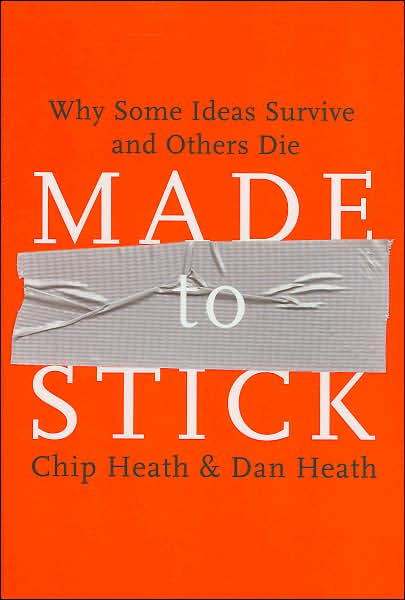
So, I pick it up (just to check it out) and the first thing I notice is its cover:
Immediately, I try to peel away that 'To' label ... but the library has carefully plastic-wrapped the cover. So I turn to the inside jacket, to read a bit of a description, and see that part of the book is going to be about discussing urban legends and conspiracy theories and why they spread so effortlessly. Reading through the rest of the jacket's copy, I can see that this is going to be my sort of book.
Is the purpose of the cover to sell books, to accurately describe what's in the book, or to tee up the reader so the book has maximum impact?
The third.
... Tactically, the cover sells the back cover, the back cover sells the flap and by then you've sold the book.
So I turn to the back cover, again not intending to read the book, just checking it out, and this is what I see: A list of the six qualities of 'stickiness' that the book is going to discuss together with page numbers illustrating the points. Like so:
Simplicity: How do you strip an idea to its core without turning it into a silly sound bite? See how Army commanders force siplicity into their battle plans - page 25
Credibility: How do you get people to believe your idea? See how NBA coaches engineered an experience that made the dangers of AIDS more palpable to their players - page 162
(That AIDS example is genius, btw. If you're just interested in flicking through the book at the library, I'd recommend it.)
So I check out the examples - which are well written, entertaining and illustrative. Then I check out the table of contents which says there's an 'Easy Reference Guide' at the back of the book. That guide is a 5 page summary of the ideas in the book - which is exactly what I want most books to have, because it saves me the work of doing it myself.
By this point, I'm intrigued and entertained enough that I read the whole introduction (which you can check out here, if you're interested).
Basically, this is exactly how I'd like a non-fiction book to be designed. Easing you into the subject matter, giving you a summary of what it says right up front (rather than hiding it in the last chapter), and providing entertaining, concrete examples. I'm looking forward to reading this.
Recently, I did a bunch of posts summarising a book called The Elements of Persuasion, which is about how to construct stories that people will pay attention to and agree with. I felt that those posts got a bit caught up in the details, so I wanted to create a summary of that summary. Which is what you're about to read.
According to the book, there are five elements of persuasion: Passion, the Hero, the Antagonist, a moment of Awareness, and the Transformation into taking action. Here's a bit more about each of those five elements:
Passion How do you get other people to care about the idea or cause that you care about?
To begin with, you need to be personally committed; it needs to be your passion. So before you tell your story, you need to ask:
Do I really care about what I'm about to say? Do I need to tell this story?
It is true?
If the answers are 'No', you should pick another idea to talk about.
Your Passion is the key to making anyone else care about your story. If people aren't connecting with your story at an emotional level, if they aren't feeling your Passion, then you're telling the wrong story.
What are the advantages of Passion?
Passion cuts through all the competing demands for an audience's attention and makes them listen to you. Check out this presentation by a 13 year old girl to the United Nations:
Passion is communicable. If your story connects with people emotionally, they will spread it for you because it's fun to tell.(*) At the start of this talk, Seth Godin shares an example of a story that spread - a story about a man who worked for the SPCA in San Francisco.
Speaking with Passion has a few more benefits:
Passion gets your audience ready to want to listen to you; it warms them up
Passion makes your story seems more vivid and more real
The more passionate and personal your story is, the easier it is to overcome stage fright; Passion helps you tell your story in a way that makes you appear natural and relaxed
Apparently, stories that are personal and told with Passion are easier for people to remember, and that it the first step to persuading them. Personal stories also increase your likeability and show that you're authentic (because you're talking about something that means something to you).
The Hero The Hero personifies the story and shows us how change our lives.
Heroes are changed by living through the story, and they take different actions because they've been changed. That means heroes show us how to change our own lives, and live according to the values in the story.
To use this idea when you're writing your story, start by reducing your story down to its central concept. Then transform that concept into actions. Finally, choose a hero who demonstrates how to take those actions.
It's vital to find the right hero for your story, and if you want to change people's minds and lives then it's best if your hero is real rather than fictional.
One final advantage of having a hero is that it allows the storyteller to unify the audience. By 'unify', I mean that the audience all see and interpret the events of the story through the same point-of-view.
The Antagonist Antagonists keep the Hero from achieving their goal.
Antagonists don't create conflict; they "clarify what the conflict is about". (I wish I'd taken more notes on this point, because it seems profound!) At the moment I interpret it to mean that stories aren't about 'defeating' the Antagonist, they're about us discovering what we need to change in order to defeat it.
If you're going to persuade people, then they must remember what you've said. Memory and recall are improved when you experience strong emotions. Think about how much you love to hate the villains in Die Hard or Star Wars or [insert a more topical movie reference of your choice here]. Using an Antagonist lets you easily generate strong negative emotions, but at the same time audiences will associate those the negative emotions with the Antagonist - which keeps your Hero sympathetic. And the audience's dislike of the antagonist will get them on the Hero's side.
Choose the 'right' antagonist. One that can be overcome, but not one that's a straw villain (either imaginary, or whose threat is overinflated). And don't demonise the Antagonist - instead, give the hero and the audience a change to learn from them.
Awareness You want to create a moment of Awareness in the audience where they see the problem for what it is and the actions they need to take to fix it.
Hopefully by this point you'll have also created the Passion to change things and given them a role model of how to change (the Hero). Awareness applies both to the Hero and to the audience; ideally, the audience should share the Hero's realisation that something needs to change.
Transformation Taking action and changing things transforms you and the world around you.
EDITED TO ADD:
Here are the links to the rest of my posts on the Elements of Persuasion.
This is the last post about Crafty Screenwriting, and in it I want to look at what it says about the elements that make up a compelling story. These elements are very similar to the ones in 'Elements of Persuasion', so I think it's worth checking out whether they agree, amplify, or contradict each other.
This is how Alex Epstein summarises the way his elements work:
A main character ... who has a goal that we (the audience) care about. ... The main character is risking a lot ... and they have at least one but ideally three basic obstacles in their way.
Main characters can be unlikeable, but we do have to care about what happens to them. What is it that makes us care? Alex proposes two ways:
their situation is familiar to us (eg. Dorothy in the Wizard of Oz)
we enjoy projecting ourselves into their shoes (eg. James Bond if you want to be a hero; D-FENS from Falling Down if you want to work through your rage)
---
The character's goal needs to be something we care about. Maybe it's internal (psychological, emotional); maybe it's external (save the world, fall in love). As Alex points out, "We don't have to necessarily be on the hero's side. We just have to be involved emotionally in what he's trying to do."
So, goals help us care about people. A person may be a jerk, but if their goal is one we can admire or get behind (put on the best show possible; kick the Nazis out of Europse), then we can root for them as a protagonist.
For me, one of the biggest tests of this (in recent years) is Daniel Plainview in There Will Be Blood. As a manipulative, obsessive 19th century oil-man, he’s not a character I feel familiar with or whose shoes I want to walk in. And his goal: ‘to con a small community out of its oil at any cost’ isn’t one I can admire or get behind. So why do I root for him? I guess partially it’s because he’s an object of fascination – Daniel Plainview is such an unusual psychological presence; the way he thinks and sees the world just rivets me (plus he’s too dangerous to take your eyes off). And partially it’s because he cares about the boy he’s raising; Plainview’s goal of raising his son well is only a small part of the film, but it’s one I can get behind.
Man, time to watch There Will Be Blood again!
This idea of goals (and methods, I guess) being things we care about also reminds me Humanity checks in the game Sorceror. A protagonist can be a real scum-bag, but they remain worthy of our attention as long as we don’t think “That’s it. I’m done with you; I don’t care what you do any more – you’ve crossed a line and you’re irredeemable as far as I’m concerned.”
Alex also observes that characters without goals lead to stories without drama.
---
The third element is risk, jeopardy, the idea that the character has something to lose. And that what they could lose is worth caring about.
Actually, some of this feels a little tautological. We'll care about a character if the thing they could lose is something we'll care about? It's the idea of 'caring' that needs to be grappled with here.
And I think Alex makes a good crack at answering that at the end of this section:
Jeopardy puts the hero in play.
I like that phrasing. The hero (who's someone we care about because we identify with them or want to be with them) is now at risk of being transformed, harmed, or losing something vital to their life. They are in play; the thing that they are risking is (essentially) themselves.
---
Finally, the main character has "at least one but ideally three basic obstacles in their way." These obstacles are:
1. An External Antagonist or Obstacle: this could be so many things ... environmental (an erupting volcano), social (a corrupt justice system), personal (a masked killer stalking you), widespread (a continent-spanning war), or nearly microscopic (a swiftly growing brain tumour).
Again, we have to care about the antagonists - perhaps because they're sympathetic; perhaps because they're scary as all hell. In fact, check out this quote from James Berardinelli's recent review of Robocop:
One of the standout elements of Robocop is the despicability of the villains. These aren't mealy mouthed bad guys - they are vile, mustache-twirling cretins who deserve horrible, painful deaths. It takes a talented director to fashion characters that become targets of such extreme vitriol. This is what Verhoeven wants; the more deeply viewers hate the bad guys, the more they will be involved in the outcome. It's nice for an audience to like the hero, but more important that they loathe the villain.
And this quote from Crafty Screenwriting addresses the other side:
If your hero has an obstacle instead of an antagonist, we still have to care about it. If your hero is crossing the Antarctic, you have to find a way to make us feel what is grand and compelling about a lot of ice. In a movie about climbing Everest, you are going to have to make us care about a really big rock.
2. An Intimate Opponent: Someone on the main character's side who is working at cross-purposes to them.
3. A Tragic or Comic Flaw (A Psychological Opponent): Indecision, guilt, self-doubt, a death wish, self-loathing, pride. This is all stuff I'm very familiar with from playing lots of Primetime Adventures - most situations can be made much worse if you just give a character enough rope to let their own Issues mess them up.
... oh, and a main character's tragic flaw can reflect the external antagonist or obstacle in some way.
That's it for Crafty Screenwriting. In about a week, I'll be moving on to the last of these books on story construction: "Made to Stick", which talks about why some ideas and stories survive and get passed on from person to person, while others wither and die. You can read excerpts from the intro here, if you're curious.
Alex Epstein's book 'Crafty Screenwriting' also has a lot to say about pitching that I think it relevant to the process of creating a story. As I mentioned earlier, he fiercely advocates NOT writing down your story for as long as possible, and instead actually telling it to people.
Why wouldn't you write down your story? Alex suggests that writing it down 'freezes' your story, making you reluctant to make big / necessary changes to it. He uses the example of 'While You Were Sleeping', whose writers pitched the film for 5 years before realising how much it would be improved by having the GUY be the one in the coma. It was easy to change the story because nothing was written down.
Alex also says that writing down your story can make it easy to overlook its flaws. I can related to this - my eyes have certainly skimmed over sections of my outlines before, as I 'know' what it's trying to convey and don't need to pay attention to it. As a result, whole sections have wound up needing to be deleted or re-arranged in finished scripts.
The best way to find out if your hook or story works is to tell it to people. Tell it out loud, over and over again, to whoever will listen.(*) Telling it allows you to see what people respond to. And because you're not writing it down, it allows you to figure out what bits of it are memorable or not.
(*) Candidates for telling your story to include co-workers, friends, your mum, kids, strangers on the bus, muggers, priests in confessional boothes.
Basically, the process of telling your story will give you an opportunity to naturally flesh it out, elaborate on it, and deepen it.
Alex also suggests three questions to think about while you're telling your story:
Is your listener interested in your hook at all? If not, then (a) rephrase it and try again, or (b) come up with a better idea.
What does it remind them of? Check these other, similar stories out.
What do they tell you? They may have ideas and criticisms. Listen to them. Even if they're off-base, you'll find out what sort of things they expected to hear or see when you told them your pitch.
Telling allows you to reinvent your story easily and on the fly.
Telling lets you immediately see the reaction to your story.
Telling mean you can hear when YOU get bored or confused.
Telling forces you to create a story that's so simple, clear and logical that you can remember it. It forces you to remember what comes next.
But what if the idea of telling someone your story completely freaks you out? Well, there are some alternatives:
Tell it to yourself
Write down the basic beats of the story on cards, mix the cards up, and try to put them back together in the right order
(... and my favourite) Write your story down. Hide those pages. Rewrite it again from memory. Hide those pages. Repeat.
I mentioned way back in my synopsising of Presentation Zen that I was going to have to do a bit more reading about the 'how to' part of how to construct a story. That reminded me that of a script-writing manual that I felt might have some relevance - Crafty Screenwriting by Alex Epstein.
Alex advocates coming up with a hook - a description that encapsulates your story in a nutshell and intrigues the audience into wanting to know more. He also fiercely advocates NOT writing down your story for as long as possible, and instead actually telling it to people.
The idea of the hook resonates with the advice I keep reading about reducing your story or presentation down to its core idea, to a single catchy phrase. Why would you do this? Well, I think Alex provides some really good insight here: we all have multiple demands placed on our attention every day - so how do you cut through the noise and make someone pay attention to you?
You have to make them want to know what happens next.
So, a hook is a fresh idea that instantly makes showbiz people want to read your script, and audiences want to see your movie. It makes people want to see how it turns out. Alex provides some examples, such as:
A puppeteer finds a secret tunnel into John Malkovich's brain
There's a bomb on a crowded city bus. If the bus slows down below 50 miles per hour, the bomb goes off
Three film-makers goes missing in the woods while taping a documentary about a legendary witch. A year later their footage is found.
In The Elements of Persuasion (TEOP), the Antagonist is defined as the thing that is keeping your Hero from achieving their goal(s). This 'thing' could be a person, or a disease (if you're a doctor), or a sinking ship (if you're stuck on the Titanic).
An Antagonist isn't used to create conflict; they're used to "clarify what the conflict is about".
So, here's why TEOP thinks you should use an Antagonist. The authors say that if you're going to persuade people, then they must remember what you've said. Citing studies that indicate that experiencing strong emotions increases the chances of remembering something, the authors then point out that using an Antagonist has two advantages:
you can easily generate strong negative emotions because of them, and
audiences will associate those the negative emotions with the Antagonist - keeping your Hero sympathetic.
Antagonists also get the audience on the Hero's side, says TEOP.
You've got to choose the 'right' antagonist, though. One that can be overcome. One that's not a straw villain (either imaginary, or whose threat is overinflated). And one that you don't demonise - because that allows your hero and your audience to learn from them. Choose the right antagonist and you're halfway to succeed (in either the goal you've set for your hero or in persuading your audience).
Awareness and Transformation
TEOP kind of peters out in its final two chapters. Rather than providing 'how to' guides on building moments of awareness and transformation into your stories, it shares a bunch of pretty interesting stories about viral marketing and retail architecture. It's become very obvious by this point that TEOP is a business book, but in these last two chapters it becomes extremely (to be generous) 'indirect' in the way it imparts its lessons; very 'show, don't tell'.
So, drawing on material from the book's introduction, 'Awareness' is the moment that allows us to learn from the story and therefore succeed. When I write it like that, it seems that Awareness applies both to the Hero and to the audience.
You want to create a moment of Awareness in the audience where they see the problem for what it is and the actions they need to take to fix it. Hopefully by this point you'll have also created the Passion to change things and given them a model of how to change (the Hero).
As for Transformation ... well, TEOP says that in commercial storytelling this usually involves you getting paid. But more generally, Transformation involves taking action that changes you and the world around you.
That's all I was able to extract in terms of how to apply the Elements of Persuasion from the last 2 chapters.
Criticisms I should point out that TEOP contains a bunch of interesting stuff that's not totally on-message. Creating teams, tips for presenting stories effectively, advice about finding meaning in your life. Stuff I found useful, but not for this synopsis.
And it turns out that my criticisms boils down to two points: This is a 225 page book that feels like it should be about 100 pages long, something that's tighter, more on-message. And I'm absolutely not the target audience ... well, sort of absolutely not. I can see how to apply some of this to my day-job. But the book is pitched at business leaders and corporate storytellers/marketeers.
Worthy of having a quick flick-through browse, filled with tangents, and it'll make you work to extract its lessons. That's my take on the Elements of Persuasion; now I'm going to try applying its principles, which I have found useful.
Heroes show us how to change things. That's what I've taken to be the essence of The Elements of Persuasion's (TEOP) discussion about the Hero. They live the story, personify it, and show us how to change our own lives.
Once you've connected with an audience through a shared passion, a hero allows the audience to 'access' the story. (*) Having a hero allows the storyteller to unify the audience, so that they all see the events and meaning of the story through the same point-of-view.
(*) I'm using 'access' to synthesise a whole bunch of concepts in TEOP: the idea of 'connecting the story to the audience's world at a broader level', 'equality', and 'looking at the world through the hero's eyes'.
'What is a hero?' is the obvious question. TEOP describes a few qualities that heroes possess; they are :
the highest common denominator; they bring out the best in themselves, the listener and the story
complexity; heroes surprise us
authenticity; heroes are real and charismatic
It's vital to find the right hero for your story, and it's best (says TEOP) if they are real rather than fictional. This is because stories are more than words; they are things that can be lived. Heroes demonstrate how to live the story.
The book provides some pretty reasonable examples of corporate and team stories, such as the behind-the-counter routines at Starbucks (story: "This is how you make a really good cup of coffee"), Harley Davidson (story: freedom and fun through getting on a bike ... I guess), and the US Marine Corp (story: Always faithful). (**)
(**) In fact, the book's description of USMC basic training is definitely worth a read, especially its description of the Crucible on pp 99-101 which synopses a 54-hour test of group performance under combat conditions coupled with myth-building. It is both stranger and more interesting than I'd ever imagined basic to be.
TEOP's advice is to reduce your story down to its central concept. Transform that concept into actions. Then choose a hero who demonstrates how to take those actions.
Criticisms
As with the section on passion, I've found that once I've boiled down TEOP's take on the hero, there's a lot of insightful material that I'd never thought of.
However, some negatives are also becoming obvious. The book is primarily directed toward a corporate audience (referring to them as 'corporate storytellers' as some points); in other words, an audience that is not me. That explains a lot about why some of the examples leave me cold.
The idea of associating each element of persuasion with one of the five classical elements seems a bit spurious. Why is the Hero associated with Earth, for instance? You could make an equally good case for Air, Fire, Water, or ... I think 'Spirit' is the fifth element the authors use.
It's a little unclear how to operationalise some of the stuff TEOP talks about. "Heroes stand their ground," says the book. "They control some territory (whether it be physical, emotional, intellectual, or spiritual) of value." Interesting stuff, but more something you the author recognise than something you implement.
There are sections (like the one on active listening) that feel like tangents or padding. I can sort of see how they connect with the aim of the book, but I'm not quite sure when to utilise them in the process of creating and telling your story.
Next up, 'The Antagonist', via a chapter of sticky stories (a chapter that I'm not quite fits in to TEOP's five elements schema).
The first 'element' of persuasion is the PASSION with which a story is told. 'Passion' is defined as the energy that makes you need to tell a story. The two big advantages of passion are that:
(i) passion can cut through all the competing demands for an audience's attention and make them listen to you
(ii) if your story connects with people emotionally, they will spread it for you because it's fun to tell (*).
(*) I'm not entirely sure the authors justify how that second point follows from a story being told with passion, though. Unless 'passion' is simultaneously "the energy that makes you need to tell a story", and "the emotion you want the story to create."
According to the authors, speaking with passion has another couple of benefits. It warms the audience up (getting them ready to want to listen to you). Passion then makes the story come alive for them; the story seems more vivid and more real.
Apparently, the more passionate and personal your story is, the easier it is to overcome the natural stage fright of telling your story to people. In particular, stories that are personal are easier to remember, and able to be told in a way that makes you appear natural and relaxed. They also increase your likeability and show that you're authentic (talking about something that means something to you).
Which brings me back to the first point: passion is your need to tell a story. The Elements of Persuasion (TEOP)describes itself as being about how to get other people to care about what you care about. The key to this, according to TEOP is that you need to be personally committed and passionately involved (in order to be able to make anyone else care). Before you tell your story, you need to ask:
Do I really care about what I'm about to say?
It is true?
If the answers are 'No', you should pick another idea to talk about. And if people aren't connecting with your story at an emotional level, then you're telling the wrong story.
Criticisms
As I mentioned earlier, I'm also trying to figure out why I've found this book so difficult to read. At this point, I don't really have firm conclusions, but some of the stuff I've noticed while working through these two chapters on Passion are:
the book occasionally makes some spurious connections between different facts
some of the books used as examples have quite tenuous connections to the points being made (going from the idea of 'victory through a single strike' as portrayed in the Book of Five Rings to William Safire's (and Presentation Zen's) idea of summing up a story with a single memorable phrase ... well, that's quite a stretch for an analogy
it's not focusing on the 'How' of how to tell or construct stories; so far, it's more about providing examples of stories. I assume it's hoping we'll learn through reflecting on those stories.
That's it for Passion; despite my criticisms I found the ideas in these section were solid and seemed true to me. The next element of persuasive story-telling is the Hero.
As a follow-on from Presentation Zen, I'm going to synopsise my notes from re-reading (*) 'The Elements of Persuasion'. This is a book that aims to teach you how to tell more effective stories, or (as the sub-title says) how to 'use stories to pitch better, sell faster, and win more business'.
(*) Actually, I've tried reading it twice before, quitting both times. Hopefully this time through, I'll be able to figure out why.
The Elements of Persuasion (TEOP, from here on in) defines a story as a 'fact, wrapped in an emotion, that compels us to take an action that transforms our world'. The authors, a scriptwriter and a former monk/communications coach, describe stories as having five elements:
The PASSION with which the story is told
A HERO who leads us through the story and allows us to see it through their eyes
An ANTAGONIST (or obstacle) that the hero must overcome
A moment of AWARENESS that allows the Hero to prevail
The TRANSFORMATION in the hero and the world that results from successfully acting on that Awareness.
I'll go into more detail about each of these as I go through the rest of the chapters. TEOP also describes how stories don't have to be lengthy, and they don't have to be verbal. As an example, it offers this image:
Back in a few days for details on the first ... I guess ... element of persuasion: Passion.
EDITED TO ADD:
Here are the links to all my Elements of Persuasion posts.
Just wanted to draw your attention again to the previous entry. It's an on-line story (told in 250 word installments). If you're interested in writing the next chapter, check it out.
According to Wikipedia, this sort of exquisite corpse (aka "exquisite cadaver" or "rotating corpse") was invented by Surrealists in France, just after World War 1 (and holy crap, was surrealism a reaction to World War 1? That seems completely reasonable now I understand the time frame). When Surrealists first played the game, their story contained the phrase "Le cadavre exquis boira le vin nouveau." ("The exquisite corpse will drink the new wine.")
Anyway, calling all bloggers. Here's a chance to have some fun.
This entry is part of an on-line exquisite corpse - a short story told in 10 installments by 10 different authors. My 250 word installment is below; if you're interested in writing the next part, scroll down to the bottom of this post for details on how this all works...
--- --- ---
2.
whistle three times if you find anything.”
“Anything, like what?” said a man Dianne didn’t recognize.
The officer explained, and by about halfway through her explanation Dianne had begun to recognize the dread of the situation, of what could’ve happened and what it could mean for who they were looking for. None of this stopped her from maneuvering her way into a group with Peter, but it did make her feel self-conscious and vaguely shitty about herself as they set off.
At first there were no words - just a focus on the task, taking seriously the idea that you had to search behind every tree, peer into every bit of the dense foliage. Added to that, the path up through the bush was slick from last night’s rain, and people’s attentions were divided between the search and just managing to stay on their feet.
So Dianne’s first words – “How did you find out about this?” - felt like they were violating the culture of diligence that had started to emerge in their group. But it was obvious that despite the awkwardness, no-one felt in a position to chastise her, and after a moment Peter realised that she was speaking to him.
“My mum called me last night. I had to get up at four to drive down here, but … yeah.”
“You had to come.” She finished his sentence and saw on his face that he wished she hadn’t. She started to apologise and then realised it would only
--- --- ---
This is part 2 of 10. You can find the other installments here (but DON'T DO THIS YET if you want to join in):
1. www.sleep-dep.blogspot.com (26 June 2009) 2. www.multi-dimensional.blogspot.com (27 June 2009) 3. 4. 5. 6. 7. 8. 9. 10.
WANT TO READ IT? Jump back to the previous entries using the links above.
WANT TO JOIN IN? This exquisite corpse operates on a first-come, first-served basis. If you want to write the next installment, FOLLOW THESE INSTRUCTIONS:
1.IMPORTANT - Don't read any of the previous entries! Read only the one you see here.
2.ALSO IMPORTANT - Post a comment here, saying “I claim the next entry”, followed by the URL/web address of your blog. If you don't do this, we'll never know where to find you.
3.Copy the text of this blog entry into a new post on your blog, but DELETE THE CHAPTER and write your own as the next installment. Start with the chapter number as I've done here, and start exactly where the last chapter left off (in mid-sentence if necessary).
4.Your entry should be EXACTLY 250 words long, unless you are writing chapter 10, in which case you must bring the story to a conclusion in 250 words or less.
5.At the end of the chapter, where the text reads: “This is part X of 10”, change this to the number of your chapter.
6.Add the URL/web address of your blog and today's date onto the list below that, so people reading later entries can jump back to your chapter.
7.Finish your chapter and post it within 24 hours of claiming your place. There – it's freaking easy! You can go back and read the rest of the story now.
8.IF YOU'VE JUST FINISHED ENTRY #10 and finished the story, DELETE THESE INSTRUCTIONS from the bottom of your post – they'll just confuse people. ALSO, let CG know by posting a comment on the first entry (on www.sleep-dep.blogspot.com), or sending him an email on squid.mohawk@gmail.com. CG will assemble a full version and send it round to all of the contributors.
.gif)


![Reblog this post [with Zemanta]](https://lh3.googleusercontent.com/blogger_img_proxy/AEn0k_uURtl4AotzkSAp2yV_vb_YqoXZj_kmz5uqoUWhxJykUQ1BGIGSN2ku97bn1GTmEeURHbwRYrv_d-TK5ADQGHAGYxyRmjfsP3DGkkkts3d1rAFswPLgPKA-M7GTTA4OR1D5HHfRGIHAeAEbBE0LF4bC=s0-d)
![Reblog this post [with Zemanta]](https://lh3.googleusercontent.com/blogger_img_proxy/AEn0k_sWKXPKOSbb_n25VKvwp737NiQhhO6kYzqMToLtt7RPO5HU2xdxcSBKgblL_3Ki1Iaj9Xr3EQ1b4kWwWBCtwo1ngUslNLa9SFgii5JYoEpsUj1O1AKrWoA6U-_EEI6zqTKvOw3HzD37KA1MtrP0LBo=s0-d)