Only a couple more posts to go in this series about how I've changed the way I approach writing (and then we move on to Phase 2 of the New Thing). I just wanted to say thank you to all the people who've been discussing this with me - especially the people who've approached me or asked after me, concerned that I'm OK.
I'm fine.
Consider this series of posts about the New Thing to be something like a character arc. While they started off describing a low point (which really was about 6 to 8 months ago), they'll end up in a good place. I'm really enjoying writing at the moment, and a lot of other elements of my life are going well too.
So, thank you for your concern and good wishes.
Also: how freaking cool is Lost right now? Evil Good Desmond. Zombie Sayid. Off-handed answerings of enormous questions, and Jack? Jack is a compelling character again? I couldn't believe it when they did it with Sawyer, but making Jack awesome seemed almost impossible to me.
Three fantastic episodes in a row, really interesting situations having been set-up to explore, and absolutely no character is safe (except for maybe Hurley and Jack).
Loving it.

Thursday, May 06, 2010

Monday, May 03, 2010
The New Thing (Part Three): Making writing fit
Two years. That's how long it took to mentally get to a point where just sitting down to write would freak me out.
Thirty minutes. That's how long it took (with the right tools) to completely flip my brain from that to seeing writing as an opportunity.
But while I was stoked that that had worked, I was becoming aware of another source of stress underneath that: stress from trying to fit writing into my work and personal life.
Some numbers: after a normal day of work, I have maybe two hours (max) where my brain is clear and active, before it starts shutting down and going to sleep. And before work, I probably have 20 to 30 minutes of free-ish time, which I often spend surfing the net. With about two-and-a-half hours of good brain time available to me, I realised I needed to create a routine for writing that I could fit into my life - a routine that would place as little pressure on me as possible.
A couple of years ago, I read a book called 'Margin', which talked about the idea of creating free time and breathing room in your life (much like the white margins that surround the words on a page). The way I had been writing - focusing on a big project, spending all my free time on it - had been filling up the page with words and leaving very little white space.

Two Things
After reflecting on it, what I realised is that when my life is going well, when I'm productive, feeling good, and not stressed at work ... then I can handle working on two extra projects. That's any big project that's going to take a lot of energy to move to the next stage (or finish!). And it's not just writing. It's anything from my '12 things to do in 2 years' list. It's blogging. It's two extra things in my life.
So here's my starting point: If I want to have margin in my life, I have to limit myself to two things. For instance:
What I didn't consider, for the longest time, was that the blog is a Thing. Writing this blog has been so important to me that I've felt like I've had to do it, even if I had lots of other stuff going on in my life. But what I realised was that blogging can't be an 'extra' thing that competes for my available writing time. It's better for me to think about blogging as just one way I can express myself through writing, and these book analyses and multi-part essays are just one of the possible 'things' I have the space in my life to write about. (That means there will probably be further changes to what I blog about, but I'll let Future Steve sort that out ...)

This isn't perfect
Through figuring all this out and applying this '2 Things' principle I seem to have stumbled into a good new space for writing - a routine for writing that fits into my life. As long as I write for 10 minutes a day, usually before going on the net in the morning and - if I can - when I first get home from work, then I'm happy. And seem to be making a lot of progress.
I'm definitely not saying that this is something people should try, and I'm not saying this routine is some perfect, finished thing. In fact, one of the great things I took from the Pixar talk is that there's no such thing as a 'perfect' way to live your life; it's just good to keep adapting to your circumstances and energy. I actually expect to keep refining and changing how I run my life every three to six months, and that's totally cool.
All I'm saying is that I have a new routine. Next: what am I going to do with it?
Thirty minutes. That's how long it took (with the right tools) to completely flip my brain from that to seeing writing as an opportunity.
But while I was stoked that that had worked, I was becoming aware of another source of stress underneath that: stress from trying to fit writing into my work and personal life.
Some numbers: after a normal day of work, I have maybe two hours (max) where my brain is clear and active, before it starts shutting down and going to sleep. And before work, I probably have 20 to 30 minutes of free-ish time, which I often spend surfing the net. With about two-and-a-half hours of good brain time available to me, I realised I needed to create a routine for writing that I could fit into my life - a routine that would place as little pressure on me as possible.
A couple of years ago, I read a book called 'Margin', which talked about the idea of creating free time and breathing room in your life (much like the white margins that surround the words on a page). The way I had been writing - focusing on a big project, spending all my free time on it - had been filling up the page with words and leaving very little white space.

Two Things
After reflecting on it, what I realised is that when my life is going well, when I'm productive, feeling good, and not stressed at work ... then I can handle working on two extra projects. That's any big project that's going to take a lot of energy to move to the next stage (or finish!). And it's not just writing. It's anything from my '12 things to do in 2 years' list. It's blogging. It's two extra things in my life.
So here's my starting point: If I want to have margin in my life, I have to limit myself to two things. For instance:
- Finishing a draft of Bad Family to send to Simon and Malcolm for peer review is a thing.
- Spending six weeks going to ceroc, to learn to dance is a thing.
- Writing this series of blog posts about The New Thing? It's a thing.
What I didn't consider, for the longest time, was that the blog is a Thing. Writing this blog has been so important to me that I've felt like I've had to do it, even if I had lots of other stuff going on in my life. But what I realised was that blogging can't be an 'extra' thing that competes for my available writing time. It's better for me to think about blogging as just one way I can express myself through writing, and these book analyses and multi-part essays are just one of the possible 'things' I have the space in my life to write about. (That means there will probably be further changes to what I blog about, but I'll let Future Steve sort that out ...)

(Future Steve?)
This isn't perfect
Through figuring all this out and applying this '2 Things' principle I seem to have stumbled into a good new space for writing - a routine for writing that fits into my life. As long as I write for 10 minutes a day, usually before going on the net in the morning and - if I can - when I first get home from work, then I'm happy. And seem to be making a lot of progress.
I'm definitely not saying that this is something people should try, and I'm not saying this routine is some perfect, finished thing. In fact, one of the great things I took from the Pixar talk is that there's no such thing as a 'perfect' way to live your life; it's just good to keep adapting to your circumstances and energy. I actually expect to keep refining and changing how I run my life every three to six months, and that's totally cool.
All I'm saying is that I have a new routine. Next: what am I going to do with it?
Sunday, May 02, 2010
Having trouble commenting?
If you've been having trouble commenting on the blog recently, I'd appreciate you trying to comment on this post. And if you still can't comment, send me an email.
Friday, April 30, 2010
A New Thing Bonus Feature: The Lone Gun Manifesto
Clive Davies-Frayne at the filmutopia blog (one of my new favourite reads for thinking about script-writing and film production) posted this film-making manifesto, which I found so inspiring that I asked him for permission to reproduce it in full. So, here's Clive, distilling 12 years of experience into how to make a film:
For the last twelve years I've been banging my head against the wall, trying to figure out how to deal with the insanity of the movie industry, whilst at the same time exploring the equally insane world of micro-budget movie making. The problem is that neither system works. The industry becomes more and more obsessed with playing it safe and the independents largely try to imitate the work patterns of the industry, only with less money. For people like me it's a nightmare, because what I want to do is make movies and have people watch them... and, to do that without investing three years of my life and all of my money into a project which then flounders around the ridiculous distribution system.
Anyway, after many years of pondering the problems of funding, shooting and distributing movies, I believe I have an answer. However, it means completely changing the way we think about movies. It is a production philosophy designed to let creative people make brilliant movies quickly, cheaply and without exploiting the people who contribute to its making.
Here are the headlines:
1) One DSLR camera, One person, One microphone (The lone gun shoots alone)
2) Strip movie making down to the basics - a camera, a great story and some actors
3) A lone gun never asks for permission to shoot at a location
4) Put something original and honest in front of the camera
5) Think like a photographer, not like a film-maker
6) Money is for food, transport and a dedicated hard-drive for each project and nothing else
7) Natural light only
8) Everyone who works on a movie, has the right to distribute that movie for free or for profit
9) No credits before the title ever, regardless of how famous someone is.
10) The end product must be cinema quality (capable of projection to cinema sizes without falling apart)
11) A creative common license for the movie (how open you go is up to you, but people must be able to share and alter it for free)
12) If you’re going to be a gorilla… you may as well wear the full monkey suit.
OK. In practical terms this means that you are shooting in public places,but never in such a way that anyone is aware you are shooting. That's why it is done best with a standard DSLR camera. (I really want to see someone figure out how to do this with the RED by the way!)
In terms of the sound recording there are two alternatives: radio mics for all cast - or the way I am doing it, a $30 pair of binaural mics, (which look like iphone headphones) jacked into a portable digital recorder. (I've tested this method and the sound quality is phenomenal, once you've got the hang of it) To use the binaural system, the actors have to set away the sound, which is placed in shot between them... and one of them is given a Zippo cigarette-lighter to clack at the start of a scene, which gives you the cue for syncing the audio.
In reality this means you are only filming mastershots. You can't control the environment to get coverage. However, this really, really speeds up the production process. Basically, you and the actors pick your location. You decide where you are going to place the camera. When you're set up, they walk into the set up, set away the audio and play out the scene. Because there is no crew and no lines to edit, the acting can be completely natural (think Woody Allen circa Manhattan).
Here's the list of kit I use (feel free to improvise better solutions):
1) A good DSLR camera
2) A portable digital audio recorder
3) A microphone (not the kind you’re thinking about.. The one I use cost $40)
4) A Zippo cigarette lighter
5) A small beanbag
6) A computer with some professional editing software on it
7) Some actors
8) A pocket sized notebook
9) A brilliant idea for a movie
10) A script
11) A dedicated hard drive
12) An idea about how you’re going to build an audience
One of the things that I think makes this philosophy work is that the writer/director decides in advance, to give everyone who contributes to the movie the rights to distribute the movie for free or for profit. My project has been running for four weeks so far - we’re in writing and pre-production. The first actor I attached has already told me he has friends at a European TV station, to whom he would like to give the finished movie... along with a raft of international arts festivals. Neither of those two distribution options would ever have occurred to me. I'm working on free distribution via iTunes and also on getting a US theatrical release via some of my US contacts. Once you take the rights shackles off a project, it's amazing what happens. Seriously amazing.
Finally, I know there are issues about working this way. It forces moviemakers to give up a lot. However, the freedoms it gives in return, to just work with a team of people quickly and creatively to make a movie, more than pays off for any restrictions.
And… finally, if you know of anyone who would make an outstanding movie, if only they had this one piece of paper, then give it to them. Pass this on to the people you believe it will inspire.
Thanks for reading this - up the revolution!
The Lone Gun Manifesto
For the last twelve years I've been banging my head against the wall, trying to figure out how to deal with the insanity of the movie industry, whilst at the same time exploring the equally insane world of micro-budget movie making. The problem is that neither system works. The industry becomes more and more obsessed with playing it safe and the independents largely try to imitate the work patterns of the industry, only with less money. For people like me it's a nightmare, because what I want to do is make movies and have people watch them... and, to do that without investing three years of my life and all of my money into a project which then flounders around the ridiculous distribution system.
Anyway, after many years of pondering the problems of funding, shooting and distributing movies, I believe I have an answer. However, it means completely changing the way we think about movies. It is a production philosophy designed to let creative people make brilliant movies quickly, cheaply and without exploiting the people who contribute to its making.
Here are the headlines:
1) One DSLR camera, One person, One microphone (The lone gun shoots alone)
2) Strip movie making down to the basics - a camera, a great story and some actors
3) A lone gun never asks for permission to shoot at a location
4) Put something original and honest in front of the camera
5) Think like a photographer, not like a film-maker
6) Money is for food, transport and a dedicated hard-drive for each project and nothing else
7) Natural light only
8) Everyone who works on a movie, has the right to distribute that movie for free or for profit
9) No credits before the title ever, regardless of how famous someone is.
10) The end product must be cinema quality (capable of projection to cinema sizes without falling apart)
11) A creative common license for the movie (how open you go is up to you, but people must be able to share and alter it for free)
12) If you’re going to be a gorilla… you may as well wear the full monkey suit.
OK. In practical terms this means that you are shooting in public places,but never in such a way that anyone is aware you are shooting. That's why it is done best with a standard DSLR camera. (I really want to see someone figure out how to do this with the RED by the way!)
In terms of the sound recording there are two alternatives: radio mics for all cast - or the way I am doing it, a $30 pair of binaural mics, (which look like iphone headphones) jacked into a portable digital recorder. (I've tested this method and the sound quality is phenomenal, once you've got the hang of it) To use the binaural system, the actors have to set away the sound, which is placed in shot between them... and one of them is given a Zippo cigarette-lighter to clack at the start of a scene, which gives you the cue for syncing the audio.
In reality this means you are only filming mastershots. You can't control the environment to get coverage. However, this really, really speeds up the production process. Basically, you and the actors pick your location. You decide where you are going to place the camera. When you're set up, they walk into the set up, set away the audio and play out the scene. Because there is no crew and no lines to edit, the acting can be completely natural (think Woody Allen circa Manhattan).
Here's the list of kit I use (feel free to improvise better solutions):
1) A good DSLR camera
2) A portable digital audio recorder
3) A microphone (not the kind you’re thinking about.. The one I use cost $40)
4) A Zippo cigarette lighter
5) A small beanbag
6) A computer with some professional editing software on it
7) Some actors
8) A pocket sized notebook
9) A brilliant idea for a movie
10) A script
11) A dedicated hard drive
12) An idea about how you’re going to build an audience
One of the things that I think makes this philosophy work is that the writer/director decides in advance, to give everyone who contributes to the movie the rights to distribute the movie for free or for profit. My project has been running for four weeks so far - we’re in writing and pre-production. The first actor I attached has already told me he has friends at a European TV station, to whom he would like to give the finished movie... along with a raft of international arts festivals. Neither of those two distribution options would ever have occurred to me. I'm working on free distribution via iTunes and also on getting a US theatrical release via some of my US contacts. Once you take the rights shackles off a project, it's amazing what happens. Seriously amazing.
Finally, I know there are issues about working this way. It forces moviemakers to give up a lot. However, the freedoms it gives in return, to just work with a team of people quickly and creatively to make a movie, more than pays off for any restrictions.
And… finally, if you know of anyone who would make an outstanding movie, if only they had this one piece of paper, then give it to them. Pass this on to the people you believe it will inspire.
Thanks for reading this - up the revolution!
Monday, April 26, 2010
The New Thing (Part Two): How I got my head together
I spent a lot of last year seriously considering not writing anymore.
I began to realise that a bad thought had been bubbling away in my head, a belief that was subtly corroding my confidence in my ability to write. That belief was: I'm afraid of writing. Sometimes I phrased it as: Writing freaks me out.
Well, while the idea that writing freaks me out was slowly starting to dominate me, I was already doing a thing I call 'free writing'.
Free writing was like a micro-PLAY! Every day I'd sit down and write about whatever I wanted for 20 minutes. And doing this free writing was proving that writing freaks me out. Every time I sat down to write (or considered sitting down), I'd be thinking bad stuff real quietly in the back of my head. Every time: Writing freaks me out. I'm burned out.
I can't do this.
I can't write.
It took months for me to even acknowledge to myself that this was happening - and, weirdly, from there it took me a little while longer to acknowledge that it was a problem. But once I had, my question was: What can I do about something I believe?
OK, so the obvious answer is: Change it. And if you've known me for more than about a year, you'll know I'm in to personal development, and read heaps of books on the subject. One of the things that's never really worked for me in this school of non-fiction is the idea that you can quickly change what you believe.
I've found some good techniques for realising I'm thinking bad thoughts, and snapping myself out of them.
But making fundamental changes, and making them instantly? No.
In my experience, I can maybe change a self-destructive belief after 3 to 5 years of hard work, and - after that - manage it with constant repetition and monitoring myself. But there were no easy answers. No instant switches.
No.
I can't remember where I found it, and I would totally link to that article if I did, but somewhere along the way my Google Reader feed threw up a link to www.recreateyourlife.com. This is a site that promises to teach you a technique that instantly changes your beliefs, and frak me it worked.
I'm not going to go into too much detail about how it does it - you can ask me in person or check out the site, which has a free, non-spammy tutorial on it. Basically it's a technique that involves three bouts of intense visualisation. First .you relive as intensely as possible your memories of when you started to form the belief. For me, that involved some difficult experiences with The Limit, Facelife, Shortland Street and a few other things.
Second, you imagine watching those memories with a group of your friends - personally, I imagine screening the memories for them on a 42'' TV in a dim, generic living room. While you imagine screening the memories, you talk about what you believe about them, ... and then you ask your friends what they believe about them.

Every single time I've had this imaginary conversation, I have been surprised at how reasonable, how divergent, and how empowering the beliefs of my hypothetical friends are.
In the case of writing, this conversation revealed that, sure, I could think of writing as a thing that freaks me out. I could also, if I wanted, think of it as a gift I give myself. A gift of at least 20 minutes a day where I could just write about whatever I wanted. Writing didn't need to be something that freaked me out; it could be an opportunity. An opportunity to discover what I'm really into at the moment. An opportunity to feed my soul and refresh my brain. God damn it, you look at it this way, and writing's the opposite of something to freak out about; it's an opportunity to get excited about something!
Using this Recreate Your Life method, it took about 20 minutes to get from: Writing freaks me out to
It's actually humbling to realise that my brain tends to, over time, lock itself into thoughts that are bad for my life - if not actively self-destructive. But it's even more humbling to realise my brain contains everything it needs to completely flip that around, if it could just find the right techniques.
There's a third bit to this technique which involves replaying your original memories but telling yourself this new, empowering belief. I think this is the coolest bit (for the geeky reason that feels like travelling back in time and opening up an alternate timeline).
So, does this work? Does it ... stick?
Yes. It totally does. It completely flipped my attitude about how to approach writing and what I want to be writing. And once I'd addressed that, I discovered a deeper concern - that I was stressing about how to fit writing into my busy life.
I'll talk about how I decided to deal with that next Monday, in Part Three.
I began to realise that a bad thought had been bubbling away in my head, a belief that was subtly corroding my confidence in my ability to write. That belief was: I'm afraid of writing. Sometimes I phrased it as: Writing freaks me out.
Well, while the idea that writing freaks me out was slowly starting to dominate me, I was already doing a thing I call 'free writing'.
If you been reading my blog for a while, you probably
know about PLAY! It's a regular break I give myself
from working on a big project where I play around
with a variety of different projects, putting absolutely
no pressure on myself to finish or achieve stuff.
I introduced it to try and stop myself from going stale
(and to fire up my enthusiasm for writing).(*)
no pressure on myself to finish or achieve stuff.
I introduced it to try and stop myself from going stale
(and to fire up my enthusiasm for writing).(*)
(*) Thought I'd try a little side-bar action for once.
Free writing was like a micro-PLAY! Every day I'd sit down and write about whatever I wanted for 20 minutes. And doing this free writing was proving that writing freaks me out. Every time I sat down to write (or considered sitting down), I'd be thinking bad stuff real quietly in the back of my head. Every time: Writing freaks me out. I'm burned out.
I can't do this.
I can't write.
It took months for me to even acknowledge to myself that this was happening - and, weirdly, from there it took me a little while longer to acknowledge that it was a problem. But once I had, my question was: What can I do about something I believe?
OK, so the obvious answer is: Change it. And if you've known me for more than about a year, you'll know I'm in to personal development, and read heaps of books on the subject. One of the things that's never really worked for me in this school of non-fiction is the idea that you can quickly change what you believe.
I've found some good techniques for realising I'm thinking bad thoughts, and snapping myself out of them.
But making fundamental changes, and making them instantly? No.
In my experience, I can maybe change a self-destructive belief after 3 to 5 years of hard work, and - after that - manage it with constant repetition and monitoring myself. But there were no easy answers. No instant switches.
No.
I can't remember where I found it, and I would totally link to that article if I did, but somewhere along the way my Google Reader feed threw up a link to www.recreateyourlife.com. This is a site that promises to teach you a technique that instantly changes your beliefs, and frak me it worked.
I'm not going to go into too much detail about how it does it - you can ask me in person or check out the site, which has a free, non-spammy tutorial on it. Basically it's a technique that involves three bouts of intense visualisation. First .you relive as intensely as possible your memories of when you started to form the belief. For me, that involved some difficult experiences with The Limit, Facelife, Shortland Street and a few other things.
Second, you imagine watching those memories with a group of your friends - personally, I imagine screening the memories for them on a 42'' TV in a dim, generic living room. While you imagine screening the memories, you talk about what you believe about them, ... and then you ask your friends what they believe about them.

Every single time I've had this imaginary conversation, I have been surprised at how reasonable, how divergent, and how empowering the beliefs of my hypothetical friends are.
In the case of writing, this conversation revealed that, sure, I could think of writing as a thing that freaks me out. I could also, if I wanted, think of it as a gift I give myself. A gift of at least 20 minutes a day where I could just write about whatever I wanted. Writing didn't need to be something that freaked me out; it could be an opportunity. An opportunity to discover what I'm really into at the moment. An opportunity to feed my soul and refresh my brain. God damn it, you look at it this way, and writing's the opposite of something to freak out about; it's an opportunity to get excited about something!
Using this Recreate Your Life method, it took about 20 minutes to get from: Writing freaks me out to
Writing is a gift I give myself; it's an opportunity to discover what excites me and what's good for me.
It's actually humbling to realise that my brain tends to, over time, lock itself into thoughts that are bad for my life - if not actively self-destructive. But it's even more humbling to realise my brain contains everything it needs to completely flip that around, if it could just find the right techniques.
There's a third bit to this technique which involves replaying your original memories but telling yourself this new, empowering belief. I think this is the coolest bit (for the geeky reason that feels like travelling back in time and opening up an alternate timeline).
So, does this work? Does it ... stick?
Yes. It totally does. It completely flipped my attitude about how to approach writing and what I want to be writing. And once I'd addressed that, I discovered a deeper concern - that I was stressing about how to fit writing into my busy life.
I'll talk about how I decided to deal with that next Monday, in Part Three.
Friday, April 23, 2010
Links of Interest: March
Jesse Schell gives a talk on how gaming will transform our world and (in the wrong hands) utterly replace our values and desires with ones designed by someone else.
And he follows that up with a description of four different types of game designer (fulfillers, humanitarians, artists and persuaders).
Jane McGonigal's talk at TED 2010 about how gaming can change the world provides an optimistic
counterpoint to Jesse's talk. Her thesis: gamers are an untapped resource, and gaming fundamentally changes people's brains to give them advantageous personal qualities.
Truly Free Film links to a Bruce Sterling talk in which (as a tangent) he discusses how to solve problems now:
Jill Golick gives a brilliant post on the bare minimum of web promotion you need to do. Some excerpts:
The Department of Internal Affairs begins internet censorship in New Zealand.
Blogger introduces a new template designer. Behold its effects by looking at my blog.
And he follows that up with a description of four different types of game designer (fulfillers, humanitarians, artists and persuaders).
Jane McGonigal's talk at TED 2010 about how gaming can change the world provides an optimistic
counterpoint to Jesse's talk. Her thesis: gamers are an untapped resource, and gaming fundamentally changes people's brains to give them advantageous personal qualities.
Truly Free Film links to a Bruce Sterling talk in which (as a tangent) he discusses how to solve problems now:
1. Write problem in a search engine, see if somebody else has solved it already.
2. Write problem in my blog; study the commentory cross-linked to other guys.
3. Write problem in Twitter. See if it gets retweeted.
4. Open source the problem; supply some instructables to get me as far as I’ve been able to get, see if the community takes it any further.
5. Start a Ning social network. Name the network after the problem, see if anybody accumulates around my problem.
6. Make a video the problem and put it on Youtube. See if it spreads virally, see if any media convergence accumulates around my problem.
7. Create a design fiction that pretends that my problem has already been solved. Create some gadget or application or product that has some relevance to my problem and see if anybody builds it.
Jill Golick gives a brilliant post on the bare minimum of web promotion you need to do. Some excerpts:
You don’t have an air date or a web site yet. But that shouldn’t stop you from having a hundred followers on Twitter or 5000 hits to a blog.
Wouldn’t it be amazing if by the time you got your airdate a thousand people or ten thousand already knew about the project? And all it cost you was a few hours a week on the web. Let’s face it, you’re on the web already. Just make the time productive.
... [Have] someone on the team contributing to a blog though prep, production and post, to have a Facebook fan page up from day 1 building interest, to start a Flickr account to house pictures from set and YouTube channel from some video.
The Department of Internal Affairs begins internet censorship in New Zealand.
Blogger introduces a new template designer. Behold its effects by looking at my blog.
Wednesday, April 21, 2010
A New Thing Bonus Feature: Ainsley Gardiner on making lovebites and Boy
Here's an nzonscreen interview with Ainsley Gardiner where she talks a little about Kahukura, lovebites and her film projects:
Tuesday, April 20, 2010
How is this series on the New Thing going to work?
This series on the New Thing has two phases. The first is going to talk about the head-space about writing that I've finally gotten into. I think there will be five posts about that, posting once a week.
In between those weekly posts, I'll have some Bonus Features which are filled with material that's related to what's going on. (One of the cool things about writing about the New Thing is that news and clips are popping up all over the place that feel inter-related to it).
At the end of those five posts (on 20 May), the series will shift into Phase 2.
Monday, April 19, 2010
The New Thing (Part One): Reasons to quit writing
I spent most of last year profoundly unhappy about writing. If you look back at the archives, you can probably tell: a regular series of posts entitled "Why I'm Not Writing", referring to the projects I was working on as 'Old Thing #1' and 'Old Thing #2'. I was frustrated, bored and had a general sense of being trapped in a grind that was only partially alleviated by doing PLAY! (my regular two-week breaks to play around with new and old ideas I'm enthusiastic about).
Most importantly, I was developing bad beliefs about writing. Beliefs like "I am afraid of writing". And "writing freaks me out." I was developing fears that if I started another piece of writing I'd get trapped by it - like my seven-year stint on The Limit. These fears and self-destructive thoughts were coming from some pretty reasonable places:
+ doing some spec rewriting on a project that didn't enthuse me
+ the high-pressure environment of working on lovebites and facelift
+ putting immense pressure on myself to finish stuff and make my projects live up to either the ideal in my head or their own potential.
Writing was turning away from being a source of joy and expression for me, and becoming a source of self-pressure, self-criticism and obligation. Not fun. As a result, writing was painful and slow. I became reluctant to commit things because no project seemed "good enough" to warrant the time I'd invest in it.
Ultimately, I began to consider stopping writing altogether. I started to mentally experiment with changing my identity to 'not a writer' and to consider what other things I could do with my life.
So there you go. I spent 2009 afraid of writing and thinking about quitting.
That's Act One. In the next two posts, I'll cover Act Two in which some help arrives from an unexpected source and I change my life (a little bit).
Sunday, April 18, 2010
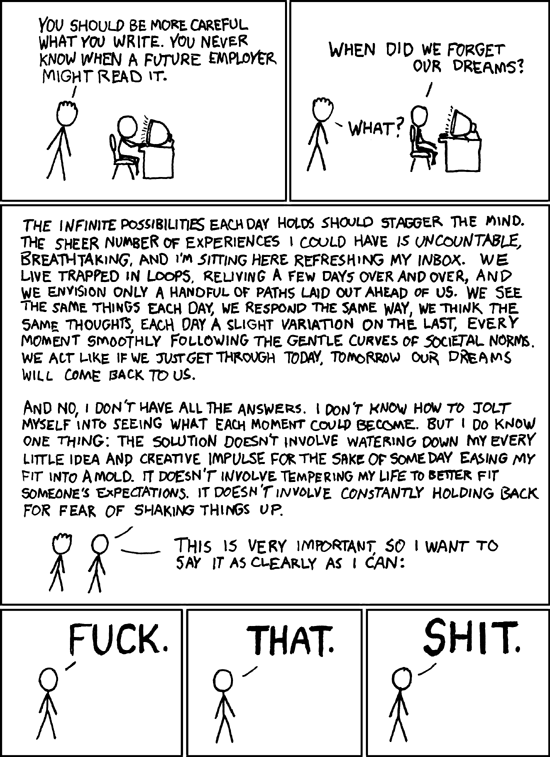
Saturday, April 17, 2010
The New Thing is coming in 2 days
Bill Cunningham over at Pulp 2.0 tweeted the following: "Quit asking permission to create something."
He then followed up with this post (which I will now sample and remix):
Oh, and Andrew and Lucy made this in an evening.
29,032 views at the time I wrote this.
He then followed up with this post (which I will now sample and remix):
You don't need anyone's permission to write, film, draw, compose - whatever. You just need to fail at it for awhile.
Anything worthwhile that's been created, invented, theorized and developed has been the result of failure. Lots and lots of failure.
People look at the end product and get intimidated by its slickness. They don't see the many iterations - the many failures - that led to the success.
Don't get intimidated by the end product. Keep trying. Keep failing. Learn from those failures
Do it, and if you like it - great. If not, if you can live without it - then you feel good about moving on.
The New Thing isn't about asking for permission. It's a discussion.
Oh, and Andrew and Lucy made this in an evening.
29,032 views at the time I wrote this.
Friday, April 16, 2010
The New Thing is coming in 3 days
Here's a post by Clay Shirky that made me question what I'm about to do. I've edited the quote I found most relevant:
In the future, at least some methods of producing video for the web will become as complex, with as many details to attend to, as television has today ...
(However ...)
The most watched minute of video made in the last five years shows baby Charlie biting his brother’s finger. (Twice!) That minute has been watched by more people than the viewership of American Idol, Dancing With The Stars, and the Superbowl combined. (174 million views and counting.)
Some video still has to be complex to be valuable, but ... expensive bits of video made in complex ways now compete with cheap bits made in simple ways. “Charlie Bit My Finger” was made by amateurs, in one take, with a lousy camera. No professionals were involved in selecting or editing or distributing it. Not one dime changed hands anywhere between creator, host, and viewers. A world where that is the kind of thing [means] complexity is neither an absolute requirement nor an automatic advantage.
Thursday, April 15, 2010
The New Thing is coming in 4 days
Seth Godin wrote one of the most important things I've read this year: the implications of having an idea that infects others.
I've mentioned this post before - it ties in to the idea of 'stickiness' that I've been blogging about in my synopsis of Made to Stick. Stickiness is a way of describing how memorable an idea is and how easy it is to transfer that idea from one person to another.
Say I write a blog post that gets 12 readers. How many people does that first generation of 12 readers tell it to? How many people does that second generation tell? As Seth says:
The New Thing takes this as its starting point.
I've mentioned this post before - it ties in to the idea of 'stickiness' that I've been blogging about in my synopsis of Made to Stick. Stickiness is a way of describing how memorable an idea is and how easy it is to transfer that idea from one person to another.
Say I write a blog post that gets 12 readers. How many people does that first generation of 12 readers tell it to? How many people does that second generation tell? As Seth says:
If you start with 10,000 fans and have an idea that on average nets .8 new people per generation, that means that 10,000 people will pass it on to 8000 people, and [they'll pass it on to] 6400 people, etc.
... Pretty soon, [your idea] dies out.
On the other hand, if you start with 100 people (99% less!) [but your] idea is twice as good (1.5 net passalong) it doesn't take long before you overtake the other plan. That's not even including the compounding of new people getting you people.
But wait! If your idea is just a little more viral, a 1.7 passalong, wow, huge results. Infinity, here we come.
The New Thing takes this as its starting point.
Wednesday, April 14, 2010
The New Thing is coming in 5 days
This is important. Svend linked me to this great talk by Ed Catmull a co-founder of Pixar, about their corporate culture, and story-creation process (it's about an hour long):
Here's the big thing I took away from it:
When you start to make ... anything (a film, a game, anything) it isn't very good. You have to go through a lot of steps to get to good. You can feel you're making progress if you can see it's taking a step forward every three to six months.
So there's some success criteria from the people at Pixar: it doesn't need to be perfect; it just needs to be moving forward regularly. From my experience, there are many ways I can tell one of my projects has taken a step forward, including:
In the last two years the big steps forward have been PLAY, getting comfortable with dating, and free writing (which I'll talk about very soon). Next is the New Thing - which will be coming in five days.
More things I took away from the Pixar talk after the jump ...
Here's the big thing I took away from it:
When you start to make ... anything (a film, a game, anything) it isn't very good. You have to go through a lot of steps to get to good. You can feel you're making progress if you can see it's taking a step forward every three to six months.
So there's some success criteria from the people at Pixar: it doesn't need to be perfect; it just needs to be moving forward regularly. From my experience, there are many ways I can tell one of my projects has taken a step forward, including:
- I've deepened my understanding of the material
- I've found a simpler, more elegant way of expressing the idea
- I've figured out what it's really about
In the last two years the big steps forward have been PLAY, getting comfortable with dating, and free writing (which I'll talk about very soon). Next is the New Thing - which will be coming in five days.
More things I took away from the Pixar talk after the jump ...
Sunday, April 11, 2010
Made to Stick: Tell me a Story

The right story makes you act
In Made to Stick, the Heath brothers describe six principles that make your idea sticky - that make it easy for people to remember and tell others about. Those six principles (and the effects they have) are:
- Simple ideas help you remember.
- Unexpected ideas make you pay attention.
- Concrete ideas help you understand.
- Credible ideas make you believe.
- Emotional ideas make you care.
- The right story makes you act.
Stories demonstrate how you can act - what steps you can take, what obstacles you might face, how to overcome them, and what results you might expect. In The Elements of Persuasion, Richard Maxwell and Robert Dickman talk about the role of the Hero - the character who embodies your message, and demonstrates "how to live your story".
A well-told story gives your audience enough information so they can mentally test how they would handle the situation. This mental rehearsal is the next best thing to actually doing something. As the Heath brothers say, stories are like flight simulators for the brain.
Sunday, April 04, 2010
Made to Stick: Let's get Emotional
Here are a couple of anti-smoking ads for you to watch, and then I'll describe what Made to Stick has to say about the role of emotion in delivering an effective message.
Compared to this:
These two ads started airing at almost the same time in the US. When teenagers were asked if they remembered any anti-smoking ads, 22 percent thought of the first 'Truth' campaign, while only 3 percent thought of the second 'Think' campaign.
 Why is this important? Why is it important that more people remember the highly emotive ad that creates feeling of rebellion, resentment and belonging to a peer group than the lighter, gentler 'Think' ads?
Made to Stick suggests a couple of reasons emotion is important:
1) Feeling an emotion means you care. When people care, they're more likely to remember and they're more likely to act on what you're saying
2) The more we reason and think, the more our ability to feel is inhibited. Analysis prevents compassion. Made to Stick cites several examples of ads in the 'World Vision helping children in developing countries' genre. That feeds back into Point (1) - basically, the less you think, the more you act.
Friday, April 02, 2010
Testosterone!
With the A-Team and The Losers coming out,(*) it's going to be a good year for action movies in which a band of elite soldiers are betrayed by someone (causing them to seek revenge).
(*) And the Expendables, but I don't trust that yet.
I'm surprised at how fun the A-Team looks, and concerned at how the trailer for the Losers seems too fun - doesn't quite capture the tone I liked from the comics.
... Hmm. OK. After actually watching the new Expendables trailer - I've changed my mind. All three of these films have great casting, and look like they're going to deliver my fix of badass.
Wednesday, March 31, 2010
The Have Done List: March
Rather than writing a to-do list, here's a list of things I did do in March:
- bought two seasons of Angel incredibly cheaply at the dump shop
- discovered (and developed a crush on) The Big Bang Theory
- used TV Gorge, before it folded
- started a game of Bad Family on Google Wave
- won poker (and 10 packets of Girl Guide biscuits)
- entertained a three-year old with a talking rabbit
- went body-surfing in Lyall Bay
- drove up and back to Auckland
- saw the Pixies perform Doolittle
- drove around Auckland by myself
Sunday, March 28, 2010
Music: February

Pearce lent me Neko Case's album Blacklisted.
Stand-out track for me so far is Deep Red Bells, which is all haunting and yearning.
... Whoa: according to Wikipedia, Deep Red Bells is inspired by her memories of growing up in Seattle while the Green River Killer was still at large.
So, yeah maybe less yearning and more melancholy.
I'm in love with the drive and intensity of this new track from Massive Attack - Babel. Here's a live performance in Moscow
Fluxblog has been posting links to Animal Collective for a while, but I'm only now starting to really let their album, Merriweather Post Pavillion, sink in. My Girls is obviously awesome, but the track I get drawn back to is Summertime Clothes.

Two changes to the blog
I've freshened up the look of the blog using the new Template Designer.
Also, you can now get to the blog via www.stevehickey.com. It only took me four years to realise that Openhost has a free option to redirect a url. No longer do I have to tell people to go to "multi hyphen dimensional dot blogspot dot com". Think of what I can do with all the time I'll be saving.
Also, you can now get to the blog via www.stevehickey.com. It only took me four years to realise that Openhost has a free option to redirect a url. No longer do I have to tell people to go to "multi hyphen dimensional dot blogspot dot com". Think of what I can do with all the time I'll be saving.
Sunday, March 21, 2010
Made to Stick: Do you believe me? Am I Credible?
What makes someone believe an idea? In Made to Stick, the Heath brothers propose a variety of things that can make a message or an idea 'credible':
- people we know and respect believe it
- the idea matches our own experience
- we're told it's true by an authority
- we're told it's true by an anti-authority (see below)
- we take it on faith
- the message stands on its own merits and is inherently believable (it has 'internal credibility')
- the message contains vivid details that make it easier to visualise the point you're making
- statistics ... but ONLY IF they're phrased in human, everyday terms
- you use an example that definitively proves the point you're making (aka 'The Sinatra Test')
- the message challenges you to test the truth of it for yourself
Get the endorsement of an Anti-Authority
You can get someone to deliver your message who has personal experience with what you're saying. Someone who has lived through the experience your message is conveying, someone who's 'living proof' that what you're saying is true or works.
Someone like Pam Laffin, for instance.
We're all aware of ads that try to seem credible because they use a celebrity endorsement from someone we want to be like, or a fronted someone with a reputation for honesty and trustworthiness (or an actor dressed to symbolise honesty and trustworthiness). Sometimes a message is delivered by an expert (like an academic or a professional).
These are all forms of credibility because they use an 'authority' to present the message. But Pam Laffin started smoking when she was 10. She's an anti-authority; she has credibility because she's real. Or rather: had credibility. Pam died on 3 November 2000 at the age of 31.
Use vivid details
Weirdly enough, simply using a vivid detail or two can make your message more believable. But these details need to be truthful, meaningful, and they need to add to your argument.
The Heath brothers cite a dance company who demonstrated how much they value diversity by letting people know that they had a 73 year old former mailman who danced with them.
Statistics (tend to make your eyes glaze over)
Statistics may sound impressive and seem like a good source of credibility, but they aren't particularly great at showing people what you mean.
I'm sure you can think of examples where people have quotes stats at you, and you've thought "These are just numbers," or "I don't understand what these numbers mean." I get baffled by stats all the time, primarily because it's hard to visualise these numbers mean in everyday, human terms.
But statistics are a good method of illustrating the relationships between things. If, rather than throwing numbers at your audience, you focus on describing that relationship in everyday, human terms you'll find people remember and understand your stats - which will make them more credible.
The Heath brothers illustrate this by quoting a series of statistics from Stephen Covey's book The 8th Habit, where a survey of employees in various companies revealed the following information:
+ Only 37 percent said they had a clear idea of what their organisation was trying to achieve and why
+ Only one in five employees said they were enthusiastic about their team's and their organisation's goals
+ Only one in five said they had a clear 'line of sight' between their daily work and their organisation's goals
+ Only 15 percent said they felt their organisation enabled them to fully execute their key goals
+ Only 20 percent said they fully trusted the organisation they worked for.
To me, that's a whole bunch of information that's pretty difficult to assimilate. So, instead, Stephen Covey provides an analogy that puts less emphasis on these numbers, and more on illustrating the relationships and meaning of those statistics using an everyday, easy-to-visualise concept:
If, say, a soccer team had these same scores, only 4 of the 11 players on the field would know which goal is theirs. Only 2 of the 11 would care. ... And all but 2 of the players would, in some way, be competing against their own team members rather than the opponent.Statistics are a good source of internal credibility but they aren't inherently helpful. They're only helpful if we understand them in human, everyday terms (which helps us get an idea of their scale and context).
The Sinatra Test
"If I can make it there, I'll make it anywhere."
-- New York, New York
(as sung by Frank Sinatra)
Passing the Sinatra Test is shorthand for saying that providing just one example is enough to establish your credibility (as long as it's the right example). For instance:
"I'm in charge of security at Fort Knox," means you can get a security job anywhere.
"Our company promptly and securely delivered the final Harry Potter book to every bookstore in America," means you can get any couriering job in America.
Test it yourself
You can challenge the person who's receiving your message to test it for themselves.
Made to Stick cites the example of the Wendy's "Where's the Beef?" ad. I'd heard about this for years, but never seen it till now. So, let's go back to the year 1984 and take a look:
The point here is that you can go into a fast-food store and test for yourself whether you're eating a bigger or smaller beef patty than you'd get at a rival store.
Figuring out a way of making it easy for your audience to establish that your message is credible for themselves, is a powerful source of credibility.

Saturday, March 20, 2010
What's coming up
Hi. I'm changing the posting schedule of the blog again. Posts are going to appear once a week until my life calms down a bit.
I'm looking forward to the next few months on multi-dimensional. This series on Made to Stick is almost over, and once that's done I'll be doing two things:
1) Summarising all the books on story creation I've been reviewing over the last year into one big post - which will bring closure to the journey that started with my dissatisfaction with the way Presentation Zen covered this subject
2) I'm going to try applying the Made to Stick principles to a few topics. If you've got any messages you want to work on communicating better, I'd like to help - so I'm inviting you guys to offer up topics you'd like to cover and we'll work through them together.
I'm also going to start a new thing where I pitch some story ideas on the blog. I am sick of developing stories in total secrecy - partly because it makes it difficult to get the benefit of everybody's ideas, but mostly because of this: an effective story is one that people want to share with others, and I won't be able to tell if you want to share it with others unless I share it with you.
That'll probably start in May. In the meantime, that's enough blogging - I'm off to enjoy the sun!
Wednesday, March 17, 2010
Links of Interest: February
Here are some of my favourite links from last month on my Google Reader's shared list:
JP talks about the implications for National Standards (Part One, Part Two). A great consideration of what they might mean for students.
I investigated and got annoyed with Google Buzz. Here's how to disable it permanently.
Axe Cop! Written by a 5-year old. Illustrated by his dad.
Seth Godin talks about the importance of devising ideas that spread. Favourite post of the month.
The showrunner of Bones discusses what's involved in creating a show that millions of people watch. One lesson: reinforce mainstream cultural expectations.
Fred Hicks describes what's involved in building an online community, in a series of practical easy-to-apply steps.
And three links from January:
Alex Epstein at Complications Ensue points out that you can use non-fiction as the basis for a screenplay without needing to buy the rights to that piece of non-fiction. He contends that the process of creating your story will completely change the way the underlying facts are represented. Alex is not a lawyer (as far as I know) but his point makes me feel much more confident about where I can get my inspiration from. (Not sure how this applies to biographies, though.)
Seth Godin links to a MOMA exhibition of the works of Tim Burton, and observes the vast number of Burton's failed projects. Seth's conclusions: finish projects, get them out the door, and get on to the next project. Don't be afraid to fail.
Seth also speculates about the future of libraries, and proposes that they shift their focus from 'providing information' to training people in how to:
a) find and use information
b) connect with and lead others.
Saturday, March 13, 2010
Made to Stick: Make it real; make it Concrete
Made to Stick is a book about what makes ideas memorable, and what makes people want to tell your ideas to other people. So far, Made to Stick has talked about making sure your ideas are:
+ simple
+ unexpected and surprising
The next quality it recommends is 'concreteness' - describing your idea as something you can see or something you can do. Make your idea vivid and easy to imagine.
For instance, compare these two goals.
Goal 1: We will build the best passenger jet in the world.
Goal 2: We will build a passenger jet that seats 131 passengers, can fly non-stop from Miami to New York City, and land on Runway 4-22 at La Guardia International Airport.
What's the difference between these two goals? What are the different things you still need to know after reading them? Imagining you're an aircraft engineer, what would your next action be after receiving those goals?
What are the benefits of concreteness?
Making something concrete means that everyone has the same clear idea of what to do. Concreteness improves your ability to co-ordinate people, and make sure they're all working in the same direction.
Also, when something is concrete, it gives us something to focus on – a symbol, a representation, a known environment we’re all familiar with. As an example of this, Made to Stick describes the creation of the Palm Pilot. When they were designing it, the creator of the company would carry around a block of wood that represented the finished Palm Pilot. He wanted to avoid the failing of previous attempts to build a handheld organiser, which he saw as the tendency to keep packing as many cool features as possible into the palm pilot. So when a tech would come up to him with a new idea and say “How about we add this?”, the company's creator would pull out his block of wood (which he carried with him everywhere) and ask where this new feature would fit.
How can you tell if something's concrete?
+ You can examine it with your senses
+ You can see someone doing it
+ You can talk about it with someone, using terms and concepts that are familiar to them
+ You can use an example to describe it.
The opposite of concrete
The opposite of concreteness is abstraction. We talk abstractly when we use buzzwords, professional jargon, and ideas and descriptions that don't have any relevance to the real world.
When something is abstract, it makes it harder to understand and remember an idea. Abstraction also encourages people to interpret your idea in different ways
Unfortunately, it's extremely easy for us to slip into describing things abstractly. I'm sure you can remember a time when you were explaining a subject you know a lot about to someone who knew very little, and you realised they weren't following you. When I do that, I often find that I've:
+ forgotten to explain an important piece of information, assuming they already know it
+ used a word that means a lot to me, but means nothing to a casual audience
+ summed up a complex idea in a pithy sentence, rather than explaining in step-by-step, real-world terms what I mean.
It’s easy to forget that we’re experts or knowledgeable in something, and we have to actively try and remember that the more expert we are, the less natural it is for us to talk like someone who knows nothing about the subject.
The upshot: if you're passionate and knowledgeable about a subject and you want other people to know about it or care about it, then you're going to have to get concrete.
How do you make something concrete?
Made to Stick recommends that you spend some time visualising your customers or the people you're trying to influence. The book uses the example of the Saddleback Church in California which seeks to recruit and convert people they call 'Saddleback Sam'. They describe Saddleback Sam as:
+ not currently attending a church and skeptical about organised religion
+ in his late 30s or early 40s
+ has (at least) a university degree
+ married with two children
+ happy in his job, and content with his life
In fact, the Saddleback Church goes into even more detail than this, but the point is that once you have a clear idea of who your customer is, you start to figure out what their needs are. What do they want? What don’t they want?
That helps you figure out what messages will appeal to them. You can make your ideas concrete in ways that meet their specific needs, and you can figure out the best ways to deliver your message. For instance, Saddleback Sam works hard and wants to spend time with his family, so tele-marketing to him at night is probably a very bad idea.
So now you're explaining your idea in a way that people can easily visualise. How do you make them believe you?
Tuesday, March 09, 2010
Games: February

The adventure situation was inspired by a Ramsay Campbell short story from Cold Print, called - I think - Voices on the Beach. Each of the characters had a relationship with a writer, Micah Brody, who lived in a beach house on the east coast of America and had recently written them a series of disturbing messages before disappearing. Into that mix, I threw a possibly racist sheriff (Micah and his brother, portrayed by one of the players, were African-American) and some non-Euclidean geometry. Based off the players succeeding in their investigation rolls, it became clear that an invasion from another universe was underway - with the beachhead being peoples' dreams.
UnSpeakable has a great narrative device built into its rules: the game can't end until one player's character has gone permanently insane. This encourages the person who's running the game (in this case, me) to really throw details and events into the story that unnerve, dismay and (ultimately) unleash madness into the universe. I took about a session and a half to get really comfortable with this but it was extremely late at night by the time we reached a point where the players were being confronted by a series of scenes of unspeakable madness on a regular basis - we had a player who had to catch the train home and I had begun to tread water with the stuff I was inventing. So we called it a night around the point that three of the characters had to burn down a church and euthanise a kindly chaplain in order to escape the horror, leaving the fourth (African-American) character to face the town's wrath.
Which left us totally disturbed without invoking the permanent insanity rule that'd mean one of the players would have to make their character start acting as the villain.
A group of us are beginning to organise a long run of Bliss Stage (my favourite game of the last 6 months). We met up after a series of emails to do some brainstorming about which teenage survivors in a ruined future version of Wellington we'd be playing and what the alien menace they'd be trying to defeat would look like. This brainstorming session was really interesting - for most of us, there were at least one or two other players we hadn't met before, and I could actually feel the trust being built between us as we learned to listen to each others' ideas, learned how to disagree with each other, and started learning how to talk through potentially difficult subject matter. One of the rules of Bliss Stage is that each session needs to begin with a bit of hanging out and connecting with each others' real lives before starting to play the game - that feels particularly wise in this situation.
We've created a nice tightly-wound situation where the teenagers are living in the tunnels under Wrights Hill, trying to learn how to farm and starting to play the next (first?) steps in their war to drive off the aliens. First session is tomorrow night!
Read Over the Edge by Robin D. Laws. I have wanted to really study a copy of this ever since one slipped through my fingers when I was working at Mind Games. In reality, this game about Naked Lunch style conspiracies on a Mediterranean island would have been great when I was gaming in the 90s. Now it feels a little too ... full. Of setting details. Of rules details (which is odd for a legendarily light game). In all, an interesting read and a great step in the career of an excellent game designer.
Finally unlocked the second-to-last level of my cellphone poker game.
Tried to play the Flash version of the Torquemada game from Dice Man. Got irritated and quit when (a) my character accidentally killed his own wife, and (b) I realised I couldn't cheat.
Played, enjoyed, and gave up quickly on Scrambled - a great idea for a path-finding game where you guide a robot through a series of obstacles.

Friday, March 05, 2010
Made to Stick: Using Suprise
To deliver your message successfully, you have to get the audience's attention and then hold the audience's attention. One way of doing this is through using surprise and the unexpected.
Unexpected ideas inspire us
In a speech to Congress in 1961, President Kennedy clearly summarised a new goal for America:
(Transcript, here.)
Kennedy's idea is huge, surprising, and (obviously) provoked reactions like "Is this worth it?", and "Why should we do it?" Kennedy clarified the reasons America needed to embark on this endeavour in a speech at Rich University in 1962.(*)
(*) Let's leave aside discussion of the real motivations for the Apollo project for now.
(Transcript, here.)
Get the audience's attention
You can get your audience's attention by surprising them. This works because we tend to think we're good at predicting what's going to happen next; we think we have a good understanding of the world around us. Surprise heppans wehn taht understanding fails us; when things occur that we don't expect.
After experiencing something unexpected, we then start paying extra special attention - trying to understand why we failed to predict what was going to happen (which is something I've hopefully just demonstrated).
Surprise means we've failed to predict what's going to happen, which causes us to pay attention so that we can make better predictions in the future.
So, how do you create surprise when you're trying to design and deviler a message?
In the previous post, I talked about identifying the core of your message. I used the example of 'time management', and narrowed my message down to the core of: Only do stuff that adds to you being the person you want to be.
To surprise people you need to explore what's counter-intuitive about your message's core. What are its unexpected implications? The authors of Made to Stick, the Heath brothers, have a nice turn of phrase about this: "Uncommon sense". Things that are common sense are obvious, and therefore easy to ignore (because we'll have guessed what's coming and won't be surprised). It's the part of your message that makes uncommon sense that will "break your audience's guessing machine".
In an attempt to illustrate, I will try and figure out what's counter-intuitive about "Only do stuff that adds to you being the person you want to be." I expect this will be reasonably hard - consider what's about to follow to be a bit of a brainstorm, rather than a final draft:
+ Without time management you'll never be happy
+ The person you want to be needs to be deliberately created
+ Creating yourself involves sculpting in time - paring away the bits that aren't you
+ Doing whatever you want is like junk food for your soul
I like that last one. I could think a bit harder and come up with more options, but let's go with that for now. So my counter-intuitive example is this:
Hold the audience's attention
Curiousity comes from recognising that we have gaps in our knowledge. Apparently we have a psychological need to fill those gaps (as the number of morning tea conversations I have that involve me consulting Wikipedia will attest).
The process of raising audience's awareness that they have gaps in their knowledge leads to them wanting to stick around until you fill those gaps with answers, facts or stories.
Made to Stick outlines a bunch of ways you can create these gaps in your audience:
+ make them publically predict something which they get wrong
+ make them realise that they disagree about the topic with other audience members
+ provoke their interest with something unfamiliar
+ highlight their current knowledge and then point out some specific knowledge they're missing
+ make them realise they need your facts.
Made to Stick highlights a principle here that's also true in screenwriting: shift your mindset away from "What information do I want to convey?" to "What questions do I want them to ask?" People will stick around to find out the answers to questions that interest them, and (according to Made to Stick) they'll even stick around to find out the answers to questions that don't.
Unexpected ideas inspire us
In a speech to Congress in 1961, President Kennedy clearly summarised a new goal for America:
(Transcript, here.)
Kennedy's idea is huge, surprising, and (obviously) provoked reactions like "Is this worth it?", and "Why should we do it?" Kennedy clarified the reasons America needed to embark on this endeavour in a speech at Rich University in 1962.(*)
(*) Let's leave aside discussion of the real motivations for the Apollo project for now.
(Transcript, here.)
Get the audience's attention
You can get your audience's attention by surprising them. This works because we tend to think we're good at predicting what's going to happen next; we think we have a good understanding of the world around us. Surprise heppans wehn taht understanding fails us; when things occur that we don't expect.
After experiencing something unexpected, we then start paying extra special attention - trying to understand why we failed to predict what was going to happen (which is something I've hopefully just demonstrated).
Surprise means we've failed to predict what's going to happen, which causes us to pay attention so that we can make better predictions in the future.
So, how do you create surprise when you're trying to design and deviler a message?
In the previous post, I talked about identifying the core of your message. I used the example of 'time management', and narrowed my message down to the core of: Only do stuff that adds to you being the person you want to be.
To surprise people you need to explore what's counter-intuitive about your message's core. What are its unexpected implications? The authors of Made to Stick, the Heath brothers, have a nice turn of phrase about this: "Uncommon sense". Things that are common sense are obvious, and therefore easy to ignore (because we'll have guessed what's coming and won't be surprised). It's the part of your message that makes uncommon sense that will "break your audience's guessing machine".
In an attempt to illustrate, I will try and figure out what's counter-intuitive about "Only do stuff that adds to you being the person you want to be." I expect this will be reasonably hard - consider what's about to follow to be a bit of a brainstorm, rather than a final draft:
+ Without time management you'll never be happy
+ The person you want to be needs to be deliberately created
+ Creating yourself involves sculpting in time - paring away the bits that aren't you
+ Doing whatever you want is like junk food for your soul
I like that last one. I could think a bit harder and come up with more options, but let's go with that for now. So my counter-intuitive example is this:
Not using time management is much like eating a king-sized block of chocolate every day. Regularly eating junk food is a bad idea if you want to be healthy. In the same way, doing whatever you want, whenever you want, without thinking about it, tends to stuff your life with things you don't really want or need. And the end result is you don't end up with enough time to do the things you really want or need to do.
Hold the audience's attention
Curiousity comes from recognising that we have gaps in our knowledge. Apparently we have a psychological need to fill those gaps (as the number of morning tea conversations I have that involve me consulting Wikipedia will attest).
The process of raising audience's awareness that they have gaps in their knowledge leads to them wanting to stick around until you fill those gaps with answers, facts or stories.
Made to Stick outlines a bunch of ways you can create these gaps in your audience:
+ make them publically predict something which they get wrong
+ make them realise that they disagree about the topic with other audience members
+ provoke their interest with something unfamiliar
+ highlight their current knowledge and then point out some specific knowledge they're missing
+ make them realise they need your facts.
Made to Stick highlights a principle here that's also true in screenwriting: shift your mindset away from "What information do I want to convey?" to "What questions do I want them to ask?" People will stick around to find out the answers to questions that interest them, and (according to Made to Stick) they'll even stick around to find out the answers to questions that don't.
Monday, March 01, 2010
Movies: February

I got through the first third of Marebito, a J-scare from the director of The Grudge and Reincarnation. I actually ended up napping instead of watching, and still haven't gotten to the point where the story actually kicks off ... I'll probably go back to it and give it another 10 minutes, but so far it seems less solid and more pretentious than Reincarnation.
Doctor Who: The End of Time (Part 1) was a nice 'moving the pieces into place' episode with a great scary kick at the end of the episode that absolutely makes me go "What the hell is the Doctor going to do?" *and* may give me some closure on Donna Noble.
Doctor Who: The End of Time (Part 2) made me cry. An effective payoff to the "He will knock four times" set-up, and a series of scenes that provided closure on a number of Russell T Davies plots. This part was less about the plot and more about the emotions, and I choked up as David Tennant finished his run. I think I'll miss his Doctor about as much as I miss Tom Baker's.
Started watching my favourite film, The Insider, but had to go do something else. Even watching the first 20 minutes though has reminded me how good this script is. An expanded review is definitely coming.

Friday, February 26, 2010
Made to Stick: Keeping things Simple
Made to Stick by Chip and Dan Heath is about creating ideas that stick in people's minds, ideas that make people want to spread them. The first element of 'stickiness' is simplicity.
Simplicity is a proverb
When you're creating an idea, you want it to be short, easy to remember. Ideally you want your idea to be short and WORTHWHILE for people to remember. For instance, think about these phrases:
"A bird in the hand is worth two in the bush."
"Do unto others as you would have others do unto you."
Proverbs are worthwhile ideas that are simple, profound, and (most importantly) useful. They provide a guide about how to behave in a complex situation or a principle to live by. Proverbs provide wisdom. And people share them - the bird-in-the-hand proverb can be found in Spain, Russia, Iceland, and even in medieval Latin documents. Its origin may be from one of Aesop's Fables, dating from around 570 B.C.
Simplicity is the most important thing
Think about a subject you know a lot about. Now, if you want to, try this mental exercise - it should take about 10 seconds. Imagine a friend asks you to explain a bit about that subject to them. They'll give you a couple of minutes to give them a bit of an overview of it.
Have a think about a few of the things you'd want to explain to them.
While you're doing that, I'll try it with the idea of time management. Skip past the bullet-points and I'll keep on with the post:
So, here's why simplicity is good. People who are experts want to communicate a lot to their audience - and the tendancy is to communicate too much. I have 12 things in my list above - the chances are that 10 minutes after I explain this stuff, my friend is going to remember nothing. Maybe one or two things at most.
When an idea is simple, it means you've found its core - the most important thing about the idea that you want to communicate.
You can't have 5 'most important' things that you want to communicate. You've got to prioritise by weeding out the important ideas that aren't the most important idea. You've got to eliminate the superfluous.
What's left is like a proverb or a haiku: the most important thing about your idea.
If I were to do this with my list above, getting rid of stuff that'd merely be nice to talk about, I'm left with this:
If I then eliminate the stuff that I think would be really beneficial to know, I get this:
Those are four principles of time management that I think are really important to know. But four is still too many - if I were forced to choose only the most important thing, then what would it be?
Only do stuff that adds to the person you want to be.
So, I didn't know that before I did this exercise. For me, the purpose behind time management is to help you live the life you want to live, and to help you be the person you want to be. Now, discussing that idea any further would be irrelevant to this post but it's a good illustration of this principle.
***
The chapter on Simplicity goes into more detail about how to achieve short, profound, essential statements of your idea. It talks about relating your idea to concepts your audience is already familiar with, and with using analogies (especially analogies that allow the audience to extrapolate a lot of information from them).
The whole chapter is a worthwhile read, but essentially it emphasises again and again the reason why we should aim for simplicity: when people remember the core of your idea, they know what's important. They know what to focus on in any given situation. Knowing the core allows them to make good choices under pressure.
Next up, ... Surprise!
Previous posts in the series:
In which I am impressed by the cover
An overview of the book
Simplicity is a proverb
When you're creating an idea, you want it to be short, easy to remember. Ideally you want your idea to be short and WORTHWHILE for people to remember. For instance, think about these phrases:
"A bird in the hand is worth two in the bush."
"Do unto others as you would have others do unto you."
Proverbs are worthwhile ideas that are simple, profound, and (most importantly) useful. They provide a guide about how to behave in a complex situation or a principle to live by. Proverbs provide wisdom. And people share them - the bird-in-the-hand proverb can be found in Spain, Russia, Iceland, and even in medieval Latin documents. Its origin may be from one of Aesop's Fables, dating from around 570 B.C.
Simplicity is the most important thing
Think about a subject you know a lot about. Now, if you want to, try this mental exercise - it should take about 10 seconds. Imagine a friend asks you to explain a bit about that subject to them. They'll give you a couple of minutes to give them a bit of an overview of it.
Have a think about a few of the things you'd want to explain to them.
While you're doing that, I'll try it with the idea of time management. Skip past the bullet-points and I'll keep on with the post:
- write everything down
- review stuff regularly
- keep a list of tasks you want to do
- have a list of goals (yearly and monthly)
- do stuff that's important but not urgent
- do things in small chunks
- do stuff that excites you
- do stuff that adds to the person you want to be
- eliminate unimportant stuff
- keep a notebook with you to write stuff down
- time management is a habit - start small
- there are lots of good books to read.
So, here's why simplicity is good. People who are experts want to communicate a lot to their audience - and the tendancy is to communicate too much. I have 12 things in my list above - the chances are that 10 minutes after I explain this stuff, my friend is going to remember nothing. Maybe one or two things at most.
When an idea is simple, it means you've found its core - the most important thing about the idea that you want to communicate.
You can't have 5 'most important' things that you want to communicate. You've got to prioritise by weeding out the important ideas that aren't the most important idea. You've got to eliminate the superfluous.
What's left is like a proverb or a haiku: the most important thing about your idea.
If I were to do this with my list above, getting rid of stuff that'd merely be nice to talk about, I'm left with this:
- have a list of goals (yearly and monthly)
- do stuff that's important but not urgent
- do things in small chunks
- do stuff that adds to the person you want to be
- eliminate unimportant stuff
- time management is a habit - start small
If I then eliminate the stuff that I think would be really beneficial to know, I get this:
- do stuff that's important but not urgent
- do stuff that adds to the person you want to be
- eliminate unimportant stuff
- time management is a habit - start small
Those are four principles of time management that I think are really important to know. But four is still too many - if I were forced to choose only the most important thing, then what would it be?
Only do stuff that adds to the person you want to be.
So, I didn't know that before I did this exercise. For me, the purpose behind time management is to help you live the life you want to live, and to help you be the person you want to be. Now, discussing that idea any further would be irrelevant to this post but it's a good illustration of this principle.
***
The chapter on Simplicity goes into more detail about how to achieve short, profound, essential statements of your idea. It talks about relating your idea to concepts your audience is already familiar with, and with using analogies (especially analogies that allow the audience to extrapolate a lot of information from them).
The whole chapter is a worthwhile read, but essentially it emphasises again and again the reason why we should aim for simplicity: when people remember the core of your idea, they know what's important. They know what to focus on in any given situation. Knowing the core allows them to make good choices under pressure.
Next up, ... Surprise!
Previous posts in the series:
In which I am impressed by the cover
An overview of the book
Monday, February 22, 2010
Time Management: Tips and hacks
I thought I'd follow up on some ideas from the Facebook post about how to stop myself from wasting time on the internet. Please let me know your ideas for not procrastinating, both online and in real life.
* I've started breaking my internet addiction through giving myself designated 'offline hours' and a dedicated half-hour in the evening where I can do guilt-free browsing and read anything I want. Also: no internet before 9 in the morning (which, it turns out, is quite hard for me to stick to)
* As part of this, I went on a one-week media fast - no news sites, or political sites, or newspapers/radio/TV. This felt great, and freed up an amazing amount of time.
* I built up some strong negative emotions (like loathing, frustration, or boredom) towards particular websites - which motivated me to block them in my hosts file. This means I can't access these sites without manually unblocking them. Seems to be working - I don't miss them, and I think I *wanted* an excuse not to go back to them. (And unless Facebook makes some changes to its new homepage design - which has made the site way more irritating - it's another site that might be joining this group.)
* Decided to not follow or read blog posts comments or discussions - this is tougher, but I've realised that I don't really process these conversations very well. They sort of swim in a haze through my eyes and brain and don't really sink into my long-term memory. A complete waste of my time, really, to look at them or check back in on them.
* I've re-categorised all my Google Reader feeds, allocating them to either 'Must Read' blogs, 'Skippable' blogs (where I can delete their posts if I'm running out of time). I also have a Probation' category now - where I put all the new blogs I'm subscribing to. I give them about a month in Probation and then decide whether to unsubscribe from them or not. Having a Probation category has also prompted me to delete several big blogs from my feed - most notably Aintitcool - which has significantly reduced the amount of infocrap I need to wade through.
Also a big shout-out to Billy from the previous Facebook post: he introduced me to the studyhacks site, which led me to this long but good talk by Merlin Mann about time and attention, and his recommendation of the 4 Hour Work Week was the tipping point into me getting the book out and having a read. Fascinating stuff.
What about you? What do you do?
Subscribe to:
Posts (Atom)